Root of Pedateleaf Snakegourd
- Chinese
- 天花粉
- Pinyin
- Tian Hua Fen
- Latin
- Radix Trichosanthis
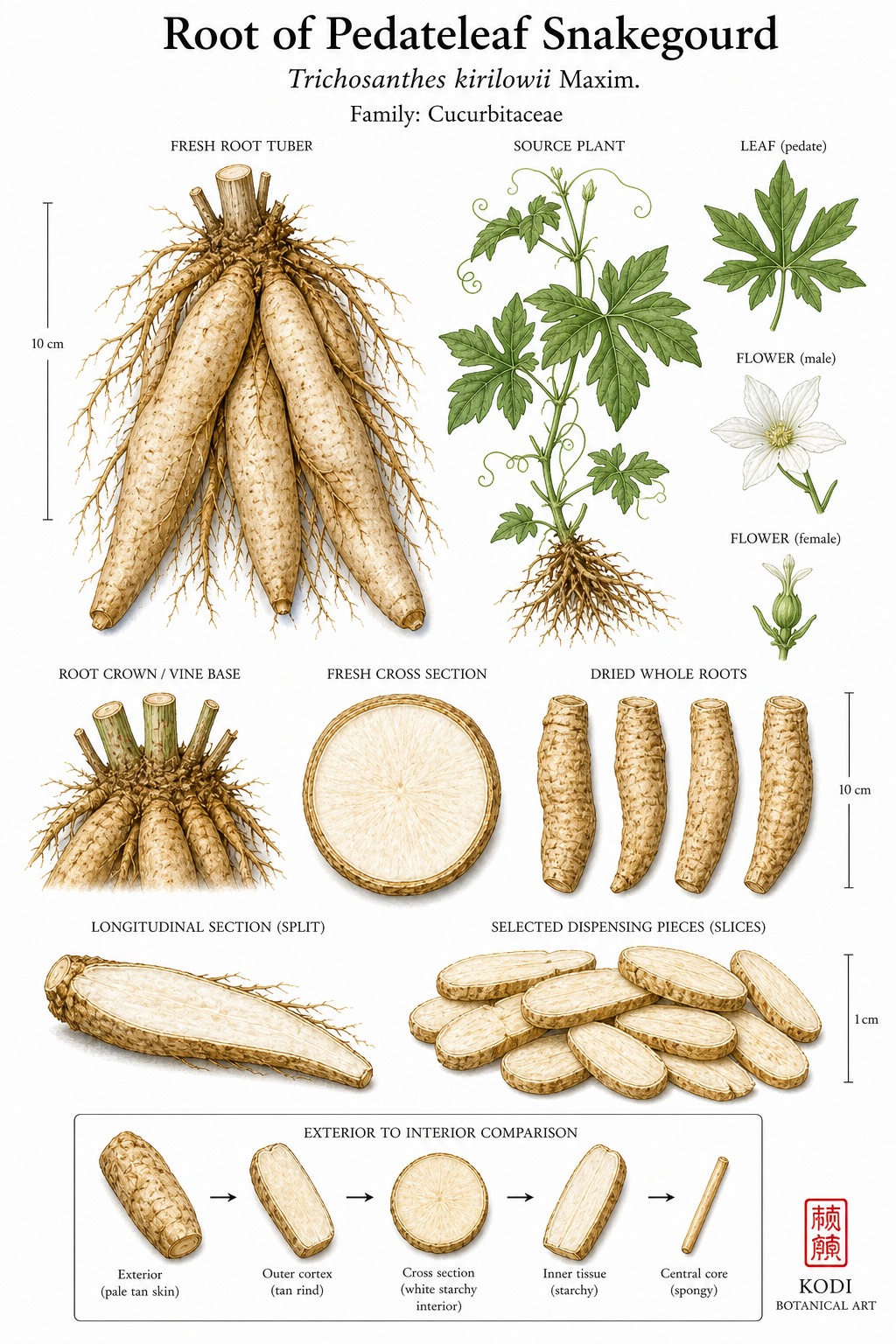
Known in TCM as Tian Hua Fen (天花粉), this sweet and slightly bitter, cold herb enters the Lung and Stomach. Traditionally, it clears heat and generates fluids ... Tian Hua Fen is a classic root for thirst, dry mouth, irritability, and fluid depletion caused by heat, most often applied for dry cough, productive cough, and phlegm accumulation. Modern research has identified Trichosanthin among its active constituents.
Part used: Root
Also Known As
Latin: Radix Trichosanthis | Pinyin: Tian Hua Fen | Chinese: 天花粉
TCM Properties
- Taste
- sweet, slightly bitter
- Temperature
- cold
- Channels
- Lung, Stomach
Traditional Use
Primary Actions
- Clears heat and generates fluids ... Tian Hua Fen is a classic root for thirst, dry mouth, irritability, and fluid depletion caused by heat.
- Clears Lung heat and moistens dryness ... it is used for dry cough, thick difficult sputum, and heat-injuring-dryness patterns in the upper burner.
- Reduces swelling and expels pus ... the root is traditionally taken for internal or external abscess patterns when heat toxin and dryness combine.
Secondary Actions
- This page stays on the starchy medicinal root and should remain separate from the already-live Gua Lou fruit lane and from seed-focused entries.
- The shorter importer pinyin Hua Fen is preserved as an alternate, but the standard medicinal name for the root is Tian Hua Fen.
Classic Formulas
- Tian Hua Fen San ... classic fluid-generating formula for wasting-thirst patterns with dryness and internal heat.
- Bei Mu Gua Lou San ... dry Lung cough formula where Tian Hua Fen helps moisten and transform constrained phlegm.
- Xian Fang Huo Ming Yin and related abscess formulas ... the root is used when swelling, heat, and pus formation require cooling and dispersing.
Classical References
- Traditional herbology presents Tian Hua Fen as a cold sweet root that both clears heat and generates fluids, a combination that explains its thirst and cough applications.
- Classical incompatibility tradition also places the Gua Lou and Tian Hua Fen group opposite Wu Tou-type aconite preparations.
Modern Research
Active Compounds
- Trichosanthin and related ribosome-inactivating proteins ... the best-known modern constituents of the root tuber
- Cucurbitacin-type compounds ... bitter triterpenoids studied in anti-inflammatory and antitumor contexts
- Polysaccharide and protein fractions ... broader extract classes explored in immune and tissue-response research
Studied Effects
- A 2025 review on Trichosanthis Radix summarized botany, ethnomedicine, phytochemistry, pharmacology, quality control, and toxicology, confirming that Tian Hua Fen remains one of the best-documented root lanes within the Trichosanthes family (PMID 40334818).
- A 2016 review on ribosome-inactivating proteins from Trichosanthes kirilowii highlighted the root tuber as a major source of bioactive proteins such as trichosanthin (PMID 27225069).
- A 2025 review revisited trichosanthin and its disease-related roles, showing that modern interest in the root still centers heavily on this protein and its downstream pharmacology (PMID 40541793).
PubMed References
- Trichosanthis Radix: A comprehensive review on botany, ethnomedicine, phytochemistry, pharmacology, quality control and toxicology. (2025)
- Ribosome-inactivating Proteins from Root Tubers and Seeds of Trichosan-thes kirilowii and Other Trichosanthes Species. (2016)
- Recent advances of trichosanthin and its role in diseases. (2025)
Safety & Interactions
Contraindications
- Pregnancy
- Cold from deficiency with loose stool
- Concurrent use with Wu Tou type aconite preparations in classical incompatibility traditions
Cautions
- Root proteins such as trichosanthin are pharmacologically potent, so concentrated extracts should not be treated as interchangeable with food-grade cucurbit use.
- Cold, fluid-generating roots can worsen weak digestion if the underlying pattern is not heat-dryness.
Conditions
- Dry Cough Traditional ★★★★☆ JSON
- Productive Cough Traditional ★★★☆☆ JSON
- Phlegm Accumulation Traditional ★★★☆☆ JSON
- Abscess Traditional ★★★☆☆ JSON
- Carbuncle Traditional ★★★☆☆ JSON
Frequently Asked Questions
What is Root of Pedateleaf Snakegourd used for?
Root of Pedateleaf Snakegourd is traditionally used to Clears heat and generates fluids ... Tian Hua Fen is a classic root for thirst, dry mouth, irritability, and fluid depletion caused by heat., Clears Lung heat and moistens dryness ... it is used for dry cough, thick difficult sputum, and heat-injuring-dryness patterns in the upper burner., Reduces swelling and expels pus ... the root is traditionally taken for internal or external abscess patterns when heat toxin and dryness combine.. Research has investigated its effects on: A 2025 review on Trichosanthis Radix summarized botany, ethnomedicine, phytochemistry, pharmacology, quality control, and toxicology, confirming that Tian Hua Fen remains one of the best-documented root lanes within the Trichosanthes family (PMID 40334818).; A 2016 review on ribosome-inactivating proteins from Trichosanthes kirilowii highlighted the root tuber as a major source of bioactive proteins such as trichosanthin (PMID 27225069)..
What are other names for Root of Pedateleaf Snakegourd?
Root of Pedateleaf Snakegourd is also known as Hua Fen, Trichosanthes Root, Snakegourd Root. In TCM: 天花粉 (Tian Hua Fen); Radix Trichosanthis.
Is Root of Pedateleaf Snakegourd safe during pregnancy?
Root of Pedateleaf Snakegourd is not recommended during pregnancy.
What are the contraindications for Root of Pedateleaf Snakegourd?
Root of Pedateleaf Snakegourd should not be used in: Pregnancy; Cold from deficiency with loose stool; Concurrent use with Wu Tou type aconite preparations in classical incompatibility traditions. Consult a qualified healthcare provider before use.