Root of Morinda Officinalis
- Chinese
- 巴戟天
- Pinyin
- Ba Ji Tian
- Latin
- Radix Morindae Officinalis
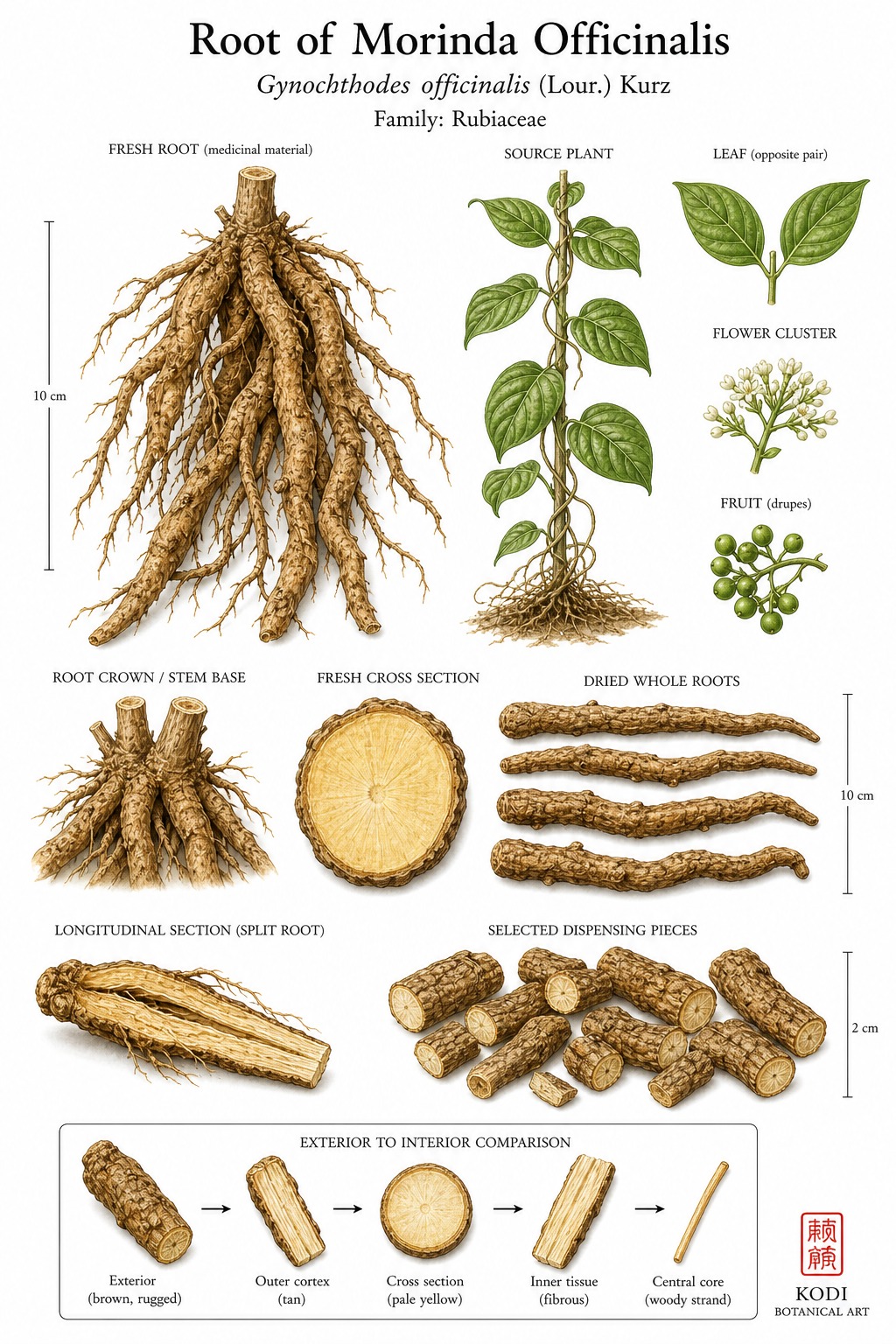
Known in TCM as Ba Ji Tian (巴戟天), this acrid and sweet, slightly warm herb enters the Kidney and Liver. Traditionally, it tonifies Kidney Yang ... Ba Ji Tian is a classic lower-burner root for cold impotence, infertility, weak fertility signs, and deep deficiency-cold with soreness and fatigue, most often applied for kidney yang deficiency, impotence, and infertility. Modern research has identified Oligosaccharides among its active constituents.
Part used: Root
Also Known As
Latin: Radix Morindae Officinalis | Pinyin: Ba Ji Tian | Chinese: 巴戟天
TCM Properties
- Taste
- acrid, sweet
- Temperature
- slightly warm
- Channels
- Kidney, Liver
Traditional Use
Primary Actions
- Tonifies Kidney Yang ... Ba Ji Tian is a classic lower-burner root for cold impotence, infertility, weak fertility signs, and deep deficiency-cold with soreness and fatigue.
- Strengthens sinews and bones ... it is widely paired for low back weakness, weak knees, and chronic cold-damp obstruction when deficiency and pain overlap.
- Dispels wind-damp without being as harshly drying as stronger hot Yang tonics ... this makes it useful when aging, weakness, and painful obstruction appear together.
Secondary Actions
- This page keeps the accepted modern taxonomy Gynochthodes officinalis while preserving the older Morinda officinalis medicinal naming used throughout the herb trade.
- Ba Ji Tian is often preferred when the clinician wants steady Kidney warming and musculoskeletal support without the heavier cloying feel of richer animal or resinous tonics.
Classic Formulas
- Er Xian Tang ... famous menopausal and Kidney-axis formula using Ba Ji Tian to warm Yang while balancing fire and water.
- Zan Yu Dan ... reproductive-tonic formula family where Ba Ji Tian supports fertility, essence, and lower-burner cold.
- Kidney-Yang and low-back formulas with Du Zhong, Xu Duan, or Yin Yang Huo ... common pairing logic for soreness, weakness, and cold-damp bi.
Classical References
- Traditional materia medica consistently places Ba Ji Tian among the gentler Kidney-Yang roots that also strengthen sinews and bones.
- Its classical use focuses on deficiency-cold, reproductive weakness, and aging lower-back patterns rather than acute excess heat.
Modern Research
Active Compounds
- Oligosaccharides including bajijiasu and inulin-type fractions ... major modern marker constituents
- Iridoid glycosides such as monotropein-related compounds ... commonly discussed in Morinda officinalis pharmacology
- Anthraquinone and phenolic fractions ... supportive constituents investigated for bone, mood, and inflammatory pathways
Studied Effects
- A 2018 comprehensive review summarized the traditional uses, phytochemistry, and pharmacology of Morinda officinalis How., giving a strong modern overview of Ba Ji Tian's classic reproductive and musculoskeletal lane (PMID 29126988).
- A 2024 systematic review focused specifically on Morinda officinalis polysaccharides and highlighted growing interest in preparation methods, structural characterization, and pharmacological activity for the herb's oligosaccharide-rich fractions (PMID 38521432).
- A 2021 systematic review and meta-analysis examined Morinda officinalis oligosaccharide capsules for depressive disorder, showing how one active fraction has already moved into clinically oriented modern research (PMID 32997072).
PubMed References
- Morinda officinalis How. - A comprehensive review of traditional uses, phytochemistry and pharmacology. (2018)
- A systematic review on polysaccharides from Morinda officinalis How: Advances in the preparation, structural characterization and pharmacological activities. (2024)
- Efficacy and safety of Morinda officinalis oligosaccharide capsules for depressive disorder: a systematic review and meta-analysis. (2021)
Safety & Interactions
Contraindications
- Yin deficiency with pronounced heat signs
- Damp-heat strangury or lower-burner heat patterns
- Constipation aggravated by warm drying herbs
Cautions
- Use carefully in people with obvious dryness, irritability, or signs that call for Yin nourishment rather than Yang warming.
- Modern clinical research often centers on isolated oligosaccharide fractions rather than whole-root decoction use.
Conditions
- Kidney Yang Deficiency Traditional ★★★★☆ JSON
- Impotence Traditional ★★★★☆ JSON
- Infertility Traditional ★★★☆☆ JSON
- Low Back Pain Traditional ★★★★☆ JSON
- Joint Pain Traditional ★★★☆☆ JSON
- Frequent Urination Traditional ★★☆☆☆ JSON
Frequently Asked Questions
What is Root of Morinda Officinalis used for?
Root of Morinda Officinalis is traditionally used to Tonifies Kidney Yang ... Ba Ji Tian is a classic lower-burner root for cold impotence, infertility, weak fertility signs, and deep deficiency-cold with soreness and fatigue., Strengthens sinews and bones ... it is widely paired for low back weakness, weak knees, and chronic cold-damp obstruction when deficiency and pain overlap., Dispels wind-damp without being as harshly drying as stronger hot Yang tonics ... this makes it useful when aging, weakness, and painful obstruction appear together.. Research has investigated its effects on: A 2018 comprehensive review summarized the traditional uses, phytochemistry, and pharmacology of Morinda officinalis How., giving a strong modern overview of Ba Ji Tian's classic reproductive and musculoskeletal lane (PMID 29126988).; A 2024 systematic review focused specifically on Morinda officinalis polysaccharides and highlighted growing interest in preparation methods, structural characterization, and pharmacological activity for the herb's oligosaccharide-rich fractions (PMID 38521432)..
What are other names for Root of Morinda Officinalis?
Root of Morinda Officinalis is also known as Ba Ji, Morinda, Gynochthodes officinalis Root. In TCM: 巴戟天 (Ba Ji Tian); Radix Morindae Officinalis.
Is Root of Morinda Officinalis safe during pregnancy?
The safety of Root of Morinda Officinalis during pregnancy has not been established. Consult a qualified healthcare provider before use.
What are the contraindications for Root of Morinda Officinalis?
Root of Morinda Officinalis should not be used in: Yin deficiency with pronounced heat signs; Damp-heat strangury or lower-burner heat patterns; Constipation aggravated by warm drying herbs. Consult a qualified healthcare provider before use.