Root of Membranous Milkvetch
- Chinese
- 黄芪
- Pinyin
- Huang Qi
- Latin
- Radix Astragali
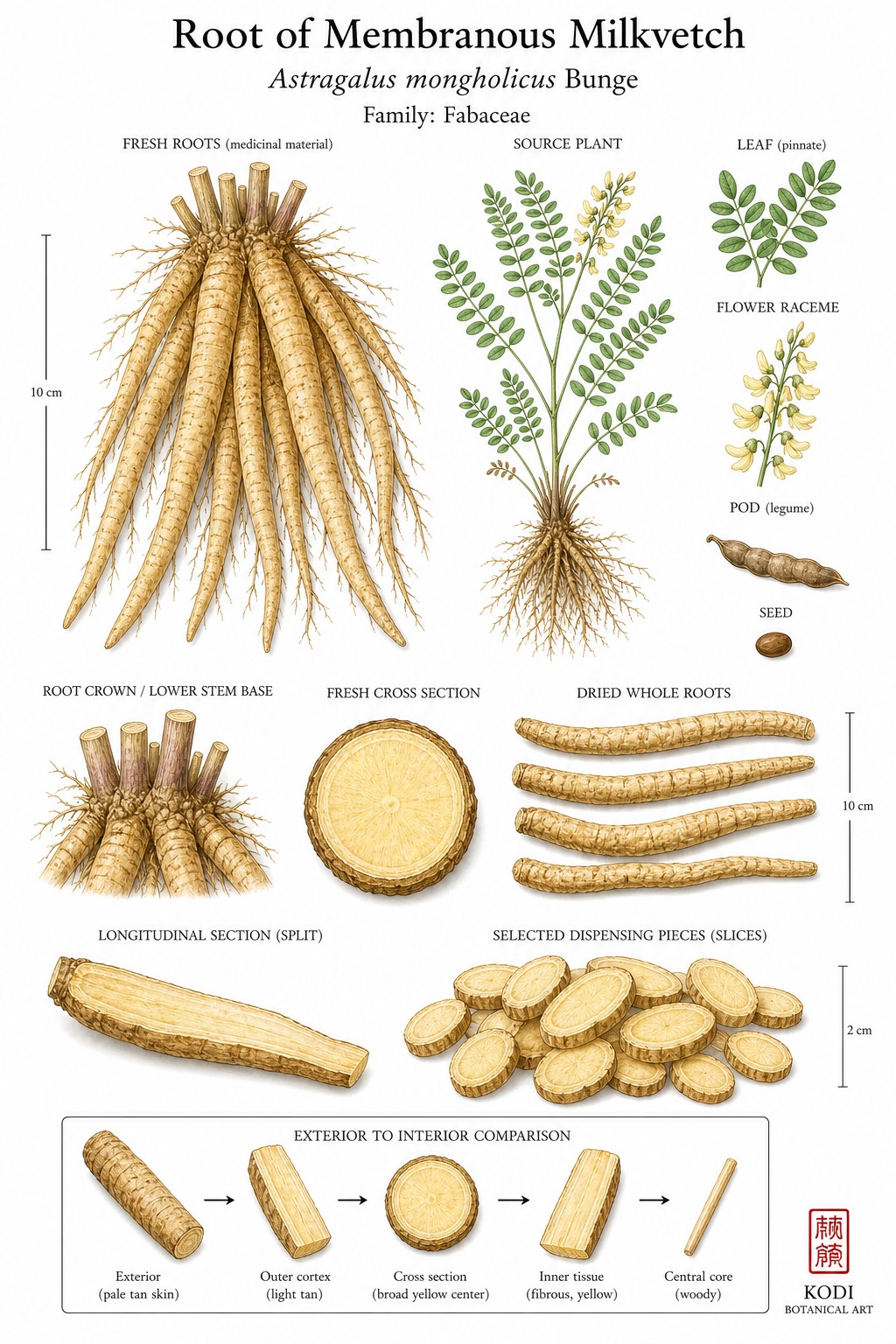
Known in TCM as Huang Qi (黄芪), this sweet, warm herb enters the Spleen and Lung. Traditionally, it tonifies Qi and strengthens Yang, most often applied for fatigue, immune deficiency, and spontaneous sweating. Modern research has identified Astragaloside among its active constituents.
Part used: Root
Also Known As
Latin: Radix Astragali | Pinyin: Huang Qi | Chinese: 黄芪
TCM Properties
- Taste
- sweet
- Temperature
- warm
- Channels
- Spleen, Lung
Traditional Use
Primary Actions
- Tonifies Qi and strengthens Yang
- Consolidates the exterior and stops sweating
- Promotes urination and reduces edema
- Supports tissue regeneration and expels pus
- Tonifies Qi to generate Blood
Secondary Actions
- Unblocks stagnation due to Qi deficiency
Classic Formulas
- Bu Zhong Yi Qi Tang … tonifies central Qi and raises Yang for prolapse, chronic fatigue, and sinking Qi
- Yu Ping Feng San … consolidates the exterior to prevent recurrent colds and spontaneous sweating
- Dang Gui Bu Xue Tang … tonifies Qi to generate Blood for Blood deficiency with low-grade fever
Classical References
- Ben Cao Gang Mu (Li Shizhen): 'Huang Qi is the chief among tonifying herbs' due to its yellow color and supreme status in supplementation
Modern Research
Active Compounds
- Astragaloside IV
- Astragalus polysaccharides (APS)
- Cycloastragenol
- Formononetin
- Calycosin
Studied Effects
- Astragaloside IV demonstrates therapeutic potential for viral and bacterial infections, inflammation, and cancer (PMID 32089240)
- Polysaccharides, flavonoids, and triterpene saponins exhibit multiple pharmacological activities (PMID 37446680)
- Synergistic effects with Radix Paeoniae Rubra in idiopathic pulmonary fibrosis via network pharmacology targets (PMID 37666859)
PubMed References
- Astragaloside IV derived from Astragalus membranaceus: A research review on the pharmacological effects (2020)
- Biosynthesis and Pharmacological Activities of Flavonoids, Triterpene Saponins and Polysaccharides Derived from Astragalus membranaceus (2023)
- Exploring the role and mechanism of Astragalus membranaceus and radix paeoniae rubra in idiopathic pulmonary fibrosis through network pharmacology and experimental validation (2023)
Safety & Interactions
Contraindications
- Excess heat conditions or active infections
- Yin deficiency with vigorous Fire
- Early-stage acute exterior conditions
- Autoimmune diseases (immune-stimulating properties may exacerbate symptoms)
- Organ transplant recipients on immunosuppressant therapy
Cautions
- Transient side effects include fatigue, headache, and low blood pressure
- Use cautiously in hormone-sensitive conditions due to estrogenic preclinical activity
- Use cautiously with bleeding disorders
Drug Interactions
- Immunosuppressants (e.g., tacrolimus) … Antagonizes immunosuppressant effects; case report documented approximately 50% reduction in tacrolimus blood concentration (High) Source: Memorial Sloan Kettering
- Anticoagulants and blood thinners (e.g., warfarin) … Exhibits anticoagulant properties; may increase bleeding risk (Moderate) Source: Memorial Sloan Kettering
- Antihypertensive medications … Lowers systolic and diastolic blood pressure; may produce additive hypotensive effect (Unknown) Source: Memorial Sloan Kettering
- Diuretics … Demonstrates natriuretic effects; may potentiate diuretic action (Unknown) Source: Memorial Sloan Kettering
- Hormonal therapies … Estrogenic properties (preclinical) may interfere with hormone-based treatments (Unknown) Source: Memorial Sloan Kettering
- P-glycoprotein substrates (e.g., doxorubicin, etoposide, vincristine) … Astragalus polysaccharides inhibit P-glycoprotein efflux pump, potentially increasing cytotoxicity of co-administered drugs (Unknown) Source: Memorial Sloan Kettering
- Gemcitabine … Astragalus pretreatment affects gemcitabine pharmacokinetics (murine model data only; clinical relevance unknown) (Unknown) Source: Memorial Sloan Kettering
Classic formulas that use Root of Membranous Milkvetch
Herbs are rarely taken alone in Chinese medicine. These formula pages show what this herb does inside a classic prescription and which pattern that prescription is chosen for.
Conditions
- Fatigue Traditional ★★★★★ JSON
- Immune Deficiency Research ★★★★☆ JSON
- Spontaneous Sweating Traditional ★★★★☆ JSON
- Edema Traditional ★★★☆☆ JSON
- Anemia Traditional ★★★☆☆ JSON
- Cancer Research ★★★☆☆ JSON
- Cardiovascular Disease Research ★★★☆☆ JSON
Frequently Asked Questions
What is Root of Membranous Milkvetch used for?
Root of Membranous Milkvetch is traditionally used to Tonifies Qi and strengthens Yang, Consolidates the exterior and stops sweating, Promotes urination and reduces edema, Supports tissue regeneration and expels pus. Research has investigated its effects on: Astragaloside IV demonstrates therapeutic potential for viral and bacterial infections, inflammation, and cancer (PMID 32089240); Polysaccharides, flavonoids, and triterpene saponins exhibit multiple pharmacological activities (PMID 37446680).
What are other names for Root of Membranous Milkvetch?
Root of Membranous Milkvetch is also known as Astragali. In TCM: 黄芪 (Huang Qi); Radix Astragali.
Is Root of Membranous Milkvetch safe during pregnancy?
The safety of Root of Membranous Milkvetch during pregnancy has not been established. Consult a qualified healthcare provider before use.
What are the contraindications for Root of Membranous Milkvetch?
Root of Membranous Milkvetch should not be used in: Excess heat conditions or active infections; Yin deficiency with vigorous Fire; Early-stage acute exterior conditions; Autoimmune diseases (immune-stimulating properties may exacerbate symptoms); Organ transplant recipients on immunosuppressant therapy. Consult a qualified healthcare provider before use.
Does Root of Membranous Milkvetch interact with any medications?
Root of Membranous Milkvetch may interact with: Immunosuppressants (e.g., tacrolimus) - Antagonizes immunosuppressant effects; case report documented approximately 50% reduction in tacrolimus blood concentration - (High severity); Anticoagulants and blood thinners (e.g., warfarin) - Exhibits anticoagulant properties; may increase bleeding risk - (Moderate severity); Antihypertensive medications - Lowers systolic and diastolic blood pressure; may produce additive hypotensive effect - (Unknown severity); Diuretics - Demonstrates natriuretic effects; may potentiate diuretic action - (Unknown severity). Always inform your healthcare provider of any herbal supplements you are taking.