Ci Wu Jia Root
- Chinese
- 刺五åŠ
- Pinyin
- Ci Wu Jia
- Latin
- Radix Acanthopanacis Senticosi
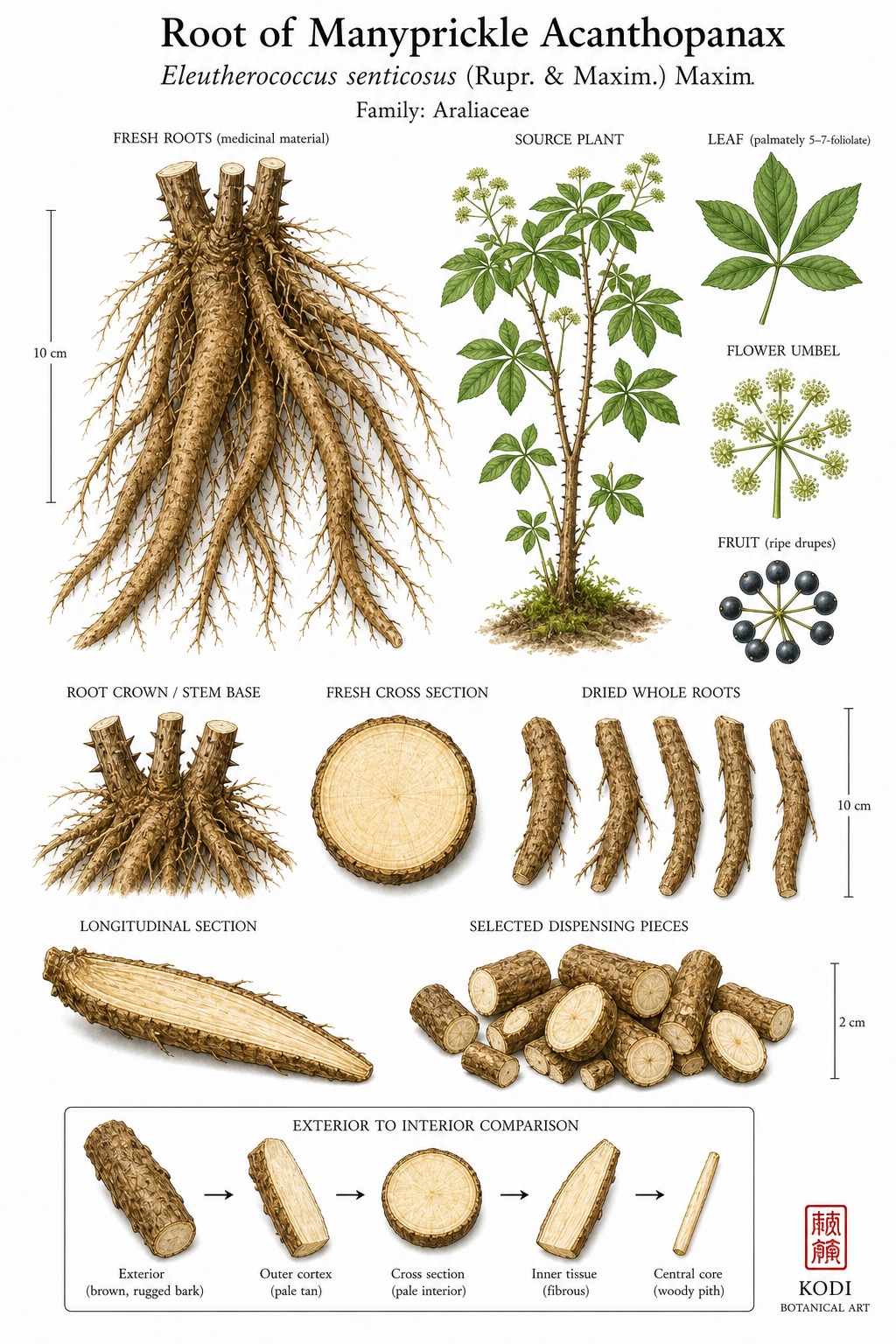
Known in TCM as Ci Wu Jia (åˆºäº”åŠ ), this acrid and slightly bitter and sweet, slightly warm herb enters the Spleen, Kidney, and Heart. Traditionally, it tonifies qi and strengthens the Spleen ... Ci Wu Jia is used for fatigue, poor appetite, and worn-down resilience without the heavier cloying feel of richer tonics, most often applied for fatigue, poor appetite, and insomnia. Modern research has identified Eleutherosides among its active constituents.
Part used: Root
Also Known As
Latin: Radix Acanthopanacis Senticosi | Pinyin: Ci Wu Jia | Chinese: 刺五åŠ
TCM Properties
- Taste
- acrid, slightly bitter, sweet
- Temperature
- slightly warm
- Channels
- Spleen, Kidney, Heart
Traditional Use
Primary Actions
- Tonifies qi and strengthens the Spleen ... Ci Wu Jia is used for fatigue, poor appetite, and worn-down resilience without the heavier cloying feel of richer tonics.
- Tonifies the Kidney and strengthens sinews and bones ... it fits chronic low-back soreness, weak limbs, and recovery after long-standing debility or overexertion.
- Calms the spirit while supporting adaptive resilience ... traditional use extends to insomnia, dream-disturbed sleep, and mental fatigue when depletion and overwork coexist.
Secondary Actions
- This page must stay distinct from Wu Jia Pi root bark and from the marketing habit of flattening every Eleutherococcus product into generic ginseng language.
- Modern adaptogen framing overlaps with the classic qi, Spleen, Kidney, and spirit-support profile, but the root page should remain a TCM monograph rather than a supplement ad.
Classic Formulas
- Ci Wu Jia tea, tincture, and tonic-wine traditions ... functional-support use more characteristic than a single famous textbook formula.
- Qi and Kidney support pairings with Huang Qi, Dang Shen, or Gou Qi Zi ... used when fatigue and depletion dominate.
- Wind-damp weakness pairings with Du Zhong and Niu Xi ... traditional strategy when soreness and weakness coexist.
Classical References
- Traditional summaries describe Ci Wu Jia as invigorating qi, strengthening the Spleen, and nourishing the Kidney while also calming the mind.
- Its use sits between tonic and functional-support categories rather than at the attacking or purgative end of the materia medica.
Modern Research
Active Compounds
- Eleutherosides and related phenylpropanoid glycosides ... the most cited modern Ci Wu Jia markers
- Lignans, coumarins, and polysaccharides ... major supportive adaptogenic and immunologic fractions
- Other phenolic compounds linked to anti-fatigue and neurocognitive research ... broader modern context
Studied Effects
- A 2011 review summarized the botany, chemistry, and pharmacology of Acanthopanax senticosus and remains a foundational broad reference for Ci Wu Jia's tonic and adaptogenic profile (PMID 21434569).
- A 2025 review focused specifically on Eleutherococcus root phytochemistry and pharmacological potential in the context of its adaptogenic effect, keeping the root identity centered (PMID 41235111).
- A 2021 narrative review of Russian clinical literature discussed mental endurance, cognition, physical performance, and respiratory-illness applications of Eleutherococcus senticosus, illustrating why Ci Wu Jia occupies such a strong modern resilience niche (PMID 34087398).
PubMed References
- Acanthopanax senticosus: review of botany, chemistry and pharmacology. (2011)
- Eleutherococcus root: a comprehensive review of its phytochemistry and pharmacological potential in the context of its adaptogenic effect. (2025)
- Findings of Russian literature on the clinical application of Eleutherococcus senticosus (Rupr. & Maxim.): A narrative review. (2021)
Safety & Interactions
Contraindications
- Acute excess heat or agitation without depletion
- Misidentified substitute material sold as generic eleuthero or ginseng
Cautions
- Blood-pressure, glucose, and stimulant-like resilience claims in the modern literature mean Ci Wu Jia should be used thoughtfully in medically managed patients.
- This root is not interchangeable with Panax ginseng, even if both are marketed as adaptogens.
- Long-term fatigue, insomnia, or low-back pain can reflect underlying disease and should not rely only on tonic herbs.
Conditions
- Fatigue Traditional ★★★☆☆ JSON
- Poor Appetite Traditional ★★☆☆☆ JSON
- Insomnia Traditional ★★☆☆☆ JSON
- Joint Pain Traditional ★★☆☆☆ JSON
- Low Back Pain Traditional ★★☆☆☆ JSON
Frequently Asked Questions
What is Ci Wu Jia Root used for?
Ci Wu Jia Root is traditionally used to Tonifies qi and strengthens the Spleen ... Ci Wu Jia is used for fatigue, poor appetite, and worn-down resilience without the heavier cloying feel of richer tonics., Tonifies the Kidney and strengthens sinews and bones ... it fits chronic low-back soreness, weak limbs, and recovery after long-standing debility or overexertion., Calms the spirit while supporting adaptive resilience ... traditional use extends to insomnia, dream-disturbed sleep, and mental fatigue when depletion and overwork coexist.. Research has investigated its effects on: A 2011 review summarized the botany, chemistry, and pharmacology of Acanthopanax senticosus and remains a foundational broad reference for Ci Wu Jia's tonic and adaptogenic profile (PMID 21434569).; A 2025 review focused specifically on Eleutherococcus root phytochemistry and pharmacological potential in the context of its adaptogenic effect, keeping the root identity centered (PMID 41235111)..
What are other names for Ci Wu Jia Root?
Ci Wu Jia Root is also known as Siberian Ginseng Root, Eleuthero Root, Acanthopanax senticosus Root. In TCM: åˆºäº”åŠ (Ci Wu Jia); Radix Acanthopanacis Senticosi.
Is Ci Wu Jia Root safe during pregnancy?
The safety of Ci Wu Jia Root during pregnancy has not been established. Consult a qualified healthcare provider before use.
What are the contraindications for Ci Wu Jia Root?
Ci Wu Jia Root should not be used in: Acute excess heat or agitation without depletion; Misidentified substitute material sold as generic eleuthero or ginseng. Consult a qualified healthcare provider before use.