Greater Du Huo Root
- Chinese
- 大独活
- Pinyin
- Da Du Huo
- Latin
- Radix Heraclei Maximi
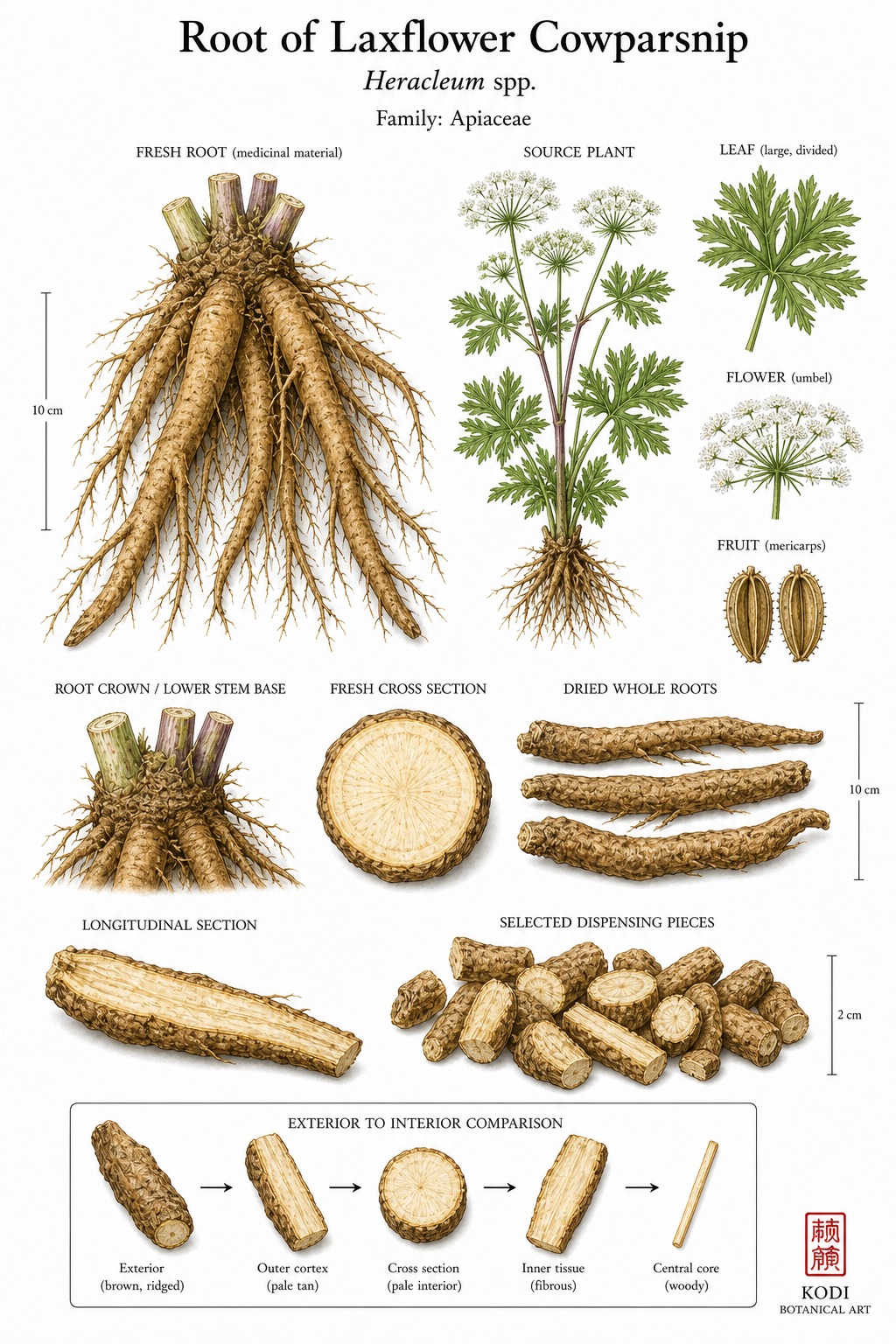
Known in TCM as Da Du Huo (大独活), this bitter and acrid, warm herb enters the Liver, Kidney, and Bladder. Traditionally, it dispels wind-damp and unblocks painful obstruction ... Da Du Huo is a broader Heracleum-root lane used for aching joints, heavy limbs, and chronic cold-damp pain, most often applied for rheumatism, joint pain, and low back pain. Modern research has identified Furanocoumarins among its active constituents.
Part used: Root
Also Known As
Latin: Radix Heraclei Maximi | Pinyin: Da Du Huo | Chinese: 大独活
TCM Properties
- Taste
- bitter, acrid
- Temperature
- warm
- Channels
- Liver, Kidney, Bladder
Traditional Use
Primary Actions
- Dispels wind-damp and unblocks painful obstruction ... Da Du Huo is a broader Heracleum-root lane used for aching joints, heavy limbs, and chronic cold-damp pain.
- Warms the channels and eases lower-back or leg weakness ... it belongs closer to musculoskeletal warming root logic than to the harmonizing or tonic lanes of other Apiaceae herbs.
- Releases exterior cold and pain in regional use ... some lineages extend it to headache or cold invasion when body pain is prominent.
Secondary Actions
- This page must stay distinct from standard Du Huo, which the Chinese materia medica anchors to Angelica pubescens rather than broad Heracleum identity.
- Heracleum chemistry includes furanocoumarins and other photoreactive compounds, so safety framing should stay more cautious than for ordinary kitchen aromatics.
Classic Formulas
- Wind-damp pain pairings with Sang Ji Sheng, Du Zhong, and Niu Xi ... regional chronic-pain logic for weakened low back and limbs.
- Cold-damp exterior pairings with Qiang Huo or Fang Feng ... used when body pain and headache dominate early invasion patterns.
- Topical or medicinal-wine use ... a practical folk lane more accurate than forcing a single famous textbook formula onto the herb.
Classical References
- Da Du Huo is best read as a warming bi-pain root inside a broader Heracleum medicinal lane, not as a direct synonym for canonical Du Huo.
- Regional use patterns emphasize pain, heaviness, and damp obstruction much more than tonification.
Modern Research
Active Compounds
- Furanocoumarins and related coumarins ... the dominant Heracleum chemistry lane
- Volatile oils and aromatic terpenes ... supportive musculoskeletal and antimicrobial interest
- Flavonoids and phenolic compounds ... broader anti-inflammatory context
Studied Effects
- A comprehensive review of the genus Heracleum summarized phytochemistry, pharmacology, and ethnobotanical use, which is currently the most honest modern evidence frame for a broad Heracleum-root page like Da Du Huo (PMID 33401836).
- A 2018 review of Heracleum persicum highlighted the anti-inflammatory and biologically active coumarin-rich profile of the genus, helping explain why Heracleum roots keep appearing in pain and swelling traditions (PMID 29866612).
- A 2010 antimycobacterial screening study found notable in-vitro activity from the roots of Heracleum maximum, adding a direct root-use data point to the otherwise genus-level evidence field (PMID 20657619).
PubMed References
- The Genus Heracleum: A Comprehensive Review on Its Phytochemistry, Pharmacology, and Ethnobotanical Values as a Useful Herb. (2016)
- Phytochemistry and biological activities of Heracleum persicum: a review. (2018)
- Antimycobacterial screening of traditional medicinal plants using the microplate resazurin assay. (2010)
Safety & Interactions
Contraindications
- Yin deficiency with heat or pronounced dryness
- Misidentified material sold under overlapping Du Huo style names
Cautions
- Heracleum species can be phototoxic because of furanocoumarin content, especially with topical use and sun exposure.
- This herb should not be conflated with standard Du Huo without source authentication.
- Broad genus-level evidence is not a license for loose self-treatment of severe pain, infection, or neurologic symptoms.
Conditions
- Rheumatism Traditional ★★★☆☆ JSON
- Joint Pain Traditional ★★★☆☆ JSON
- Low Back Pain Traditional ★★★☆☆ JSON
- Common Cold Traditional ★☆☆☆☆ JSON
Frequently Asked Questions
What is Greater Du Huo Root used for?
Greater Du Huo Root is traditionally used to Dispels wind-damp and unblocks painful obstruction ... Da Du Huo is a broader Heracleum-root lane used for aching joints, heavy limbs, and chronic cold-damp pain., Warms the channels and eases lower-back or leg weakness ... it belongs closer to musculoskeletal warming root logic than to the harmonizing or tonic lanes of other Apiaceae herbs., Releases exterior cold and pain in regional use ... some lineages extend it to headache or cold invasion when body pain is prominent.. Research has investigated its effects on: A comprehensive review of the genus Heracleum summarized phytochemistry, pharmacology, and ethnobotanical use, which is currently the most honest modern evidence frame for a broad Heracleum-root page like Da Du Huo (PMID 33401836).; A 2018 review of Heracleum persicum highlighted the anti-inflammatory and biologically active coumarin-rich profile of the genus, helping explain why Heracleum roots keep appearing in pain and swelling traditions (PMID 29866612)..
What are other names for Greater Du Huo Root?
Greater Du Huo Root is also known as Greater Du Huo, Cowparsnip Root, Heracleum Root. In TCM: 大独活 (Da Du Huo); Radix Heraclei Maximi.
Is Greater Du Huo Root safe during pregnancy?
The safety of Greater Du Huo Root during pregnancy has not been established. Consult a qualified healthcare provider before use.
What are the contraindications for Greater Du Huo Root?
Greater Du Huo Root should not be used in: Yin deficiency with heat or pronounced dryness; Misidentified material sold under overlapping Du Huo style names. Consult a qualified healthcare provider before use.