Juteleaf Raspberry Root
- Chinese
- 悬钩茎
- Pinyin
- Xuan Gou Jing
- Latin
- Radix seu Caulis Rubi Corchorifolii
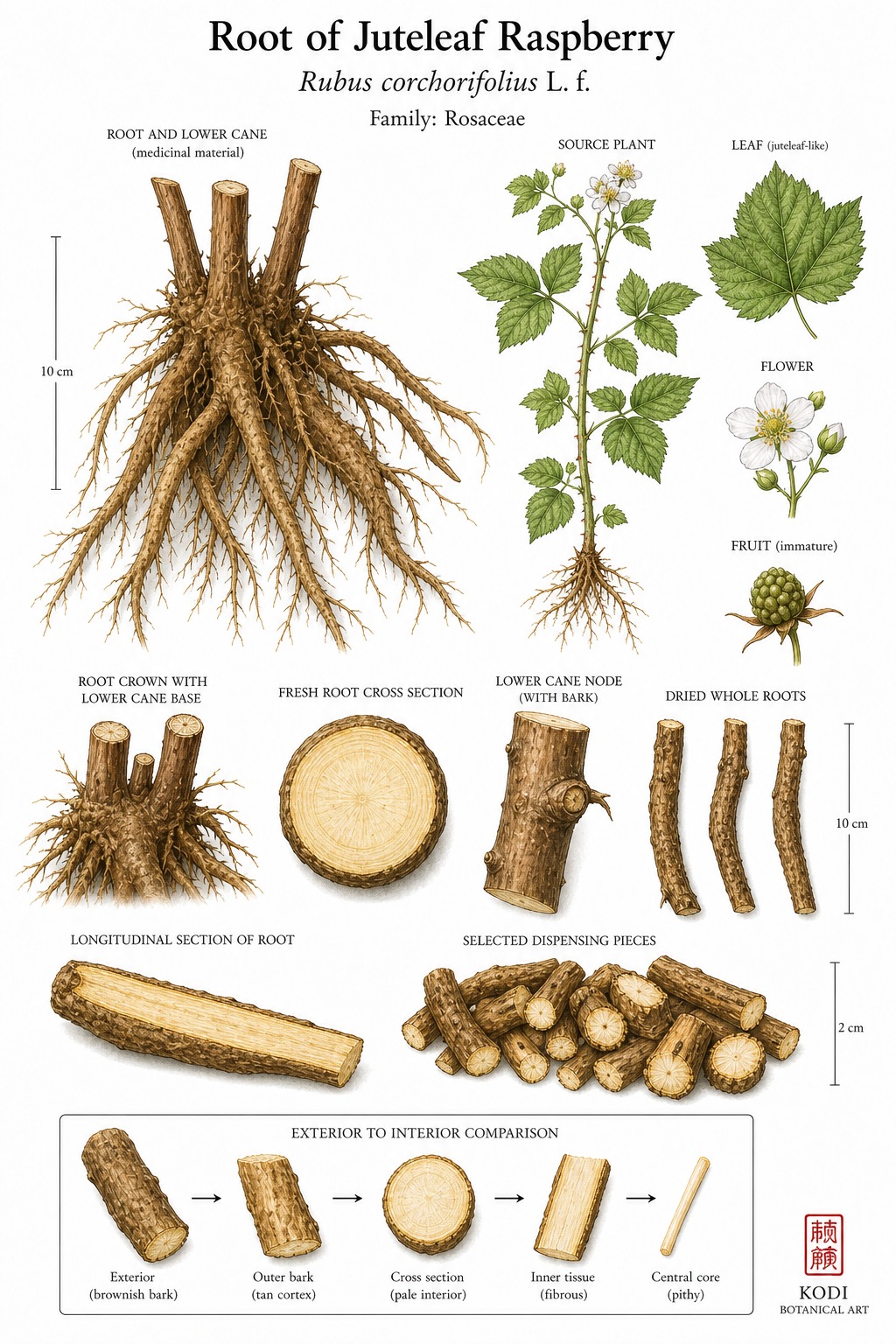
Known in TCM as Xuan Gou Jing (悬钩茎), this sweet and sour, neutral herb enters the Liver, Kidney, and Lung. Traditionally, it dispels wind-damp and frees the channels ... Xuan Gou Jing is best framed as a regional Rubus root and lower-cane medicine for aching limbs, rheumatic pain, and constrained movement, most often applied for joint pain, rheumatism, and low back pain. Modern research has identified Diterpenoids among its active constituents.
Part used: Root
Also Known As
Latin: Radix seu Caulis Rubi Corchorifolii | Pinyin: Xuan Gou Jing | Chinese: 悬钩茎
TCM Properties
- Taste
- sweet, sour
- Temperature
- neutral
- Channels
- Liver, Kidney, Lung
Traditional Use
Primary Actions
- Dispels wind-damp and frees the channels ... Xuan Gou Jing is best framed as a regional Rubus root and lower-cane medicine for aching limbs, rheumatic pain, and constrained movement.
- Strengthens the lower back and sinews in folk practice ... its mild sweet-sour profile fits long-use support for chronic soreness and weakness rather than drastic attacking treatment.
- Clears lingering toxin and settles swollen tissue in mixed trade descriptions ... but the strongest indexed identity remains root-and-lower-cane material rather than a neatly standardized root drug.
Secondary Actions
- The inherited Latin points to Caulis Rubi Corchorifolii, and the illustration prompt explicitly keeps root and lower-cane material together ... this page should acknowledge that mixed trade identity instead of pretending the modern record is cleaner than it is.
- Direct PubMed-indexed evidence on the medicinal root itself is sparse, so modern claims should stay species-level and chemistry-led.
Classic Formulas
- Regional wind-damp pairings with Du Huo, Sang Ji Sheng, or Niu Xi ... practical pain-relief logic rather than a famous classical prescription lane.
- Lower-back support pairings with Gou Ji or Xu Duan ... folk-style musculoskeletal use when chronic soreness dominates.
- Mixed root-cane decoction use ... more accurate than forcing a highly standardized pharmacopoeial formula history onto the record.
Classical References
- Database-linked indexing describes Xuan Gou Jing as mild, sweet-sour, and entering the Lung, Liver, and Kidney, which fits a gentle channel-opening and lower-back support profile.
- Because the trade identity blends root and lower-cane material, conservative language is more accurate than overfitting one narrow modern indication.
Modern Research
Active Compounds
- Diterpenoids and ent-kaurane compounds ... reported from Rubus corchorifolius
- Flavonoids and glycosides ... highlighted in tissue-metabolomics and biosynthesis studies
- Polyphenolic fractions ... broader species-level antioxidant context
Studied Effects
- A 2025 tissue-metabolomics study compared different parts of Rubus corchorifolius and confirmed meaningful chemical variation across tissues, which supports keeping root and lower-cane identity explicit instead of assuming fruit data applies directly (PMID 40059878).
- A 2017 paper identified an ent-kaurane diterpenoid from Rubus corchorifolius with antiproliferative effects on human colon-cancer cells, illustrating one modern chemistry lane attached to this species (PMID 28169543).
- A 2017 study on terpenoids from Rubus corchorifolius leaves also showed antiproliferative activity, reinforcing that current indexed evidence is species-level rather than tightly root-specific (PMID 28134947).
PubMed References
- Widely targeted metabolomics of different tissues in Rubus corchorifolius. (2025)
- Novel ent-Kaurane Diterpenoid from Rubus corchorifolius L. f. Inhibits Human Colon Cancer Cell Growth via Inducing Cell Cycle Arrest and Apoptosis. (2017)
- Identification of terpenoids from Rubus corchorifolius L. f. leaves and their anti-proliferative effects on human cancer cells. (2017)
Safety & Interactions
Contraindications
- Cases where pathology is acute, invasive, or rapidly progressive rather than chronic and channel-based
- Known allergy to Rubus species
Cautions
- Direct medicinal-root evidence is sparse, and the published modern record is not strong enough to justify broad therapeutic claims.
- Mixed root-and-cane sourcing means quality control matters more than on highly standardized single-part herbs.
- This page is not equivalent to raspberry fruit or berry-supplement literature.
Conditions
- Joint Pain Traditional ★★☆☆☆ JSON
- Rheumatism Traditional ★★☆☆☆ JSON
- Low Back Pain Traditional ★★☆☆☆ JSON
- Traumatic Injury Traditional ★☆☆☆☆ JSON
Frequently Asked Questions
What is Juteleaf Raspberry Root used for?
Juteleaf Raspberry Root is traditionally used to Dispels wind-damp and frees the channels ... Xuan Gou Jing is best framed as a regional Rubus root and lower-cane medicine for aching limbs, rheumatic pain, and constrained movement., Strengthens the lower back and sinews in folk practice ... its mild sweet-sour profile fits long-use support for chronic soreness and weakness rather than drastic attacking treatment., Clears lingering toxin and settles swollen tissue in mixed trade descriptions ... but the strongest indexed identity remains root-and-lower-cane material rather than a neatly standardized root drug.. Research has investigated its effects on: A 2025 tissue-metabolomics study compared different parts of Rubus corchorifolius and confirmed meaningful chemical variation across tissues, which supports keeping root and lower-cane identity explicit instead of assuming fruit data applies directly (PMID 40059878).; A 2017 paper identified an ent-kaurane diterpenoid from Rubus corchorifolius with antiproliferative effects on human colon-cancer cells, illustrating one modern chemistry lane attached to this species (PMID 28169543)..
What are other names for Juteleaf Raspberry Root?
Juteleaf Raspberry Root is also known as Rubus corchorifolius, Raspberry Root and Cane, Caulis Rubi Corchorifolii. In TCM: 悬钩茎 (Xuan Gou Jing); Radix seu Caulis Rubi Corchorifolii.
Is Juteleaf Raspberry Root safe during pregnancy?
The safety of Juteleaf Raspberry Root during pregnancy has not been established. Consult a qualified healthcare provider before use.
What are the contraindications for Juteleaf Raspberry Root?
Juteleaf Raspberry Root should not be used in: Cases where pathology is acute, invasive, or rapidly progressive rather than chronic and channel-based; Known allergy to Rubus species. Consult a qualified healthcare provider before use.