Bai Lian Root
- Chinese
- 白蔹
- Pinyin
- Bai Lian
- Latin
- Radix Ampelopsis
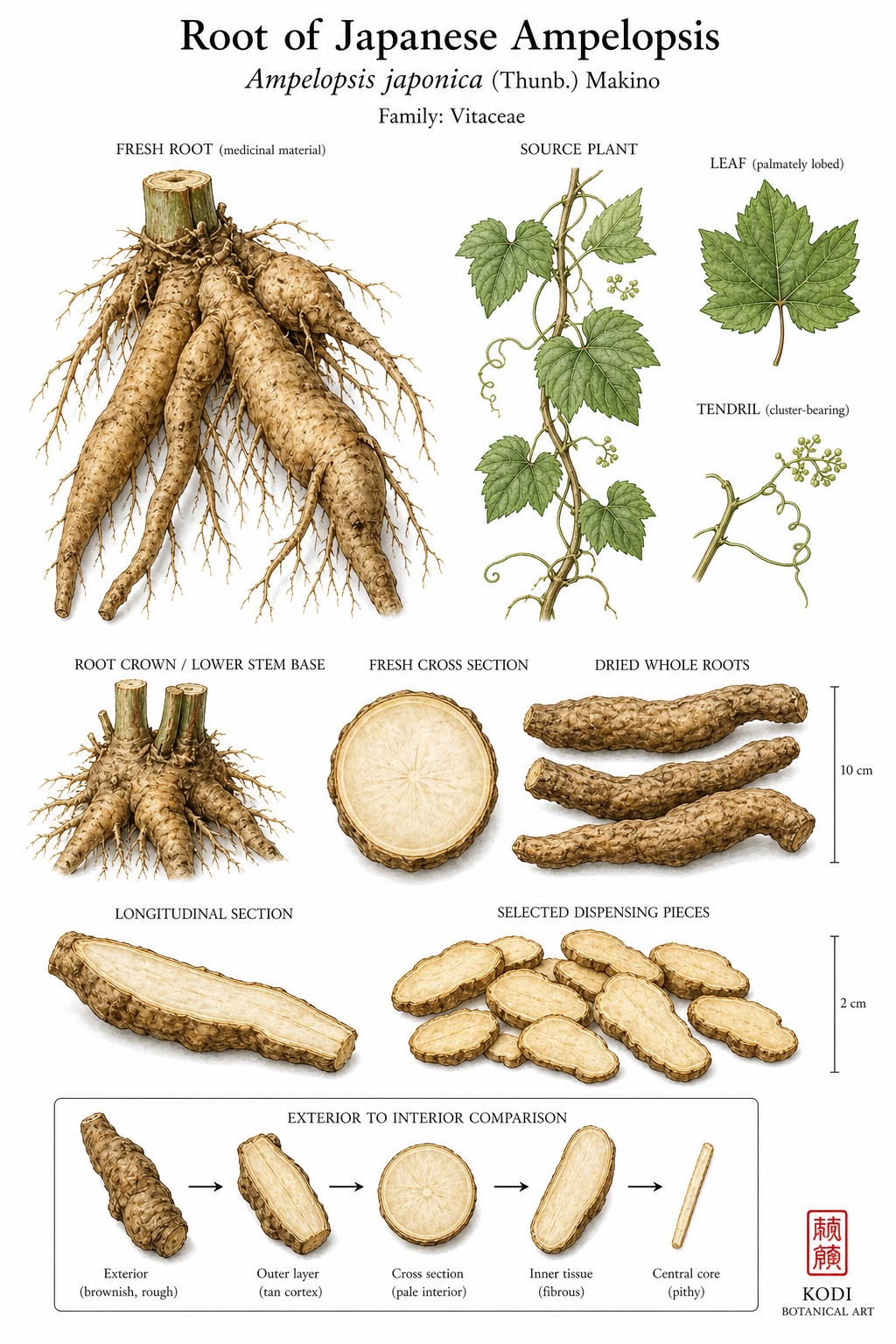
Known in TCM as Bai Lian (白蔹), this bitter and sweet, slightly cold herb enters the Liver and Stomach. Traditionally, it clears heat and resolves toxin ... Bai Lian is classically used for abscesses, boils, toxic swelling, and inflamed lesions that need a cooling root with reducing action, most often applied for abscess, carbuncle, and mastitis. Modern research has identified Oligostilbenes among its active constituents.
Part used: Root
Also Known As
Latin: Radix Ampelopsis | Pinyin: Bai Lian | Chinese: 白蔹
TCM Properties
- Taste
- bitter, sweet
- Temperature
- slightly cold
- Channels
- Liver, Stomach
Traditional Use
Primary Actions
- Clears heat and resolves toxin ... Bai Lian is classically used for abscesses, boils, toxic swelling, and inflamed lesions that need a cooling root with reducing action.
- Reduces swelling and dissipates clumping ... it is used for breast abscess, nodular swelling, and painful lesions where hardness, heat, and redness are prominent.
- Promotes tissue repair while easing pain ... topical or internal use extends to burns, fissures, ulcerative lesions, and other damaged tissues that need both cooling and restraint.
Secondary Actions
- This page should stay on the medicinal root lane of Ampelopsis japonica and not drift into decorative vine or edible-fruit styling.
- Modern anti-cancer interest is substantial, but the classical identity still centers on sores, swelling, and tissue injury rather than on a generic supplement profile.
Classic Formulas
- Bai Lian San style applications ... classic sore and ulcer logic using Bai Lian for heat, swelling, and tissue damage.
- Topical pairings with Bai Ji or Da Huang ... a traditional strategy for burns, fissures, and stubborn inflamed lesions.
- Heat-toxic breast and throat pairings with Pu Gong Ying, Lian Qiao, or similar resolving herbs ... practical internal-use logic.
Classical References
- Traditional herbology emphasizes Bai Lian for heat-toxic sores, swelling, and the promotion of flesh generation in damaged tissue.
- It is more reducing and lesion-focused than tonifying, so use language should stay on abscess, swelling, and repair patterns.
Modern Research
Active Compounds
- Oligostilbenes and related polyphenols ... among the most studied Bai Lian fractions
- Triterpenoids and flavonoids ... supportive chemistry tied to anti-inflammatory and anti-cancer research
- Phenolic compounds with antioxidant and signaling effects ... recurrent in modern pharmacology papers
Studied Effects
- A 2026 systematic review brought together traditional knowledge and modern science around Ampelopsis japonica, emphasizing anti-cancer compounds, polypharmacology, and translational potential while keeping the species identity centered (PMID 41176139).
- A 2013 study showed that Ampelopsis Radix protected dopaminergic neurons in Parkinson's disease models, illustrating the breadth of research now attached to Bai Lian root constituents (PMID 24204389).
- A 2022 mouse study reported anti-inflammatory effects of Ampelopsis japonica root on contact dermatitis, giving a modern correlate to Bai Lian's longstanding heat-toxic lesion use (PMID 35907172).
PubMed References
- Bridging traditional knowledge and modern science: A systematic review of Ampelopsis japonica with emphasis on novel anti-cancer compounds, polypharmacology and clinical translation potential. (2026)
- Ampelopsis Radix Protects Dopaminergic Neurons against 1-Methyl-4-phenylpyridinium/1-methyl-4-phenyl-1,2,3,6-tetrahydropyridine-Induced Toxicity in Parkinson's Disease Models In Vitro and In Vivo. (2013)
- Anti-inflammatory Effects of Ampelopsis Japonica Root on Contact Dermatitis in Mice. (2022)
Safety & Interactions
Contraindications
- Cold deficiency without heat or toxic swelling
- Severely weakened digestion that cannot tolerate bitter cooling roots
Cautions
- Much of the anti-cancer literature is still preclinical and should not be turned into self-treatment claims.
- Topical and internal uses are not interchangeable in dose or intent.
- Painful breast masses, severe ulcers, or rapidly spreading skin lesions need medical evaluation.
Conditions
Frequently Asked Questions
What is Bai Lian Root used for?
Bai Lian Root is traditionally used to Clears heat and resolves toxin ... Bai Lian is classically used for abscesses, boils, toxic swelling, and inflamed lesions that need a cooling root with reducing action., Reduces swelling and dissipates clumping ... it is used for breast abscess, nodular swelling, and painful lesions where hardness, heat, and redness are prominent., Promotes tissue repair while easing pain ... topical or internal use extends to burns, fissures, ulcerative lesions, and other damaged tissues that need both cooling and restraint.. Research has investigated its effects on: A 2026 systematic review brought together traditional knowledge and modern science around Ampelopsis japonica, emphasizing anti-cancer compounds, polypharmacology, and translational potential while keeping the species identity centered (PMID 41176139).; A 2013 study showed that Ampelopsis Radix protected dopaminergic neurons in Parkinson's disease models, illustrating the breadth of research now attached to Bai Lian root constituents (PMID 24204389)..
What are other names for Bai Lian Root?
Bai Lian Root is also known as Ampelopsis Root, Japanese Ampelopsis Root, Ampelopsis Radix. In TCM: 白蔹 (Bai Lian); Radix Ampelopsis.
Is Bai Lian Root safe during pregnancy?
The safety of Bai Lian Root during pregnancy has not been established. Consult a qualified healthcare provider before use.
What are the contraindications for Bai Lian Root?
Bai Lian Root should not be used in: Cold deficiency without heat or toxic swelling; Severely weakened digestion that cannot tolerate bitter cooling roots. Consult a qualified healthcare provider before use.