Jin Guo Lan Root
- Chinese
- 金果榄
- Pinyin
- Jin Guo Lan
- Latin
- Radix Tinosporae
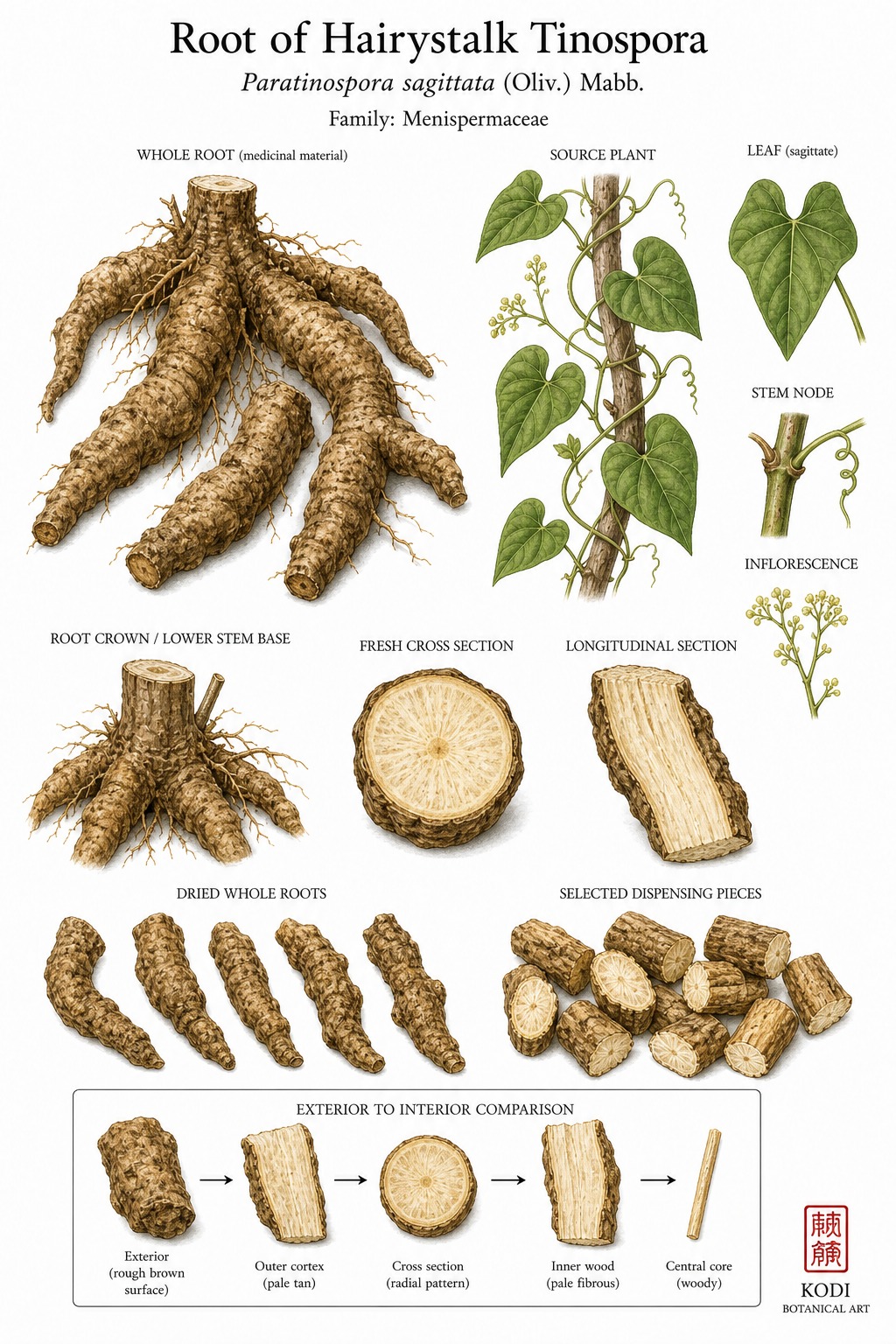
Known in TCM as Jin Guo Lan (金果榄), this bitter, cold herb enters the Lung and Stomach. Traditionally, it clears heat and resolves toxin ... Jin Guo Lan is best known for fiery sore throat, pharyngeal swelling, tonsillar inflammation, and hot toxic lesions, most often applied for pharyngitis, tonsillitis, and sore throat. Modern research has identified Clerodane among its active constituents.
Part used: Root
Also Known As
Latin: Radix Tinosporae | Pinyin: Jin Guo Lan | Chinese: 金果榄
TCM Properties
- Taste
- bitter
- Temperature
- cold
- Channels
- Lung, Stomach
Traditional Use
Primary Actions
- Clears heat and resolves toxin ... Jin Guo Lan is best known for fiery sore throat, pharyngeal swelling, tonsillar inflammation, and hot toxic lesions.
- Benefits the throat and mouth ... it is used for acute pharyngitis, painful swallowing, oral ulceration, and similar upper-aerodigestive heat patterns.
- Reduces painful inflammatory swelling ... beyond throat disease, the tuberous root is used when toxin, redness, and swelling dominate rather than when deficiency or cold are primary.
Secondary Actions
- Current taxonomy points the main source plant to Paratinospora sagittata even though much older literature still files it under Tinospora sagittata.
- This page should stay on the toxic-heat throat and swelling lane ... not on the broader tonic image associated with other Tinospora traditions such as Guduchi.
Classic Formulas
- Regional throat formulas pairing Jin Guo Lan with Shan Dou Gen, She Gan, or Ban Lan Gen ... practical acute-inflammation logic.
- Dai and Zhuang medicine uses for fiery throat and toxic swelling ... more characteristic than a single famous pan-Chinese classical prescription.
- Heat-toxic ulcer and sore pairings ... used when mouth or throat lesions are painful, red, and swollen.
Classical References
- Chinese pharmacopeial usage centers on tuberous root material for clearing heat, detoxifying, and relieving throat disease.
- The root medicine should not be treated as interchangeable with every other Tinospora stem or adaptogenic vine record.
Modern Research
Active Compounds
- Clerodane diterpenoids and related tinotanoid-type constituents ... the main modern chemistry lane
- Alkaloids, lignans, and phenolic compounds ... broader supportive constituent classes reported in Tinosporae Radix reviews
- Polysaccharide and metabolite fractions ... relevant to inflammation and quality-marker work
Studied Effects
- A 2024 review summarized the traditional use, botany, phytochemistry, bioactivity, and quality markers of Tinosporae Radix, confirming why Jin Guo Lan remains anchored to heat-toxic throat disease and inflammatory use (PMID 37859314).
- A 2024 study found that Tinosporae Radix attenuated acute pharyngitis through glycerophospholipid and inflammatory-pathway regulation, giving direct modern support to one of its main traditional indications (PMID 39568590).
- A 2025 paper isolated anti-inflammatory clerodane diterpenoids from the tuberous root of Paratinospora sagittata, tying current chemistry work directly back to the root material on this page (PMID 40183097).
PubMed References
- Tinosporae radix: A Review of Traditional Use, Botany, Phytochemistry, Bioactivity, and Quality Marker. (2024)
- Tinosporae Radix attenuates acute pharyngitis by regulating glycerophospholipid metabolism and inflammatory responses through PI3K-Akt signaling pathway. (2024)
- Clerodane diterpenoids with anti-inflammatory activity from the tuberous root of Paratinospora sagittata (Oliv.) Wei Wang. (2025)
Safety & Interactions
Contraindications
- Cold deficiency sore throat or weak digestion without heat signs
- Long unsupervised use for chronic illness when the pattern is unclear
Cautions
- Throat pain can reflect serious bacterial or airway disease and should not rely only on herbal self-care.
- Taxonomic relabeling between Tinospora and Paratinospora makes authenticated sourcing important.
- Concentrated root extracts and isolated diterpenoids are more pharmacologically intense than ordinary decoction-strength use.
Conditions
- Pharyngitis Traditional ★★★☆☆ JSON
- Tonsillitis Traditional ★★★☆☆ JSON
- Sore Throat Traditional ★★★☆☆ JSON
- Oral Ulcers Traditional ★★☆☆☆ JSON
Frequently Asked Questions
What is Jin Guo Lan Root used for?
Jin Guo Lan Root is traditionally used to Clears heat and resolves toxin ... Jin Guo Lan is best known for fiery sore throat, pharyngeal swelling, tonsillar inflammation, and hot toxic lesions., Benefits the throat and mouth ... it is used for acute pharyngitis, painful swallowing, oral ulceration, and similar upper-aerodigestive heat patterns., Reduces painful inflammatory swelling ... beyond throat disease, the tuberous root is used when toxin, redness, and swelling dominate rather than when deficiency or cold are primary.. Research has investigated its effects on: A 2024 review summarized the traditional use, botany, phytochemistry, bioactivity, and quality markers of Tinosporae Radix, confirming why Jin Guo Lan remains anchored to heat-toxic throat disease and inflammatory use (PMID 37859314).; A 2024 study found that Tinosporae Radix attenuated acute pharyngitis through glycerophospholipid and inflammatory-pathway regulation, giving direct modern support to one of its main traditional indications (PMID 39568590)..
What are other names for Jin Guo Lan Root?
Jin Guo Lan Root is also known as Tinospora Root, Tinosporae Radix, Paratinospora sagittata. In TCM: 金果榄 (Jin Guo Lan); Radix Tinosporae.
Is Jin Guo Lan Root safe during pregnancy?
The safety of Jin Guo Lan Root during pregnancy has not been established. Consult a qualified healthcare provider before use.
What are the contraindications for Jin Guo Lan Root?
Jin Guo Lan Root should not be used in: Cold deficiency sore throat or weak digestion without heat signs; Long unsupervised use for chronic illness when the pattern is unclear. Consult a qualified healthcare provider before use.