Qian Hu Root
- Chinese
- å‰èƒ¡
- Pinyin
- Qian Hu
- Latin
- Radix Peucedani
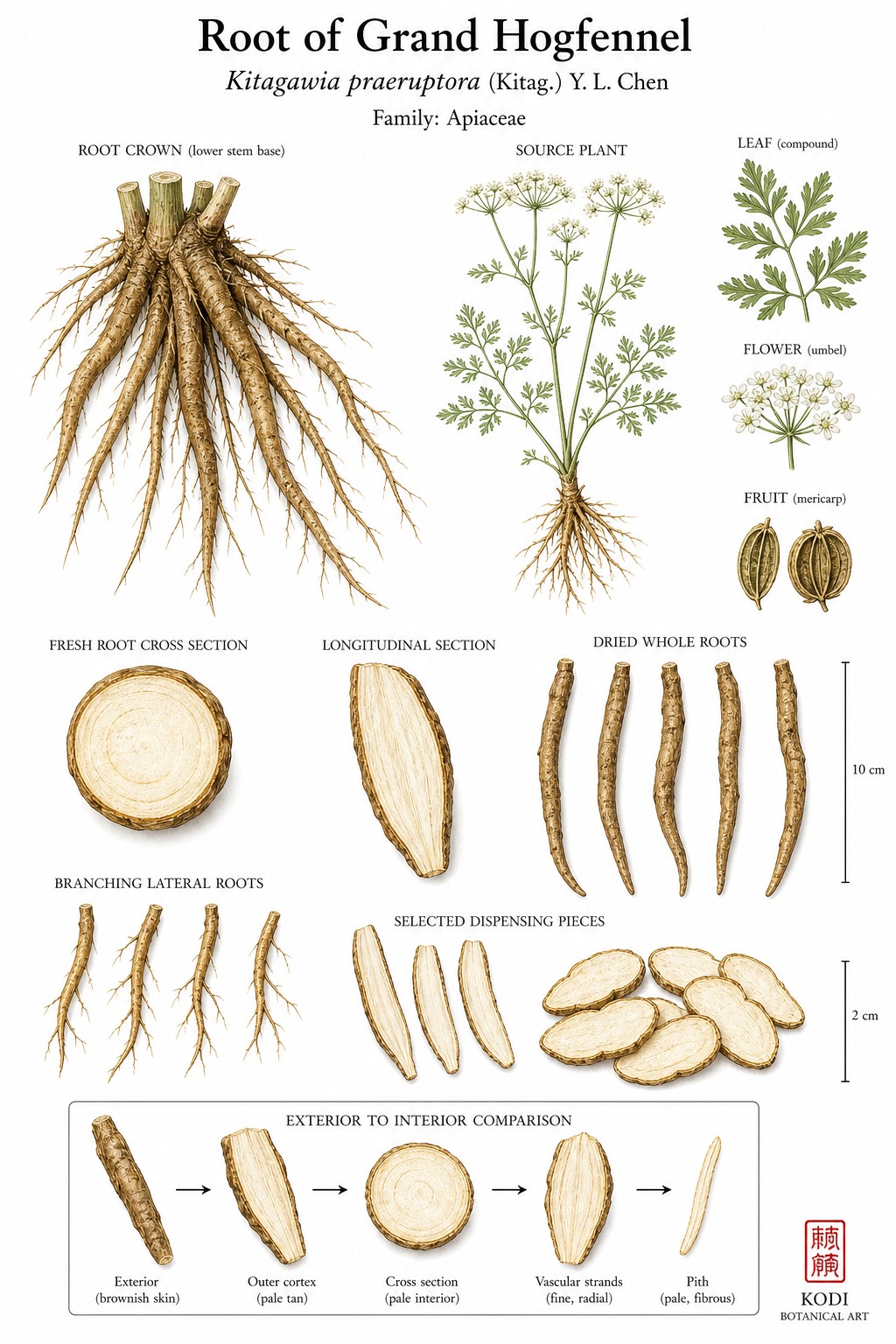
Known in TCM as Qian Hu (å‰èƒ¡), this bitter and acrid, slightly cold herb enters the Lung. Traditionally, it redirects Lung qi downward and transforms phlegm ... Qian Hu is a classic cough root for productive cough, chest congestion, and thick sputum that needs movement rather than simple moistening, most often applied for productive cough, phlegm accumulation, and common cold. Modern research has identified Angular among its active constituents.
Part used: Root
Also Known As
Latin: Radix Peucedani | Pinyin: Qian Hu | Chinese: å‰èƒ¡
TCM Properties
- Taste
- bitter, acrid
- Temperature
- slightly cold
- Channels
- Lung
Traditional Use
Primary Actions
- Redirects Lung qi downward and transforms phlegm ... Qian Hu is a classic cough root for productive cough, chest congestion, and thick sputum that needs movement rather than simple moistening.
- Releases the exterior and vents wind-heat ... it is used when cough overlaps with early exterior invasion, slight fever, or body discomfort.
- Opens the chest and eases constrained respiratory fullness ... especially when cough, phlegm, and poor qi descent occur together.
Secondary Actions
- The accepted source plant now points to Kitagawia praeruptora in current taxonomy, but much indexed pharmacology still appears under Peucedanum praeruptorum.
- This page must stay on true Qian Hu and not drift into Bupleurum, Angelica, or generic decorative Apiaceae logic.
Classic Formulas
- Xing Su San ... classic cool-dry or wind-cold cough formula where Qian Hu helps descend Lung qi and move phlegm.
- Jin Fei Cao San ... traditional cough formula using Qian Hu when exterior influence and sputum are both present.
- Qian Hu San type productive-cough formulas ... standard pairing logic with Jie Geng, Sang Bai Pi, and other Lung-qi herbs.
Classical References
- Materia medica consistently places Qian Hu in the Lung as a descending herb for cough with phlegm and early exterior involvement.
- Authentication matters because current taxonomy has shifted while older trade and research language often still says Peucedanum praeruptorum.
Modern Research
Active Compounds
- Angular pyranocoumarins such as praeruptorins A, B, and C ... the best-known Qian Hu markers
- Other coumarins and furanocoumarins ... important for pharmacology and authentication
- Volatile and supportive phenolic fractions ... minor but recurrent constituent groups
Studied Effects
- A 2015 review summarized the botany, phytochemistry, pharmacology, and pharmacokinetics of Peucedani Radix, reinforcing why Qian Hu remains a core cough root rather than just a coumarin source (PMID 25553708).
- A 2024 review revisited the traditional uses, pharmacology, and phytochemistry of Peucedanum praeruptorum, helping bridge older species naming with current taxonomy and confirming ongoing respiratory and anti-inflammatory interest (PMID 38633612).
- A 2013 systematic review focused on praeruptorins from Peucedanum species and highlighted bronchodilatory, cardiovascular, and anti-inflammatory research directions relevant to Qian Hu chemistry (PMID 24371820).
PubMed References
- Research progress of the studies on the roots of Peucedanum praeruptorum dunn (Peucedani radix). (2015)
- The traditional uses, pharmacology, and phytochemistry of Peucedanum praeruptorum Dunn. (2024)
- Biological activities and pharmacokinetics of praeruptorins from Peucedanum species: a systematic review. (2013)
Safety & Interactions
Contraindications
- Dry cough without phlegm
- Qi deficiency cough without excess sputum or exterior involvement
- Poorly authenticated trade material
Cautions
- Coumarin-rich extracts and isolated compounds are not equivalent to ordinary decoction use.
- Taxonomic shifts from Peucedanum to Kitagawia increase the need for authenticated sourcing.
- The descending and dispersing nature of Qian Hu can aggravate dryness if the wrong cough pattern is treated.
Conditions
- Productive Cough Traditional ★★★★☆ JSON
- Phlegm Accumulation Traditional ★★★☆☆ JSON
- Common Cold Traditional ★★☆☆☆ JSON
- Headache Traditional ★★☆☆☆ JSON
Frequently Asked Questions
What is Qian Hu Root used for?
Qian Hu Root is traditionally used to Redirects Lung qi downward and transforms phlegm ... Qian Hu is a classic cough root for productive cough, chest congestion, and thick sputum that needs movement rather than simple moistening., Releases the exterior and vents wind-heat ... it is used when cough overlaps with early exterior invasion, slight fever, or body discomfort., Opens the chest and eases constrained respiratory fullness ... especially when cough, phlegm, and poor qi descent occur together.. Research has investigated its effects on: A 2015 review summarized the botany, phytochemistry, pharmacology, and pharmacokinetics of Peucedani Radix, reinforcing why Qian Hu remains a core cough root rather than just a coumarin source (PMID 25553708).; A 2024 review revisited the traditional uses, pharmacology, and phytochemistry of Peucedanum praeruptorum, helping bridge older species naming with current taxonomy and confirming ongoing respiratory and anti-inflammatory interest (PMID 38633612)..
What are other names for Qian Hu Root?
Qian Hu Root is also known as Peucedani Radix, Kitagawia praeruptora Root, Peucedanum Root. In TCM: å‰èƒ¡ (Qian Hu); Radix Peucedani.
Is Qian Hu Root safe during pregnancy?
The safety of Qian Hu Root during pregnancy has not been established. Consult a qualified healthcare provider before use.
What are the contraindications for Qian Hu Root?
Qian Hu Root should not be used in: Dry cough without phlegm; Qi deficiency cough without excess sputum or exterior involvement; Poorly authenticated trade material. Consult a qualified healthcare provider before use.