Garden Burnet Root
- Chinese
- 地榆
- Pinyin
- Di Yu
- Latin
- Radix Sanguisorbae
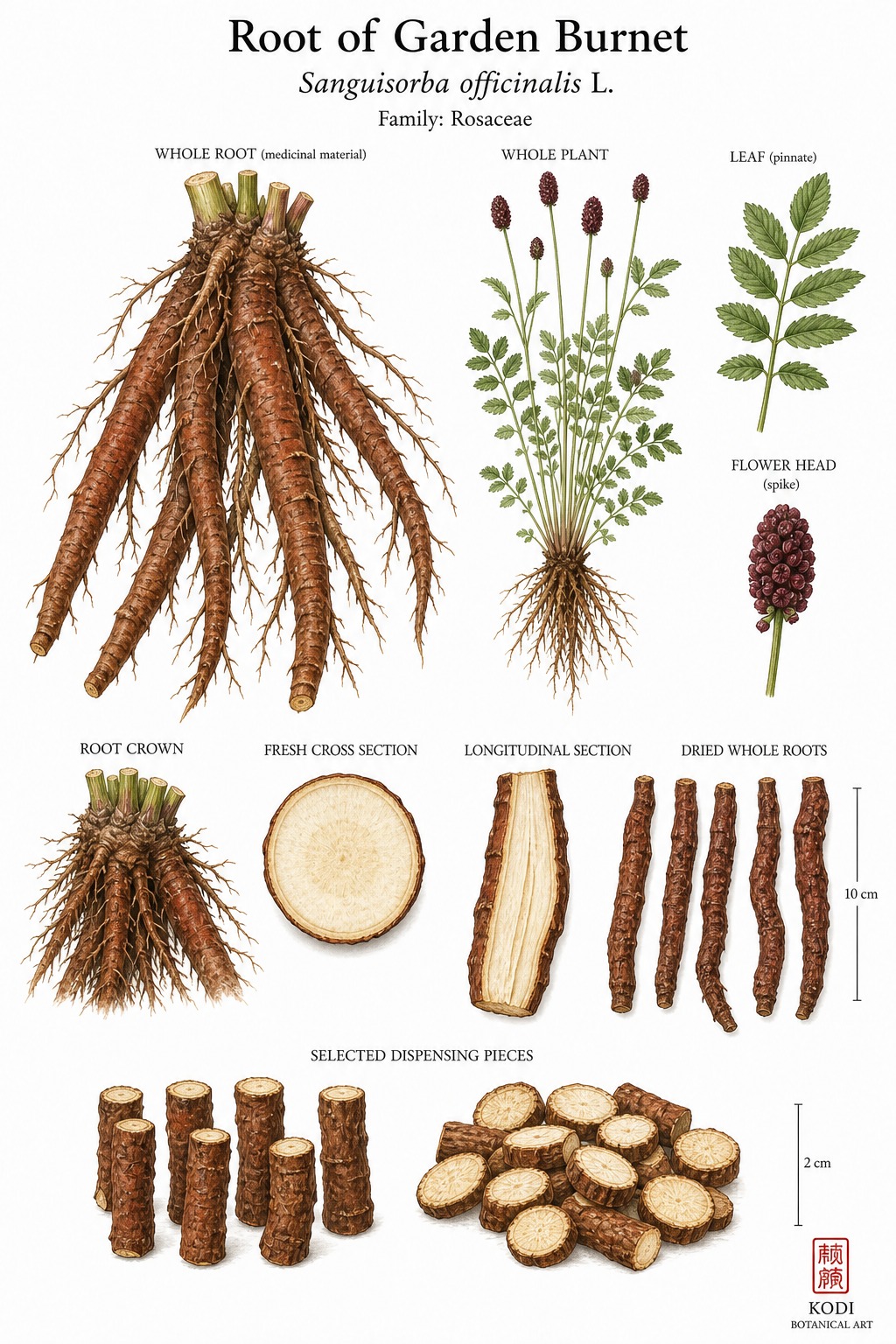
Known in TCM as Di Yu (地榆), this bitter and sour and astringent, slightly cold herb enters the Large Intestine, Liver, and Stomach. Traditionally, it cools blood and stops bleeding ... Di Yu is a classic root for bleeding from heat, especially hemorrhoidal bleeding, bloody stool, and lower-burner blood-loss patterns, most often applied for hemorrhoids, abnormal uterine bleeding, and dysentery. Modern research has identified Hydrolysable among its active constituents.
Part used: Root
Also Known As
Latin: Radix Sanguisorbae | Pinyin: Di Yu | Chinese: 地榆
TCM Properties
- Taste
- bitter, sour, astringent
- Temperature
- slightly cold
- Channels
- Large Intestine, Liver, Stomach
Traditional Use
Primary Actions
- Cools blood and stops bleeding ... Di Yu is a classic root for bleeding from heat, especially hemorrhoidal bleeding, bloody stool, and lower-burner blood-loss patterns.
- Clears heat and resolves toxic swelling ... the root is used for dysenteric heat, weeping sores, ulcerated lesions, and inflamed tissue when lower-body heat is obvious.
- Aids damaged tissue and burns ... raw or topical use extends to burns, moist lesions, and damaged skin where cooling and astringing actions are both useful.
Secondary Actions
- This record should stay on the medicinal root lane ... not on aerial burnet folk uses or ornamental garden-plant confusion.
- Processing matters ... raw Di Yu is more cooling and toxin-resolving, while charred Di Yu is classically preferred when stronger hemostatic emphasis is needed.
Classic Formulas
- Di Yu San type hemorrhoidal-bleeding formulas ... a classic lower-burner bleeding lane.
- Heat-clearing hemostatic pairings with Huai Hua, Ce Bai Ye, or Huang Qin ... used when bleeding and inflammation coexist.
- Topical burn and sore applications with astringent or tissue-repairing herbs such as Bai Ji ... practical external-use logic.
Classical References
- Materia medica consistently values Di Yu for lower-body bleeding and damp-heat dysentery rather than for warming or tonifying work.
- The raw-versus-charred distinction is part of its classical identity and should not be erased in simplified summaries.
Modern Research
Active Compounds
- Hydrolysable tannins ... strongly astringent fractions tied to hemostatic and gut-protective interest
- Triterpenoid saponins such as ziyuglycoside derivatives ... major modern marker compounds
- Phenolic acids and flavonoids ... supportive anti-inflammatory and antioxidant fractions
Studied Effects
- A 2021 genus-level review summarized the traditional uses, chemistry, and medical applications of Sanguisorba, giving modern context for Di Yu's hemostatic and anti-inflammatory reputation (PMID 34616302).
- A 2018 review focused specifically on Sanguisorba officinalis and its phytotherapeutic activities, reinforcing why the root remains important for bleeding, inflammation, and mucosal injury discussions (PMID 29433389).
- A 2023 study found that Sanguisorba officinalis ethyl acetate extract attenuated ulcerative colitis through PI3K-AKT, NF-κB, and STAT3-related inflammatory pathways, offering a modern correlate to Di Yu's lower-bowel heat use (PMID 37717310).
PubMed References
- A Comprehensive Review of Genus Sanguisorba: Traditional Uses, Chemical Constituents and Medical Applications. (2021)
- Phytotherapeutic Activities of Sanguisorba officinalis and its Chemical Constituents: A Review. (2018)
- Sanguisorba officinalis ethyl acetate extract attenuates ulcerative colitis through inhibiting PI3K-AKT/NF-κB/ STAT3 pathway uncovered by single-cell RNA sequencing. (2023)
Safety & Interactions
Contraindications
- Cold deficiency without heat or bleeding
- Marked constipation from dryness rather than heat and toxin
Cautions
- Its cooling and astringent nature can be poorly matched to chronic deficiency patterns without heat.
- Raw and charred forms are not interchangeable if hemostatic emphasis is the treatment goal.
- Persistent rectal bleeding, severe burns, or ulcerating lesions require medical evaluation and should not rely on self-treatment alone.
Conditions
- Hemorrhoids Traditional ★★★☆☆ JSON
- Abnormal Uterine Bleeding Traditional ★★★☆☆ JSON
- Dysentery Traditional ★★★☆☆ JSON
- Skin Burns Traditional ★★☆☆☆ JSON
Frequently Asked Questions
What is Garden Burnet Root used for?
Garden Burnet Root is traditionally used to Cools blood and stops bleeding ... Di Yu is a classic root for bleeding from heat, especially hemorrhoidal bleeding, bloody stool, and lower-burner blood-loss patterns., Clears heat and resolves toxic swelling ... the root is used for dysenteric heat, weeping sores, ulcerated lesions, and inflamed tissue when lower-body heat is obvious., Aids damaged tissue and burns ... raw or topical use extends to burns, moist lesions, and damaged skin where cooling and astringing actions are both useful.. Research has investigated its effects on: A 2021 genus-level review summarized the traditional uses, chemistry, and medical applications of Sanguisorba, giving modern context for Di Yu's hemostatic and anti-inflammatory reputation (PMID 34616302).; A 2018 review focused specifically on Sanguisorba officinalis and its phytotherapeutic activities, reinforcing why the root remains important for bleeding, inflammation, and mucosal injury discussions (PMID 29433389)..
What are other names for Garden Burnet Root?
Garden Burnet Root is also known as Sanguisorba Root, Di Yu Root, Sanguisorbae Radix. In TCM: 地榆 (Di Yu); Radix Sanguisorbae.
Is Garden Burnet Root safe during pregnancy?
The safety of Garden Burnet Root during pregnancy has not been established. Consult a qualified healthcare provider before use.
What are the contraindications for Garden Burnet Root?
Garden Burnet Root should not be used in: Cold deficiency without heat or bleeding; Marked constipation from dryness rather than heat and toxin. Consult a qualified healthcare provider before use.