Kansui Root
- Chinese
- 甘é‚
- Pinyin
- Gan Sui
- Latin
- Radix Kansui
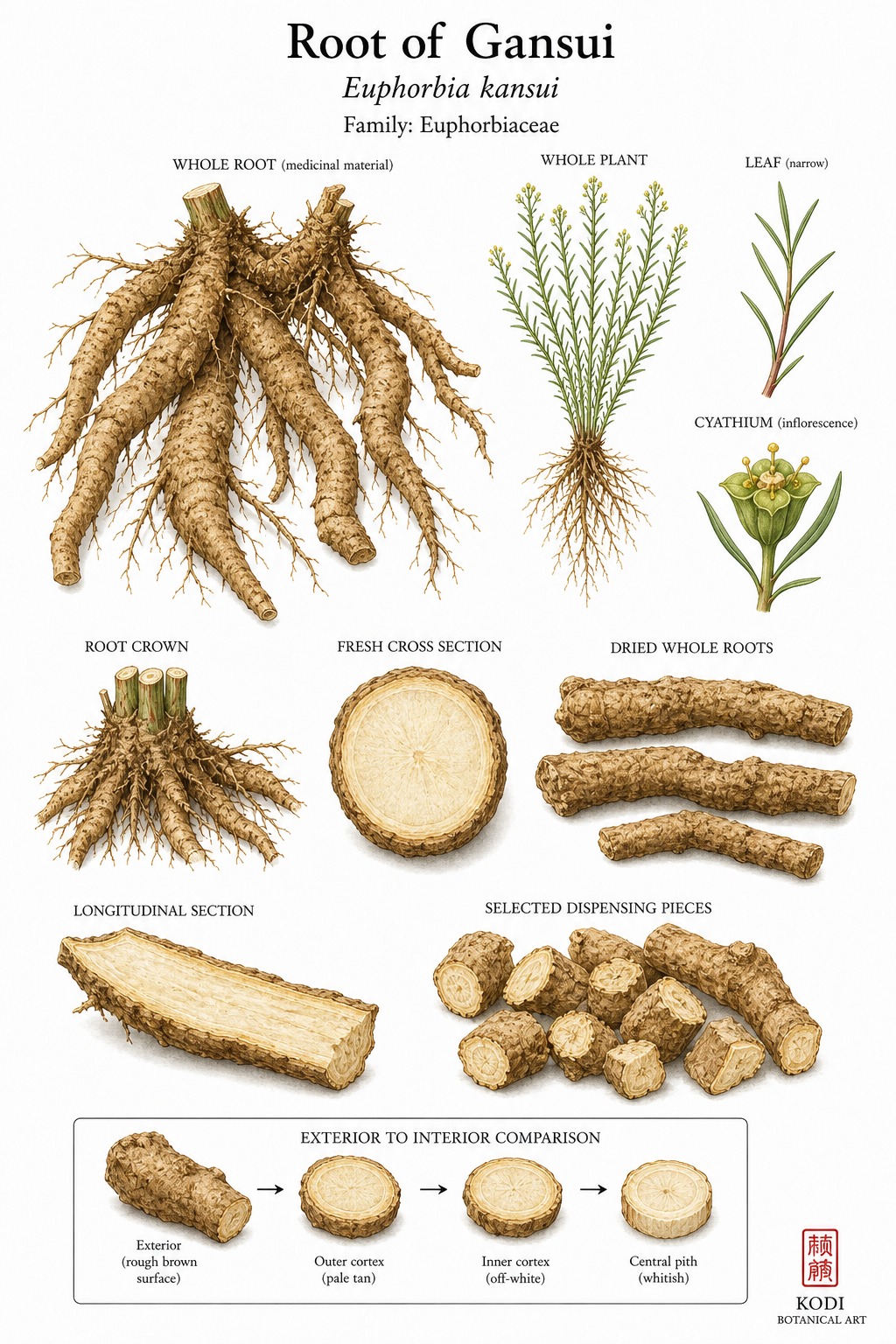
Known in TCM as Gan Sui (甘é‚), this bitter and sweet, cold herb enters the Kidney, Lung, and Large Intestine. Traditionally, it drastically drives out retained water ... Gan Sui is one of the strongest harsh purgatives in Chinese medicine and is reserved for severe edema, ascites, or stubborn chest and abdominal fluid retention, most often applied for edema, phlegm accumulation, and wheezing. Modern research has identified Diterpenoid among its active constituents.
Part used: Root
Also Known As
Latin: Radix Kansui | Pinyin: Gan Sui | Chinese: 甘é‚
TCM Properties
- Taste
- bitter, sweet
- Temperature
- cold
- Channels
- Kidney, Lung, Large Intestine
Traditional Use
Primary Actions
- Drastically drives out retained water ... Gan Sui is one of the strongest harsh purgatives in Chinese medicine and is reserved for severe edema, ascites, or stubborn chest and abdominal fluid retention.
- Expels phlegm and thin-fluid accumulation ... it is used when congested water and phlegm obstruct the Lung, producing fullness, wheezing, or pronounced retained-fluid patterns that milder draining herbs will not move.
- Breaks through severe excess accumulation ... classical use emphasizes short-term attack on repletion patterns, not routine use for ordinary puffiness or chronic weakness.
Secondary Actions
- This record must stay on the toxic Euphorbia kansui root lane and not be softened into a general diuretic page.
- Modern practice usually prefers processed or formula-level use because raw Gan Sui is irritating and has a narrow therapeutic margin.
Classic Formulas
- Shi Zao Tang ... classic severe water-retention formula in which Gan Sui is paired with Da Ji and Yuan Hua for fluid lodged above the diaphragm.
- Gan Sui Ban Xia Tang ... classic phlegm-fluid accumulation strategy when stubborn retained fluids obstruct the chest or epigastrium.
- Short-course purgative pairings using vinegar-processed material or moderating ingredients such as da zao ... traditional attempts to preserve action while reducing harshness.
Classical References
- Materia medica places Gan Sui among the strongest water-draining and phlegm-expelling toxic herbs, appropriate only for true excess accumulation.
- Its traditional reputation depends as much on correct pattern selection and processing as on the herb itself.
Modern Research
Active Compounds
- Diterpenoid esters including ingenane- and jatrophane-type constituents ... major bioactive and toxicity-driving Euphorbia fractions
- Triterpenes and sterols ... supportive constituent classes discussed in review literature
- Irritant resin fractions ... relevant to both purgative activity and adverse-effect potential
Studied Effects
- A 2016 review summarized the chemistry and biology of Euphorbia kansui, reinforcing why the herb is both pharmacologically active and clinically hazardous (PMID 27080940).
- A 2020 review of vinegar processing showed that preparation changes both the chemistry and the biological activity of Gan Sui, supporting the traditional insistence that processing matters (PMID 31931159).
- A 2019 zebrafish-larva study documented hepatotoxicity from Euphorbia kansui exposure in vivo, matching longstanding warnings that this is a toxic attack herb rather than a casual detox plant (PMID 31132752).
PubMed References
Safety & Interactions
Contraindications
- Pregnancy
- Frailty, dehydration, or marked qi and fluid deficiency
- Inflamed digestive mucosa, active ulceration, or severe bowel sensitivity
Cautions
- Gan Sui is a toxic drastic purgative and should not be self-prescribed for simple swelling, constipation, or weight loss goals.
- Raw root and concentrated extracts can cause severe gastrointestinal irritation and systemic toxicity.
- Traditional processing changes both chemistry and safety profile, so product identity matters.
Conditions
- Edema Traditional ★★★★☆ JSON
- Phlegm Accumulation Traditional ★★★☆☆ JSON
- Wheezing Traditional ★★☆☆☆ JSON
- Productive Cough Traditional ★★☆☆☆ JSON
Frequently Asked Questions
What is Kansui Root used for?
Kansui Root is traditionally used to Drastically drives out retained water ... Gan Sui is one of the strongest harsh purgatives in Chinese medicine and is reserved for severe edema, ascites, or stubborn chest and abdominal fluid retention., Expels phlegm and thin-fluid accumulation ... it is used when congested water and phlegm obstruct the Lung, producing fullness, wheezing, or pronounced retained-fluid patterns that milder draining herbs will not move., Breaks through severe excess accumulation ... classical use emphasizes short-term attack on repletion patterns, not routine use for ordinary puffiness or chronic weakness.. Research has investigated its effects on: A 2016 review summarized the chemistry and biology of Euphorbia kansui, reinforcing why the herb is both pharmacologically active and clinically hazardous (PMID 27080940).; A 2020 review of vinegar processing showed that preparation changes both the chemistry and the biological activity of Gan Sui, supporting the traditional insistence that processing matters (PMID 31931159)..
What are other names for Kansui Root?
Kansui Root is also known as Euphorbia kansui Root, Kansui Euphorbia, Kansui. In TCM: ç”˜é‚ (Gan Sui); Radix Kansui.
Is Kansui Root safe during pregnancy?
Kansui Root is not recommended during pregnancy.
What are the contraindications for Kansui Root?
Kansui Root should not be used in: Pregnancy; Frailty, dehydration, or marked qi and fluid deficiency; Inflamed digestive mucosa, active ulceration, or severe bowel sensitivity. Consult a qualified healthcare provider before use.