Foxtail Sophora Root
- Chinese
- 苦甘è‰
- Pinyin
- Ku Gan Cao
- Latin
- Radix Sophorae Alopecuroidis
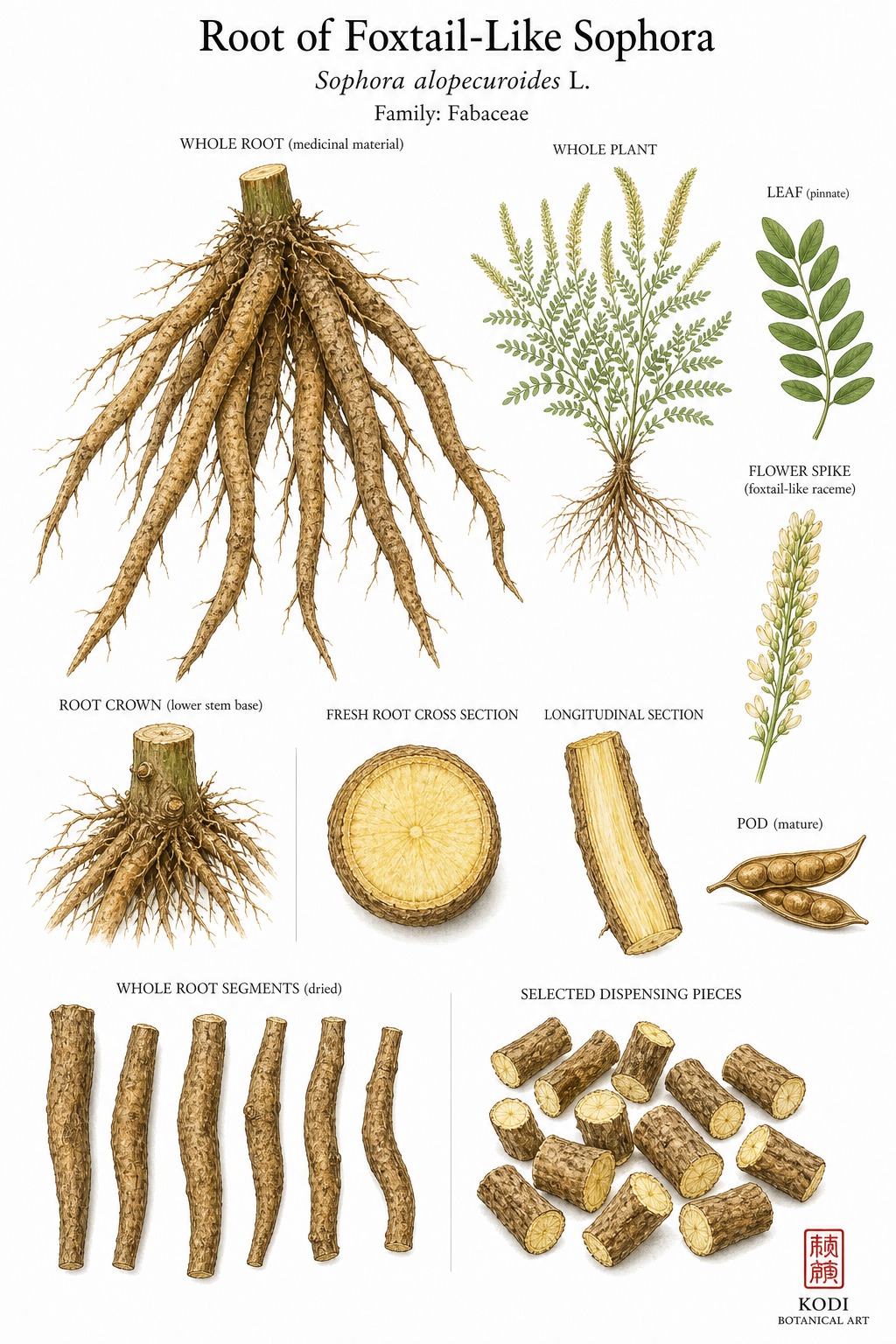
Known in TCM as Ku Gan Cao (苦甘è‰), this bitter, cold herb enters the Large Intestine, Liver, and Bladder. Traditionally, it clears heat and resolves toxin ... regional use of Ku Gan Cao centers on bitter-cold root material for damp-heat and toxic patterns showing inflamed skin, sore throat, or dysenteric bowel complaints, most often applied for eczema, dysentery, and furunculosis. Modern research has identified Quinolizidine among its active constituents.
Part used: Root
Also Known As
Latin: Radix Sophorae Alopecuroidis | Pinyin: Ku Gan Cao | Chinese: 苦甘è‰
TCM Properties
- Taste
- bitter
- Temperature
- cold
- Channels
- Large Intestine, Liver, Bladder
Traditional Use
Primary Actions
- Clears heat and resolves toxin ... regional use of Ku Gan Cao centers on bitter-cold root material for damp-heat and toxic patterns showing inflamed skin, sore throat, or dysenteric bowel complaints.
- Dries dampness and reduces itchy or weeping eruptions ... the root is used in folk and regional medicine for eczema, recurrent dermatitis, and other hot irritated lesions rather than as a gentle tonic.
- Relieves painful swelling in hot obstructive states ... traditional use extends to sore lesions, inflamed tissue, and pain conditions where heat, toxin, or infection-like presentation dominates.
Secondary Actions
- This page stays root-forward even though older indexing often mixes root, whole-herb, seed, and isolated-alkaloid literature under Sophora alopecuroides.
- Ku Gan Cao should not be flattened into Ku Shen ... Sophora flavescens is a separate medicinal with a stronger standard TCM identity and a better-defined pharmacopoeial track.
Classic Formulas
- Regional decoctions pairing Ku Gan Cao with Huang Qin, Pu Gong Ying, or similar bitter detoxifying herbs ... used when damp-heat skin or throat inflammation is prominent.
- Topical wash logic with other heat-clearing herbs ... a practical folk lane for eczema, recurrent dermatitis, or infected-looking skin lesions.
- Heat-toxic dysentery pairings with herbs such as Huang Lian or Qin Pi ... a conservative regional strategy rather than a famous textbook formula.
Classical References
- Modern ethnopharmacology summaries note that multiple parts of Sophora alopecuroides have been used medicinally, but regional root use repeatedly clusters around dysentery, eczema, recurrent dermatitis, and furuncle-type lesions.
- Because the indexed literature often pools root, aerial parts, seeds, and alkaloids together, conservative root-specific wording is more accurate than pretending the modern evidence is perfectly standardized.
Modern Research
Active Compounds
- Quinolizidine alkaloids such as aloperine, matrine, sophoridine, and oxymatrine ... the dominant pharmacologically active Sophora constituents
- Flavonoids including alopecurones and related prenylated compounds ... repeatedly discussed in Sophora alopecuroides chemistry
- Polysaccharides and phenolic fractions ... supportive antioxidant and immunologic research lanes
Studied Effects
- A 2020 review synthesized the ethnopharmacology, phytochemistry, and pharmacology of Sophora alopecuroides and confirmed that traditional use spans dysentery, eczema, recurrent dermatitis, furuncle-like lesions, and infectious heat disorders, while also warning that the literature often combines multiple plant parts (PMID 31442619).
- A 2021 rat study reported wound-healing support from Sophora alopecuroides preparations, giving a modern correlate to its regional use on damaged or inflamed skin (PMID 33689799).
- A 2023 study found neuroinflammatory and oxidative-stress benefit in Parkinson's disease models, illustrating how alkaloid-rich Sophora chemistry continues to attract systems-level pharmacology research beyond simple antimicrobial folk use (PMID 36611142).
PubMed References
- Sophora alopecuroides L.: An ethnopharmacological, phytochemical, and pharmacological review. (2020)
- Evaluation of the wound healing potential of Sophora alopecuroides in SD rat's skin. (2021)
- Sophora alopecuroides Alleviates Neuroinflammation and Oxidative Damage of Parkinson's Disease In Vitro and In Vivo. (2023)
Safety & Interactions
Contraindications
- Cold deficiency or chronic diarrhea without signs of heat or dampness
- Pregnancy without expert supervision
- Cases where a better-defined standard herb such as Ku Shen is the truer match
Cautions
- Sophora alopecuroides is alkaloid-rich, and concentrated extracts should not be treated like casual tea-strength folk preparations.
- Published studies often blur the distinction between root, seed, whole-herb, and isolated-alkaloid evidence, so herb-specific claims should stay conservative.
- Regional trade names such as Ku Dou Gen and Ku Shen Cao can create identity confusion if sourcing is poor.
Conditions
- Eczema Traditional ★★★☆☆ JSON
- Dysentery Traditional ★★★☆☆ JSON
- Furunculosis Traditional ★★☆☆☆ JSON
- Sore Throat Traditional ★★☆☆☆ JSON
Frequently Asked Questions
What is Foxtail Sophora Root used for?
Foxtail Sophora Root is traditionally used to Clears heat and resolves toxin ... regional use of Ku Gan Cao centers on bitter-cold root material for damp-heat and toxic patterns showing inflamed skin, sore throat, or dysenteric bowel complaints., Dries dampness and reduces itchy or weeping eruptions ... the root is used in folk and regional medicine for eczema, recurrent dermatitis, and other hot irritated lesions rather than as a gentle tonic., Relieves painful swelling in hot obstructive states ... traditional use extends to sore lesions, inflamed tissue, and pain conditions where heat, toxin, or infection-like presentation dominates.. Research has investigated its effects on: A 2020 review synthesized the ethnopharmacology, phytochemistry, and pharmacology of Sophora alopecuroides and confirmed that traditional use spans dysentery, eczema, recurrent dermatitis, furuncle-like lesions, and infectious heat disorders, while also warning that the literature often combines multiple plant parts (PMID 31442619).; A 2021 rat study reported wound-healing support from Sophora alopecuroides preparations, giving a modern correlate to its regional use on damaged or inflamed skin (PMID 33689799)..
What are other names for Foxtail Sophora Root?
Foxtail Sophora Root is also known as Sophora alopecuroides Root, Ku Dou Gen, Ku Shen Cao. In TCM: è‹¦ç”˜è‰ (Ku Gan Cao); Radix Sophorae Alopecuroidis.
Is Foxtail Sophora Root safe during pregnancy?
The safety of Foxtail Sophora Root during pregnancy has not been established. Consult a qualified healthcare provider before use.
What are the contraindications for Foxtail Sophora Root?
Foxtail Sophora Root should not be used in: Cold deficiency or chronic diarrhea without signs of heat or dampness; Pregnancy without expert supervision; Cases where a better-defined standard herb such as Ku Shen is the truer match. Consult a qualified healthcare provider before use.