Dyers Woad Root
- Chinese
- 板蓝根
- Pinyin
- Ban Lan Gen
- Latin
- Radix Isatidis Seu Baphicacanthi
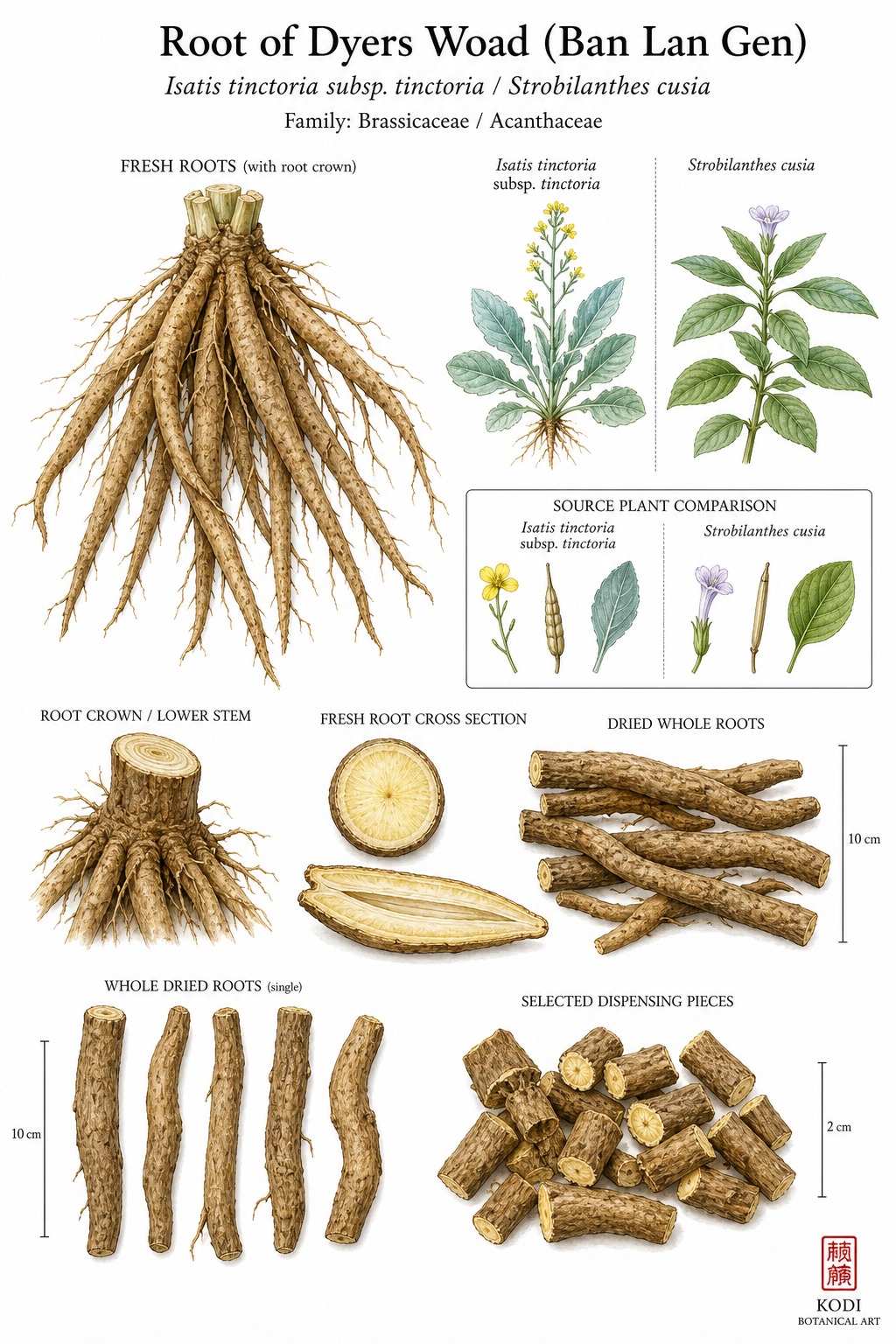
Known in TCM as Ban Lan Gen (板蓝根), this bitter, cold herb enters the Heart and Stomach. Traditionally, it clears heat and resolves toxin ... Ban Lan Gen is one of the best-known root medicines for hot toxic sore throat, epidemic heat, and inflammatory upper-respiratory presentations, most often applied for pharyngitis, sore throat, and upper respiratory infection. Modern research has identified Indigo among its active constituents.
Part used: Root
Also Known As
Latin: Radix Isatidis Seu Baphicacanthi | Pinyin: Ban Lan Gen | Chinese: 板蓝根
TCM Properties
- Taste
- bitter
- Temperature
- cold
- Channels
- Heart, Stomach
Traditional Use
Primary Actions
- Clears heat and resolves toxin ... Ban Lan Gen is one of the best-known root medicines for hot toxic sore throat, epidemic heat, and inflammatory upper-respiratory presentations.
- Cools the blood ... traditional use extends to febrile diseases with heat entering the blood level, rash, agitation, and toxic heat with swelling.
- Benefits the throat and reduces swelling ... painful red throat, swollen tonsils, and heat-toxic neck or glandular swelling are among its most familiar applications.
Secondary Actions
- This page preserves the conservative dual-source root identity reflected in modern trade and pharmacopoeial discussion, with Ban Lan Gen rooted mainly in Isatis indigotica research but also linked editorially to the Strobilanthes cusia lineage.
- It should remain distinct from the existing `isatis-leaf` and `indigoplant-leaf` monographs, which cover leaf-based Da Qing Ye traditions rather than the root.
Classic Formulas
- Ban Lan Gen granule and related throat-clearing patent-medicine traditions ... modern continuation of its heat-toxic sore-throat role.
- Qing Wen Jie Du formula lineages ... epidemic-heat and throat-toxin contexts where Ban Lan Gen supports heat-clearing and detoxification.
- Ban Lan Gen with Da Qing Ye and Qing Dai ... classic blue-herb family strategy for hot inflammatory throat and epidemic patterns.
Classical References
- Traditional herbology treats Ban Lan Gen as bitter and cold, entering the Heart and Stomach to clear heat, resolve toxin, cool the blood, and benefit the throat.
- The root and leaf are related but not identical medicinal lanes, which is why keeping Ban Lan Gen distinct from Da Qing Ye improves editorial accuracy.
Modern Research
Active Compounds
- Indigo and indirubin ... hallmark compounds long associated with Isatis pharmacology
- Epigoitrin and related alkaloid-associated markers ... common quality-control and antiviral discussion points
- Lignans such as lariciresinol derivatives ... important root constituents in influenza and inflammation research
- Polysaccharides and organic acids ... supportive constituent groups discussed in systematic reviews
Studied Effects
- A systematic review of Isatidis Radix and Isatidis Folium summarized ethnopharmacology, phytochemistry, and pharmacology across the root and leaf traditions, reinforcing Ban Lan Gen's modern relevance in antiviral and anti-inflammatory research (PMID 34543684).
- A 2021 review of Isatis indigotica summarized phytochemistry, pharmacological activities, and clinical applications, with Ban Lan Gen remaining one of the plant's most visible medicinal use lanes (PMID 33779758).
- A 2015 study found that lariciresinol-4-O-β-D-glucopyranoside from Isatis indigotica root inhibited influenza A virus-induced pro-inflammatory response, offering a direct mechanistic bridge between root chemistry and traditional epidemic-heat use (PMID 26320688).
PubMed References
- Isatidis Radix and Isatidis Folium: A systematic review on ethnopharmacology, phytochemistry and pharmacology. (2022)
- Isatis indigotica: a review of phytochemistry, pharmacological activities and clinical applications. (2021)
- Lariciresinol-4-O-β-D-glucopyranoside from the root of Isatis indigotica inhibits influenza A virus-induced pro-inflammatory response. (2015)
Safety & Interactions
Contraindications
- Spleen-Stomach deficiency cold without clear heat or toxin
Cautions
- Ban Lan Gen is a strongly cold heat-clearing root and can aggravate weak digestion or loose stool in people without clear heat signs.
- Much of the modern evidence is preclinical, and much of the published chemistry focuses more on Isatis lineages than on every dual-source trade context.
- It should not be casually treated as interchangeable with the leaf-based Da Qing Ye pages.
Conditions
- Pharyngitis Traditional ★★★★☆ JSON
- Sore Throat Traditional ★★★★☆ JSON
- Upper Respiratory Infection Research ★★★☆☆ JSON
- Furunculosis Traditional ★★☆☆☆ JSON
Frequently Asked Questions
What is Dyers Woad Root used for?
Dyers Woad Root is traditionally used to Clears heat and resolves toxin ... Ban Lan Gen is one of the best-known root medicines for hot toxic sore throat, epidemic heat, and inflammatory upper-respiratory presentations., Cools the blood ... traditional use extends to febrile diseases with heat entering the blood level, rash, agitation, and toxic heat with swelling., Benefits the throat and reduces swelling ... painful red throat, swollen tonsils, and heat-toxic neck or glandular swelling are among its most familiar applications.. Research has investigated its effects on: A systematic review of Isatidis Radix and Isatidis Folium summarized ethnopharmacology, phytochemistry, and pharmacology across the root and leaf traditions, reinforcing Ban Lan Gen's modern relevance in antiviral and anti-inflammatory research (PMID 34543684).; A 2021 review of Isatis indigotica summarized phytochemistry, pharmacological activities, and clinical applications, with Ban Lan Gen remaining one of the plant's most visible medicinal use lanes (PMID 33779758)..
What are other names for Dyers Woad Root?
Dyers Woad Root is also known as Isatidis Root, Banlangen, Isatis indigotica root, Strobilanthes cusia root. In TCM: 板蓝根 (Ban Lan Gen); Radix Isatidis Seu Baphicacanthi.
Is Dyers Woad Root safe during pregnancy?
The safety of Dyers Woad Root during pregnancy has not been established. Consult a qualified healthcare provider before use.
What are the contraindications for Dyers Woad Root?
Dyers Woad Root should not be used in: Spleen-Stomach deficiency cold without clear heat or toxin. Consult a qualified healthcare provider before use.