Mai Dong Ophiopogon Root Tuber
- Chinese
- 麦冬
- Pinyin
- Mai Dong
- Latin
- Radix Ophiopogonis
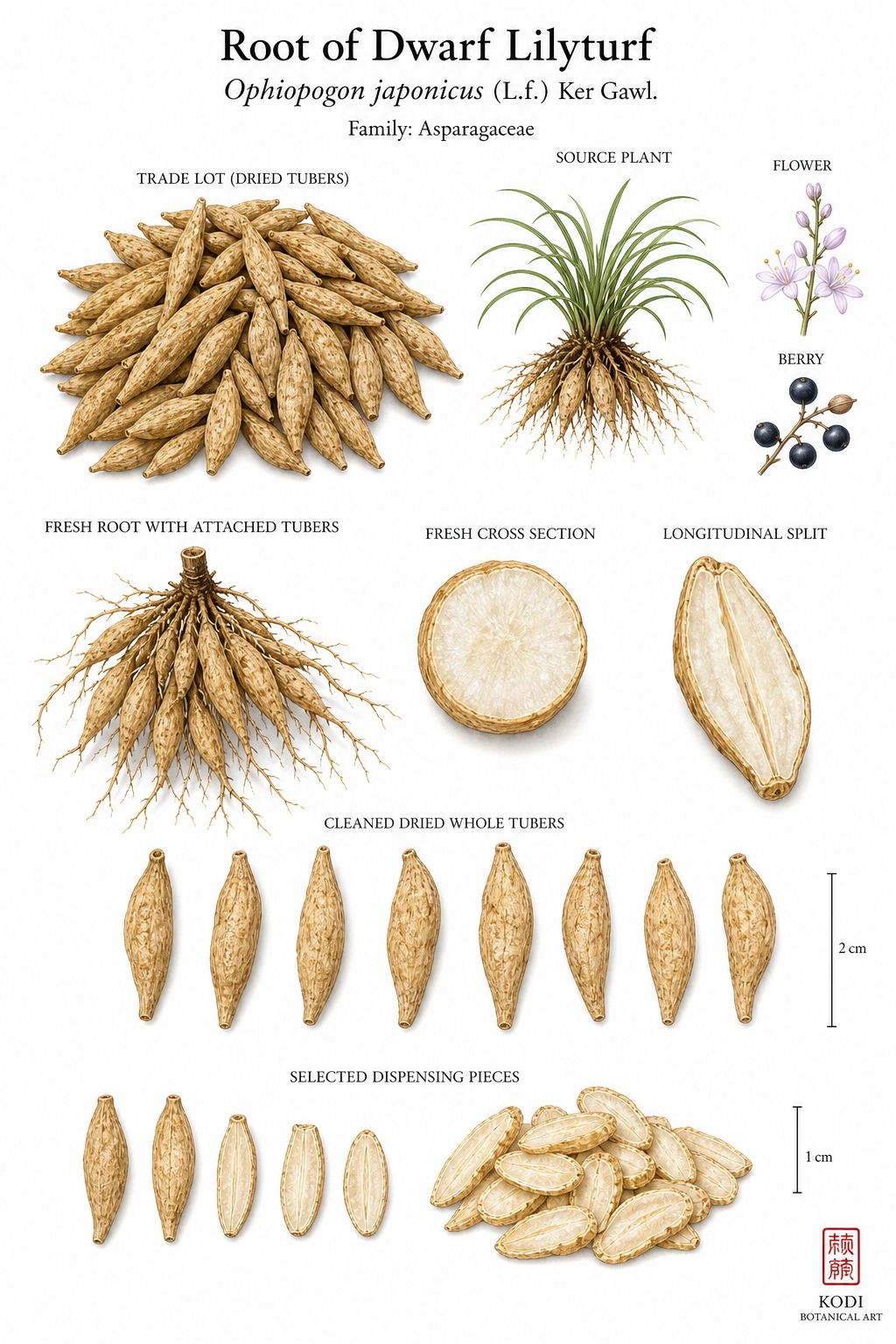
Known in TCM as Mai Dong (麦冬), this sweet and slightly bitter, slightly cold herb enters the Heart, Lung, and Stomach. Traditionally, it nourishes yin and generates fluids ... standard Mai Dong is one of the best-known herbs for restoring Lung and Stomach fluids after chronic dryness, heat injury, or long illness, most often applied for dry cough, yin deficiency, and pharyngitis. Modern research has identified Ophiopogon among its active constituents.
Part used: Root
Also Known As
Latin: Radix Ophiopogonis | Pinyin: Mai Dong | Chinese: 麦冬
TCM Properties
- Taste
- sweet, slightly bitter
- Temperature
- slightly cold
- Channels
- Heart, Lung, Stomach
Traditional Use
Primary Actions
- Nourishes yin and generates fluids ... standard Mai Dong is one of the best-known herbs for restoring Lung and Stomach fluids after chronic dryness, heat injury, or long illness.
- Moistens the Lung and stops dry cough ... it is a classic choice for dry throat, scanty sputum, and chronic cough from yin depletion.
- Clears Heart irritability ... Mai Dong is also used for restlessness, palpitations, and poor sleep when deficient heat or fluid depletion disturbs the Heart.
Secondary Actions
- This page preserves the standard grouped-trade-lot Mai Dong lane and keeps it distinct from the larger Cun Dong material and the core-retaining Lian Xin Mai Dong sibling.
- It also needs to remain separate from the repo's `liriope-root-tuber` page so the Ophiopogon and Liriope sourcing streams do not blur together.
Classic Formulas
- Mai Men Dong Tang ... the signature formula reference for maidong in Lung-Stomach dryness with cough and rebellious qi.
- Sheng Mai San ... classic qi-and-yin support formula that uses maidong to rebuild fluids and support the Heart.
- Sha Shen Mai Dong Tang ... important dry-Lung formula where maidong supports moistening without harsh coldness.
Classical References
- Mai Dong occupies a central place in traditional yin-nourishing herbology because it moistens dryness while also addressing irritability and thirst.
- The present page keeps that canonical Ophiopogon maidong role clear without collapsing it into regional Liriope substitutes.
Modern Research
Active Compounds
- Ophiopogon polysaccharides ... major research-active macromolecular fractions
- Steroidal saponins such as ophiopogonins ... key constituents in modern Ophiopogon pharmacology
- Homoisoflavonoids ... important supportive compounds in antioxidant and anti-inflammatory work
- Flavonoids and related secondary metabolites ... broader contributors to the herb's chemistry profile
Studied Effects
- A 2025 review focused on Ophiopogon japonicus polysaccharides and summarized their extraction, safety evaluation, and wide range of biological activities, underscoring how central these fractions are to current Mai Dong research (PMID 39863237).
- A 2024 review further examined extraction, purification, structural characterization, bioactivities, and structure-activity relationships of Ophiopogon japonicus polysaccharides, providing a more detailed modern chemistry map for Mai Dong (PMID 39624687).
- A 2019 review of polysaccharides from traditional Chinese herbs provides broader context for why Ophiopogon remains a major reference herb in functional polysaccharide research (PMID 31030757).
PubMed References
- Extraction and purification of Ophiopogon japonicus polysaccharides, structural characterization, biological activity, safety evaluation, chemical modification and potential applications: A review (2025)
- Extraction, purification, structural characterization, bioactivities, modifications and structure-activity relationship of polysaccharides from Ophiopogon japonicus: a review. (2024)
- The structures and biological functions of polysaccharides from traditional Chinese herbs. (2019)
Safety & Interactions
Contraindications
- Loose stools or weak digestion with damp accumulation
- Cold-phlegm congestion without true yin or fluid deficiency
Cautions
- Mai Dong is nourishing and moistening, so it can feel heavy or cloying in patients with significant dampness or weak digestion.
- Most modern studies investigate Ophiopogon japonicus broadly and do not sharply separate lot-style distinctions such as Cun Dong or Lian Xin Mai Dong.
- The long-standing overlap between Ophiopogon and Liriope products means source authentication still matters.
Conditions
- Dry Cough Traditional ★★★★☆ JSON
- Yin Deficiency Traditional ★★★★☆ JSON
- Pharyngitis Traditional ★★☆☆☆ JSON
- Palpitations Traditional ★★☆☆☆ JSON
Frequently Asked Questions
What is Mai Dong Ophiopogon Root Tuber used for?
Mai Dong Ophiopogon Root Tuber is traditionally used to Nourishes yin and generates fluids ... standard Mai Dong is one of the best-known herbs for restoring Lung and Stomach fluids after chronic dryness, heat injury, or long illness., Moistens the Lung and stops dry cough ... it is a classic choice for dry throat, scanty sputum, and chronic cough from yin depletion., Clears Heart irritability ... Mai Dong is also used for restlessness, palpitations, and poor sleep when deficient heat or fluid depletion disturbs the Heart.. Research has investigated its effects on: A 2025 review focused on Ophiopogon japonicus polysaccharides and summarized their extraction, safety evaluation, and wide range of biological activities, underscoring how central these fractions are to current Mai Dong research (PMID 39863237).; A 2024 review further examined extraction, purification, structural characterization, bioactivities, and structure-activity relationships of Ophiopogon japonicus polysaccharides, providing a more detailed modern chemistry map for Mai Dong (PMID 39624687)..
What are other names for Mai Dong Ophiopogon Root Tuber?
Mai Dong Ophiopogon Root Tuber is also known as Mai Men Dong, Ophiopogon Root Tuber, Ophiopogon japonicus. In TCM: 麦冬 (Mai Dong); Radix Ophiopogonis.
Is Mai Dong Ophiopogon Root Tuber safe during pregnancy?
The safety of Mai Dong Ophiopogon Root Tuber during pregnancy has not been established. Consult a qualified healthcare provider before use.
What are the contraindications for Mai Dong Ophiopogon Root Tuber?
Mai Dong Ophiopogon Root Tuber should not be used in: Loose stools or weak digestion with damp accumulation; Cold-phlegm congestion without true yin or fluid deficiency. Consult a qualified healthcare provider before use.