Divaricate Saposhnikovia Root
- Chinese
- 防风
- Pinyin
- Fang Feng
- Latin
- Radix Saposhnikoviae
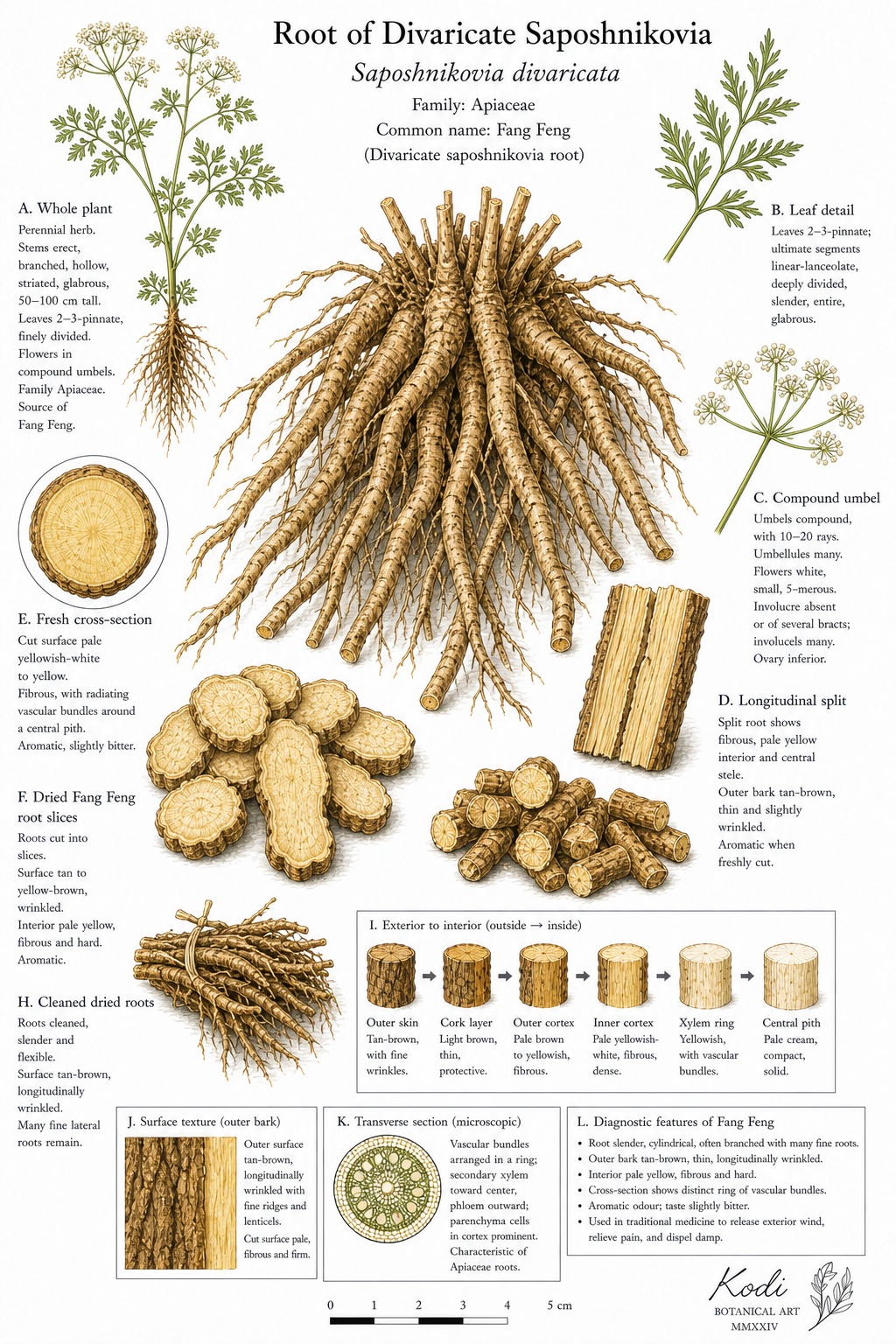
Known in TCM as Fang Feng (防风), this acrid and sweet, slightly warm herb enters the Bladder, Liver, and Spleen. Traditionally, it releases the exterior and expels wind ... Fang Feng is a standard herb for wind-cold and wind-damp presentations with headache, body aches, aversion to wind, and early-stage exterior disorder, most often applied for common cold, headache, and urticaria. Modern research has identified Prim-O-glucosylcimifugin among its active constituents.
Part used: Root
Also Known As
Latin: Radix Saposhnikoviae | Pinyin: Fang Feng | Chinese: 防风
TCM Properties
- Taste
- acrid, sweet
- Temperature
- slightly warm
- Channels
- Bladder, Liver, Spleen
Traditional Use
Primary Actions
- Releases the exterior and expels wind ... Fang Feng is a standard herb for wind-cold and wind-damp presentations with headache, body aches, aversion to wind, and early-stage exterior disorder.
- Dispels wind-damp and alleviates pain ... it is widely used for wandering or obstructive pain affecting the head, neck, limbs, and joints, especially when wind is part of the pattern.
- Stops spasms and relieves itching ... traditional use extends to tetany, tremor, urticaria, and itchy eruptions where wind movement is the dominant clinical idea.
Secondary Actions
- Fang Feng is more flexible than a simple cold-release herb because it also appears in damp-pain, skin-itching, and spasm contexts.
- This page should stay on authentic Saposhnikovia divaricata root material and not drift toward other Apiaceae roots with broadly similar dried appearances.
Classic Formulas
- Jing Fang Bai Du San ... exterior-releasing and damp-dispelling formula in which Fang Feng is a key wind herb.
- Yu Ping Feng San ... famous formula that uses Fang Feng to help stabilize the exterior and reduce recurrent susceptibility.
- Xiao Feng San ... classic wind-itching and rash formula that highlights Fang Feng for diffuse pruritic skin presentations.
Classical References
- Materia medica tradition treats Fang Feng as one of the central herbs for wind, especially when pain, itching, or spasmodic movement accompanies the exterior pattern.
- Its sweet-acrid, slightly warm profile explains why it can release and disperse without being as harshly drying as some stronger wind-damp herbs.
Modern Research
Active Compounds
- Prim-O-glucosylcimifugin ... one of the best-known chromone markers in Fang Feng
- Cimifugin ... major chromone associated with anti-inflammatory research
- 5-O-methylvisammioside ... another commonly cited Saposhnikovia chromone constituent
- Coumarins and polysaccharides ... supportive constituent groups discussed in broader pharmacology reviews
Studied Effects
- A 2020 review summarized the ethnopharmacology, phytochemistry, and pharmacology of Saposhnikovia divaricata, reinforcing why Fang Feng remains important beyond simple exterior-release use (PMID 32328867).
- A 2016 study reported anti-inflammatory and anti-osteoarthritis effects from Saposhnikovia divaricata ethanol extract in vitro and in vivo, supporting its continued relevance in pain and joint research (PMID 27042186).
- A 2013 study found that Fang Feng chromone extract suppressed experimental rheumatoid arthritis pathways, giving a modern mechanistic correlate for some traditional painful-obstruction use (PMID 23711830).
PubMed References
- Saposhnikovia divaricata-An Ethnopharmacological, Phytochemical and Pharmacological Review. (2020)
- Anti-Inflammatory and Antiosteoarthritis Effects of Saposhnikovia divaricata ethanol Extract: In Vitro and In Vivo Studies. (2016)
- The suppressive effects of Saposhnikovia divaricata (Fangfeng) chromone extract on rheumatoid arthritis via inhibition of nuclear factor-κB and mitogen activated proteinkinases activation on collagen-induced arthritis model. (2013)
Safety & Interactions
Contraindications
- Marked yin deficiency heat or fluid depletion without external wind
- Headache or dizziness from rising Liver yang rather than wind invasion
Cautions
- Fang Feng is best matched to real wind patterns ... chronic itching or pain without a wind component may call for a different herbal direction.
- Its warming and dispersing quality can be a poor fit for patients who are already dry, depleted, or heat-agitated.
- Modern research remains mostly preclinical despite a strong pharmacologic literature.
Conditions
- Common Cold Traditional ★★★★☆ JSON
- Headache Traditional ★★★☆☆ JSON
- Urticaria Traditional ★★★☆☆ JSON
- Rheumatism Traditional ★★☆☆☆ JSON
Frequently Asked Questions
What is Divaricate Saposhnikovia Root used for?
Divaricate Saposhnikovia Root is traditionally used to Releases the exterior and expels wind ... Fang Feng is a standard herb for wind-cold and wind-damp presentations with headache, body aches, aversion to wind, and early-stage exterior disorder., Dispels wind-damp and alleviates pain ... it is widely used for wandering or obstructive pain affecting the head, neck, limbs, and joints, especially when wind is part of the pattern., Stops spasms and relieves itching ... traditional use extends to tetany, tremor, urticaria, and itchy eruptions where wind movement is the dominant clinical idea.. Research has investigated its effects on: A 2020 review summarized the ethnopharmacology, phytochemistry, and pharmacology of Saposhnikovia divaricata, reinforcing why Fang Feng remains important beyond simple exterior-release use (PMID 32328867).; A 2016 study reported anti-inflammatory and anti-osteoarthritis effects from Saposhnikovia divaricata ethanol extract in vitro and in vivo, supporting its continued relevance in pain and joint research (PMID 27042186)..
What are other names for Divaricate Saposhnikovia Root?
Divaricate Saposhnikovia Root is also known as Saposhnikovia Root, Ledebouriella Root, Saposhnikovia divaricata. In TCM: 防风 (Fang Feng); Radix Saposhnikoviae.
Is Divaricate Saposhnikovia Root safe during pregnancy?
The safety of Divaricate Saposhnikovia Root during pregnancy has not been established. Consult a qualified healthcare provider before use.
What are the contraindications for Divaricate Saposhnikovia Root?
Divaricate Saposhnikovia Root should not be used in: Marked yin deficiency heat or fluid depletion without external wind; Headache or dizziness from rising Liver yang rather than wind invasion. Consult a qualified healthcare provider before use.