Ting Hu Suo Corydalis Root
- Chinese
- 延胡索
- Pinyin
- Ting Hu Suo
- Latin
- Rhizoma Corydalis
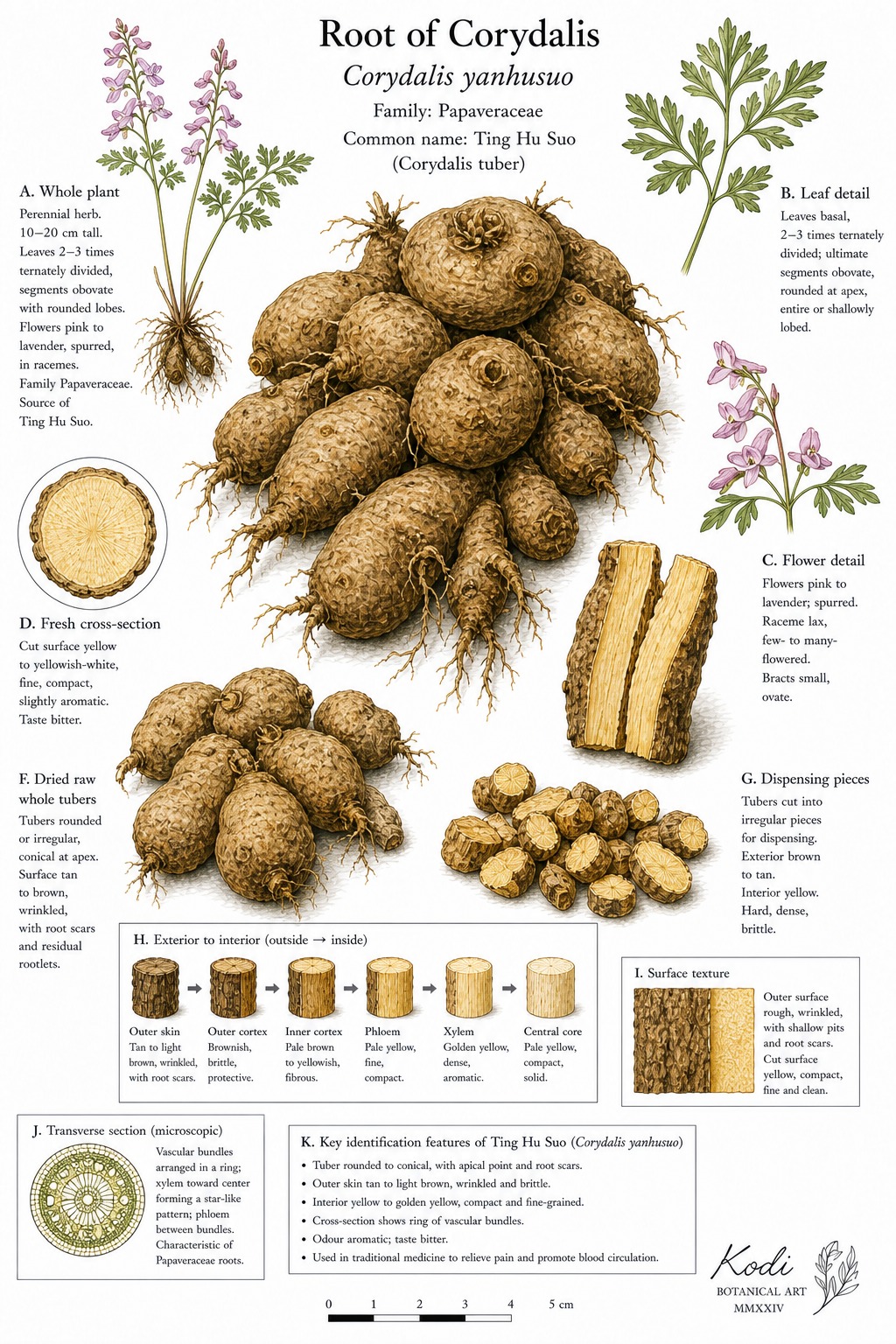
Known in TCM as Ting Hu Suo (延胡索), this acrid and bitter, warm herb enters the Heart, Liver, and Spleen. Traditionally, it invigorates Blood, moves qi, and relieves pain ... Ting Hu Suo stays within the classic Yan Hu Suo pain-herb lane, especially when fixed pain and distention show both qi stagnation and blood stasis, most often applied for abdominal pain, dysmenorrhea, and chest pain. Modern research has identified Tetrahydropalmatine among its active constituents.
Part used: Rhizome
Also Known As
Latin: Rhizoma Corydalis | Pinyin: Ting Hu Suo | Chinese: 延胡索
TCM Properties
- Taste
- acrid, bitter
- Temperature
- warm
- Channels
- Heart, Liver, Spleen
Traditional Use
Primary Actions
- Invigorates Blood, moves qi, and relieves pain ... Ting Hu Suo stays within the classic Yan Hu Suo pain-herb lane, especially when fixed pain and distention show both qi stagnation and blood stasis.
- Relieves chest, flank, epigastric, and abdominal pain ... it is widely used for digestive, menstrual, and constrained Liver-type pain patterns rather than for vague deficiency aches.
- Addresses traumatic and gynecologic pain ... trade-name variation does not change the core materia medica identity, so the herb still belongs in dysmenorrhea, postpartum stasis, and injury-related pain formulas.
Secondary Actions
- This page preserves the Ting Hu Suo naming lane as a raw trade-lot sibling of the canonical `corydalis-tuber` record rather than pretending it is a different species or a different medicinal function.
- The associated illustration notes emphasize a larger clustered raw tuber lot, which is useful for merchandising accuracy but does not justify separate pharmacology.
Classic Formulas
- Jin Ling Zi San ... classic pairing with Chuan Lian Zi for hypochondriac, epigastric, and lower-abdominal pain from constrained Liver qi with heat or stasis.
- Yan Hu Suo Zhi Tong Wan ... pain-formula tradition built directly around corydalis for generalized stagnation pain.
- Shao Fu Zhu Yu Tang and related gynecologic stasis formulas ... contexts where corydalis helps move and relieve lower-abdominal pain.
Classical References
- Traditional materia medica consistently treats Yan Hu Suo and its close naming variants as premier analgesic herbs that move both qi and blood.
- Editorially, the key point is that Ting Hu Suo belongs to the same Corydalis yanhusuo root-tuber stream as Yan Hu Suo, Xuan Hu, and Yuan Hu trade labels.
Modern Research
Active Compounds
- Tetrahydropalmatine ... the best-known alkaloid associated with analgesic and sedative effects
- Dehydrocorybulbine ... a pain-related alkaloid studied in neuropathic and inflammatory models
- Protopine and related isoquinoline alkaloids ... supportive constituents within the broader corydalis alkaloid profile
- Quaternary and tertiary alkaloid fractions ... the main pharmacologically active chemical families in raw corydalis tuber material
Studied Effects
- A 2021 review summarized the analgesic chemistry of Corydalis yanhusuo and highlighted its rich alkaloid profile as the basis for the herb's long-standing reputation as a pain medicine (PMID 34946576).
- Experimental work showed that Corydalis yanhusuo extract has significant antinociceptive activity across inflammatory and neuropathic pain models, supporting its broad traditional use for painful stagnation (PMID 27622550).
- A 2022 review of processing, compatibility, pharmacology, pharmacokinetics, and safety underscored that vinegar-processing changes efficacy and toxicity considerations and remains central to modern understanding of raw and prepared corydalis lanes alike (PMID 35003289).
PubMed References
Safety & Interactions
Contraindications
- Pregnancy
- Heavy menstrual bleeding without stasis
- Severe qi or blood deficiency pain without obstruction
Cautions
- Ting Hu Suo is still a moving pain herb and can be too dispersing when there is active bleeding or clear deficiency without stasis.
- Its alkaloids may cause dizziness, sedation, or gastrointestinal upset in sensitive patients or excessive doses.
- Trade-lot naming does not change the need for caution around prolonged unsupervised use.
Conditions
- Abdominal Pain Traditional ★★★★☆ JSON
- Dysmenorrhea Traditional ★★★★☆ JSON
- Chest Pain Traditional ★★★☆☆ JSON
- Traumatic Injury Traditional ★★☆☆☆ JSON
Frequently Asked Questions
What is Ting Hu Suo Corydalis Root used for?
Ting Hu Suo Corydalis Root is traditionally used to Invigorates Blood, moves qi, and relieves pain ... Ting Hu Suo stays within the classic Yan Hu Suo pain-herb lane, especially when fixed pain and distention show both qi stagnation and blood stasis., Relieves chest, flank, epigastric, and abdominal pain ... it is widely used for digestive, menstrual, and constrained Liver-type pain patterns rather than for vague deficiency aches., Addresses traumatic and gynecologic pain ... trade-name variation does not change the core materia medica identity, so the herb still belongs in dysmenorrhea, postpartum stasis, and injury-related pain formulas.. Research has investigated its effects on: A 2021 review summarized the analgesic chemistry of Corydalis yanhusuo and highlighted its rich alkaloid profile as the basis for the herb's long-standing reputation as a pain medicine (PMID 34946576).; Experimental work showed that Corydalis yanhusuo extract has significant antinociceptive activity across inflammatory and neuropathic pain models, supporting its broad traditional use for painful stagnation (PMID 27622550)..
What are other names for Ting Hu Suo Corydalis Root?
Ting Hu Suo Corydalis Root is also known as Corydalis, Yan Hu Suo, Corydalis yanhusuo. In TCM: 延胡索 (Ting Hu Suo); Rhizoma Corydalis.
Is Ting Hu Suo Corydalis Root safe during pregnancy?
Ting Hu Suo Corydalis Root is not recommended during pregnancy.
What are the contraindications for Ting Hu Suo Corydalis Root?
Ting Hu Suo Corydalis Root should not be used in: Pregnancy; Heavy menstrual bleeding without stasis; Severe qi or blood deficiency pain without obstruction. Consult a qualified healthcare provider before use.