Duyiwei Root
- Chinese
- 独一味
- Pinyin
- Du Yi Wei
- Latin
- Radix Lamiophlomidis Rotatae
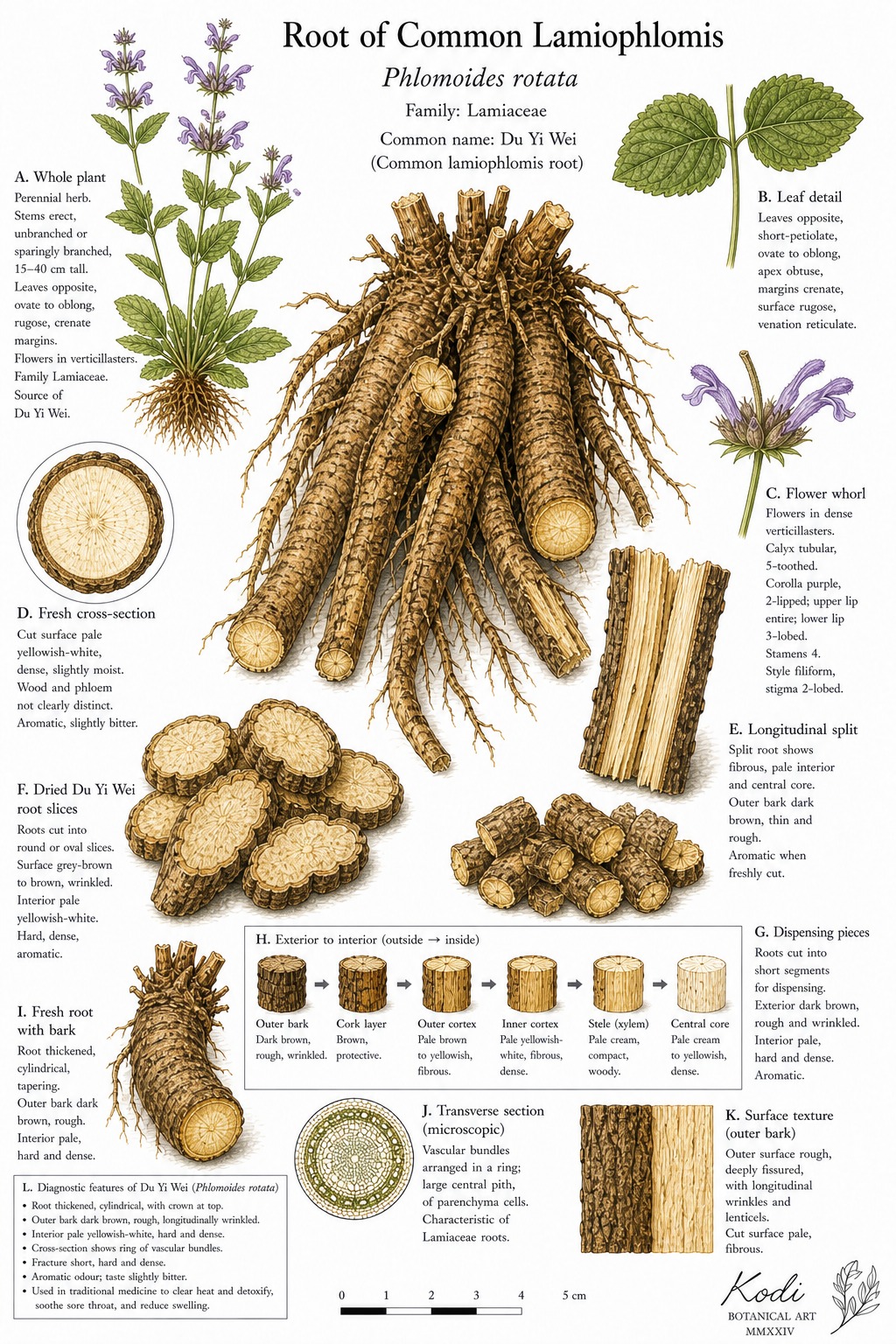
Known in TCM as Du Yi Wei (独一味), this bitter, neutral herb enters the Liver. Traditionally, it stops bleeding and reduces swelling ... Du Yi Wei is a Tibetan and regional Chinese medicine used for traumatic bleeding, wound-related swelling, and painful soft-tissue injury, most often applied for traumatic injury, joint pain, and rheumatism. Modern research has identified Iridoid among its active constituents.
Part used: Root
Also Known As
Latin: Radix Lamiophlomidis Rotatae | Pinyin: Du Yi Wei | Chinese: 独一味
TCM Properties
- Taste
- bitter
- Temperature
- neutral
- Channels
- Liver
Traditional Use
Primary Actions
- Stops bleeding and reduces swelling ... Du Yi Wei is a Tibetan and regional Chinese medicine used for traumatic bleeding, wound-related swelling, and painful soft-tissue injury.
- Relieves pain in fractures, sprains, and musculoskeletal injury ... it is especially valued when pain and local tissue damage coexist rather than when the pattern is purely internal deficiency.
- Moves blood through traumatic and obstructive pain patterns ... traditional use includes bruising, rheumatic pain, and some gynecologic or dental pain settings where swelling and stasis are prominent.
Secondary Actions
- The classic identity of Du Yi Wei is analgesic and hemostatic at the same time, which is why it often appears in trauma and postoperative products rather than only in one-sided pain or bleeding formulas.
- This page follows the root lane imported in the dataset, but much of the modern literature discusses Lamiophlomis rotata more broadly as a whole medicinal material rather than isolating every plant part.
Classic Formulas
- Trauma and fracture support formulas ... used when bruising, pain, and bleeding or oozing coexist.
- Postoperative and wound-recovery patent-medicine logic ... one of the best-known modern clinical lanes for Du Yi Wei preparations.
- Rheumatic and painful-obstruction combinations in Tibetan-medicine style use when swelling and pain remain prominent.
Classical References
- Traditional Tibetan and regional use consistently emphasizes pain relief, hemostasis, swelling reduction, and support after injury.
- It should be understood first as a trauma and pain herb, not as a general tonic or simple anti-inflammatory supplement.
Modern Research
Active Compounds
- Iridoid glycosides such as shanzhiside methylester and related marker constituents
- Phenylethanoid glycosides and flavonoids ... supportive classes in Duyiwei pharmacology
- Broader Lamiophlomis glycoside fractions studied for analgesic, hemostatic, and anti-inflammatory effects
Studied Effects
- A 2020 review summarized the traditional uses, phytochemistry, pharmacology, and toxicology of Lamiophlomis rotata and highlighted its anti-nociceptive, haemostatic, anti-inflammatory, and immunomodulatory profile (PMID 35495311).
- A 2014 study described Lamiophlomis rotata as an orally available Tibetan herbal painkiller and found reduction of pain hypersensitivity through spinal glucagon-like peptide-1 receptor activity, offering a particularly direct modern correlate for Du Yi Wei's analgesic reputation (PMID 25247855).
- A 2018 toxicology study on iridoid-glycoside extract from Lamiophlomis rotata supports caution with concentrated preparations even though the herb is widely used in clinical pain products (PMID 29287802).
PubMed References
- Traditional uses, phytochemistry, pharmacology and toxicology of Lamiophlomis rotata (Benth.) Kudo: a review. (2020)
- Lamiophlomis rotata, an orally available Tibetan herbal painkiller, specifically reduces pain hypersensitivity states through the activation of spinal glucagon-like peptide-1 receptors. (2014)
- Acute and sub-chronic toxicological studies of the iridoid glycosides extract of Lamiophlomis rotata (Benth.) Kudo in rats. (2018)
Safety & Interactions
Contraindications
- Unclear bleeding disorders that need urgent medical evaluation rather than self-treatment
- Patterns where strong movement of blood and tissue repair logic is not appropriate
Cautions
- Concentrated Duyiwei capsules and extracts are not equivalent to simple traditional topical or decoction use.
- The modern pain-product reputation of this herb should not be mistaken for proof that it is universally benign at high doses or in every bleeding situation.
Conditions
- Traumatic Injury Traditional ★★★★☆ JSON
- Joint Pain Traditional ★★★☆☆ JSON
- Rheumatism Traditional ★★☆☆☆ JSON
- Toothache Traditional ★☆☆☆☆ JSON
Frequently Asked Questions
What is Duyiwei Root used for?
Duyiwei Root is traditionally used to Stops bleeding and reduces swelling ... Du Yi Wei is a Tibetan and regional Chinese medicine used for traumatic bleeding, wound-related swelling, and painful soft-tissue injury., Relieves pain in fractures, sprains, and musculoskeletal injury ... it is especially valued when pain and local tissue damage coexist rather than when the pattern is purely internal deficiency., Moves blood through traumatic and obstructive pain patterns ... traditional use includes bruising, rheumatic pain, and some gynecologic or dental pain settings where swelling and stasis are prominent.. Research has investigated its effects on: A 2020 review summarized the traditional uses, phytochemistry, pharmacology, and toxicology of Lamiophlomis rotata and highlighted its anti-nociceptive, haemostatic, anti-inflammatory, and immunomodulatory profile (PMID 35495311).; A 2014 study described Lamiophlomis rotata as an orally available Tibetan herbal painkiller and found reduction of pain hypersensitivity through spinal glucagon-like peptide-1 receptor activity, offering a particularly direct modern correlate for Du Yi Wei's analgesic reputation (PMID 25247855)..
What are other names for Duyiwei Root?
Duyiwei Root is also known as Lamiophlomis rotata Root, Phlomoides rotata Root, Tibetan Duyiwei. In TCM: 独一味 (Du Yi Wei); Radix Lamiophlomidis Rotatae.
Is Duyiwei Root safe during pregnancy?
The safety of Duyiwei Root during pregnancy has not been established. Consult a qualified healthcare provider before use.
What are the contraindications for Duyiwei Root?
Duyiwei Root should not be used in: Unclear bleeding disorders that need urgent medical evaluation rather than self-treatment; Patterns where strong movement of blood and tissue repair logic is not appropriate. Consult a qualified healthcare provider before use.