Thunder God Vine Root
- Chinese
- 雷公藤
- Pinyin
- Lei Gong Teng
- Latin
- Radix Tripterygii Wilfordii
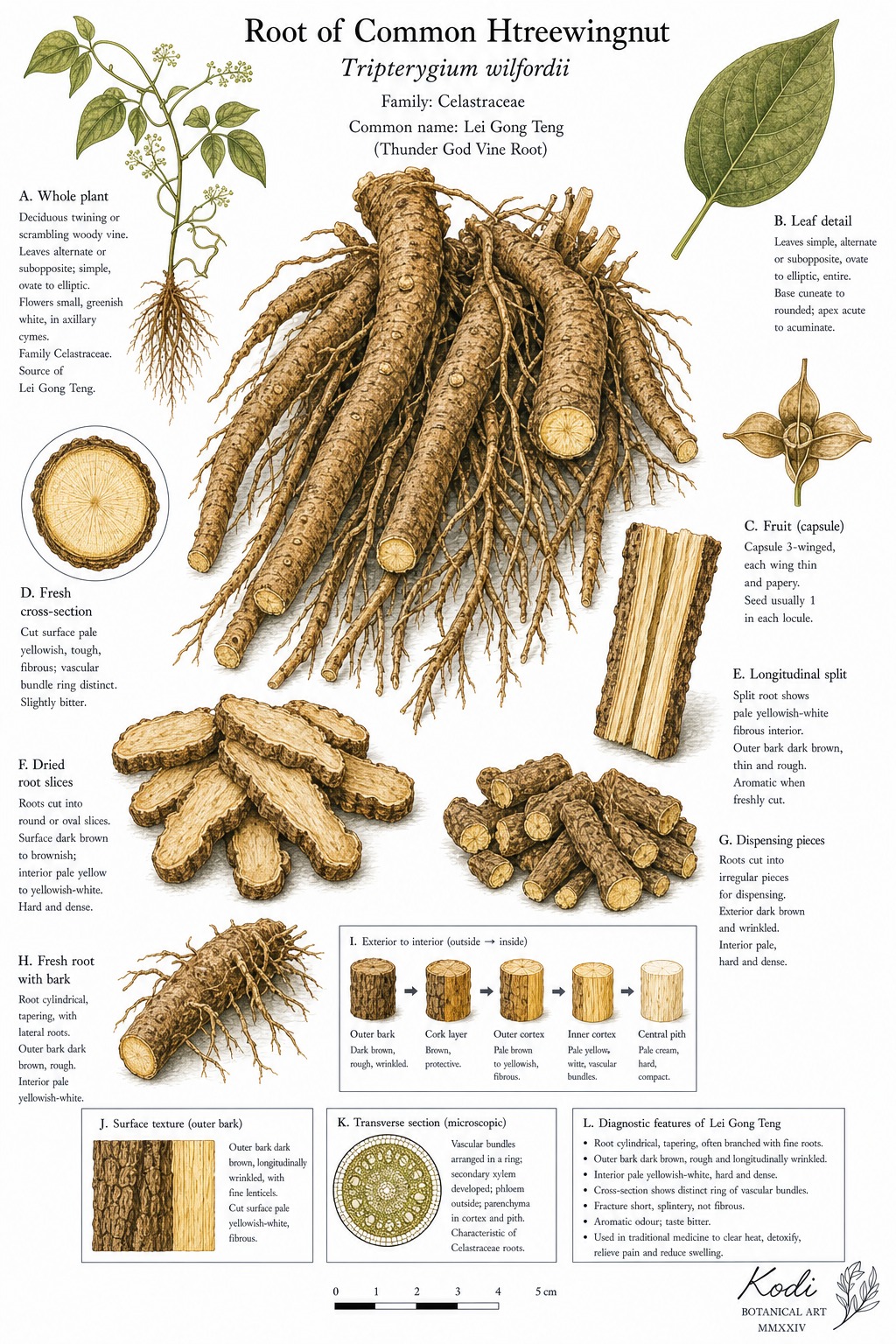
Known in TCM as Lei Gong Teng (雷公藤), this bitter and acrid, cold herb enters the Liver and Kidney. Traditionally, it dispels wind-damp and relieves severe painful obstruction ... Lei Gong Teng is used in modern Chinese practice for swollen, inflamed, and deeply fixed joint pain when ordinary damp-heat or bi herbs are not enough, most often applied for rheumatoid arthritis, joint pain, and rheumatism. Modern research has identified Triptolide among its active constituents.
Part used: Root
Also Known As
Latin: Radix Tripterygii Wilfordii | Pinyin: Lei Gong Teng | Chinese: 雷公藤
TCM Properties
- Taste
- bitter, acrid
- Temperature
- cold
- Channels
- Liver, Kidney
Traditional Use
Primary Actions
- Dispels wind-damp and relieves severe painful obstruction ... Lei Gong Teng is used in modern Chinese practice for swollen, inflamed, and deeply fixed joint pain when ordinary damp-heat or bi herbs are not enough.
- Reduces swelling and resolves toxic inflammation ... traditional and contemporary use extends to inflammatory skin disease, nodular swelling, and stubborn autoimmune-type patterns.
- Strongly suppresses excess inflammatory reactivity ... this herb belongs to the narrow class of powerful toxic medicinals whose therapeutic attraction and danger are inseparable.
Secondary Actions
- Modern use is heavily tied to standardized Tripterygium preparations and rheumatology rather than to casual home decoction of crude root material.
- This should not be framed as a gentle damp-heat or arthritis herb ... fertility toxicity, organ toxicity, and immunosuppressive effects are central to the identity of Lei Gong Teng.
Classic Formulas
- Modern Tripterygium-glycoside tablet practice ... especially in rheumatoid and autoimmune settings where supervised use is pursued despite major toxicity concerns.
- Severe damp-heat bi combinations with Fang Ji, Yi Yi Ren, or Qin Jiao logic ... used when hot swollen joints dominate.
- Inflammatory skin and swelling patterns in contemporary hospital-style Chinese herbal practice rather than in simple classical folk use.
Classical References
- Lei Gong Teng sits at the boundary between traditional materia medica and modern specialist use because it is effective enough to remain important while toxic enough to demand unusually strict caution.
- Its best-known modern niche is inflammatory and autoimmune disease, especially rheumatoid arthritis.
Modern Research
Active Compounds
- Triptolide ... the best-known highly active and toxic diterpenoid epoxide in Tripterygium wilfordii
- Celastrol ... a major quinone methide triterpenoid linked to anti-inflammatory and immunomodulatory research
- Tripterygium glycosides and related multi-component extract fractions used in clinical and toxicology studies
Studied Effects
- A 2021 review described Tripterygium wilfordii as an inspiring resource for rheumatoid-arthritis treatment while emphasizing that toxicity remains the main barrier to broader safe clinical use (PMID 33296090).
- A 2019 quantitative evidence synthesis focused on adverse events associated with Tripterygium wilfordii Hook F and reinforced that multi-organ toxicity is not incidental but a defining clinical concern (PMID 31780926).
- A 2019 study on reproductive systemic toxicity of Tripterygium wilfordii glucosides highlighted fertility and reproductive safety as major reasons this herb cannot be treated casually (PMID 30814076).
PubMed References
- Tripterygium wilfordii: An inspiring resource for rheumatoid arthritis treatment. (2021)
- Adverse Events Associated With Treatment of Tripterygium wilfordii Hook F: A Quantitative Evidence Synthesis. (2019)
- Reproductive Systemic Toxicity and Mechanism of Glucosides of Tripterygium wilfordii Hook. F. (GTW). (2019)
Safety & Interactions
Contraindications
- Pregnancy
- Trying to conceive or concerns about fertility
- Active liver disease, significant kidney disease, or frail constitution
- Use outside specialist supervision
Cautions
- Lei Gong Teng is associated with gastrointestinal, hepatic, renal, hematologic, reproductive, and immunologic toxicity.
- The fertility and reproductive risks are major, not theoretical side notes.
- This herb should be sourced only in authenticated supervised preparations and not treated as a home arthritis remedy.
Conditions
- Rheumatoid Arthritis Research ★★★★☆ JSON
- Joint Pain Traditional ★★★☆☆ JSON
- Rheumatism Traditional ★★★☆☆ JSON
- Eczema Traditional ★★☆☆☆ JSON
Frequently Asked Questions
What is Thunder God Vine Root used for?
Thunder God Vine Root is traditionally used to Dispels wind-damp and relieves severe painful obstruction ... Lei Gong Teng is used in modern Chinese practice for swollen, inflamed, and deeply fixed joint pain when ordinary damp-heat or bi herbs are not enough., Reduces swelling and resolves toxic inflammation ... traditional and contemporary use extends to inflammatory skin disease, nodular swelling, and stubborn autoimmune-type patterns., Strongly suppresses excess inflammatory reactivity ... this herb belongs to the narrow class of powerful toxic medicinals whose therapeutic attraction and danger are inseparable.. Research has investigated its effects on: A 2021 review described Tripterygium wilfordii as an inspiring resource for rheumatoid-arthritis treatment while emphasizing that toxicity remains the main barrier to broader safe clinical use (PMID 33296090).; A 2019 quantitative evidence synthesis focused on adverse events associated with Tripterygium wilfordii Hook F and reinforced that multi-organ toxicity is not incidental but a defining clinical concern (PMID 31780926)..
What are other names for Thunder God Vine Root?
Thunder God Vine Root is also known as Tripterygium wilfordii Root, TwHF, Thunder God Vine. In TCM: 雷公藤 (Lei Gong Teng); Radix Tripterygii Wilfordii.
Is Thunder God Vine Root safe during pregnancy?
Thunder God Vine Root is not recommended during pregnancy.
What are the contraindications for Thunder God Vine Root?
Thunder God Vine Root should not be used in: Pregnancy; Trying to conceive or concerns about fertility; Active liver disease, significant kidney disease, or frail constitution; Use outside specialist supervision. Consult a qualified healthcare provider before use.