Chinese Thorowax Root
- Chinese
- 柴胡
- Pinyin
- Chai Hu
- Latin
- Radix Bupleuri
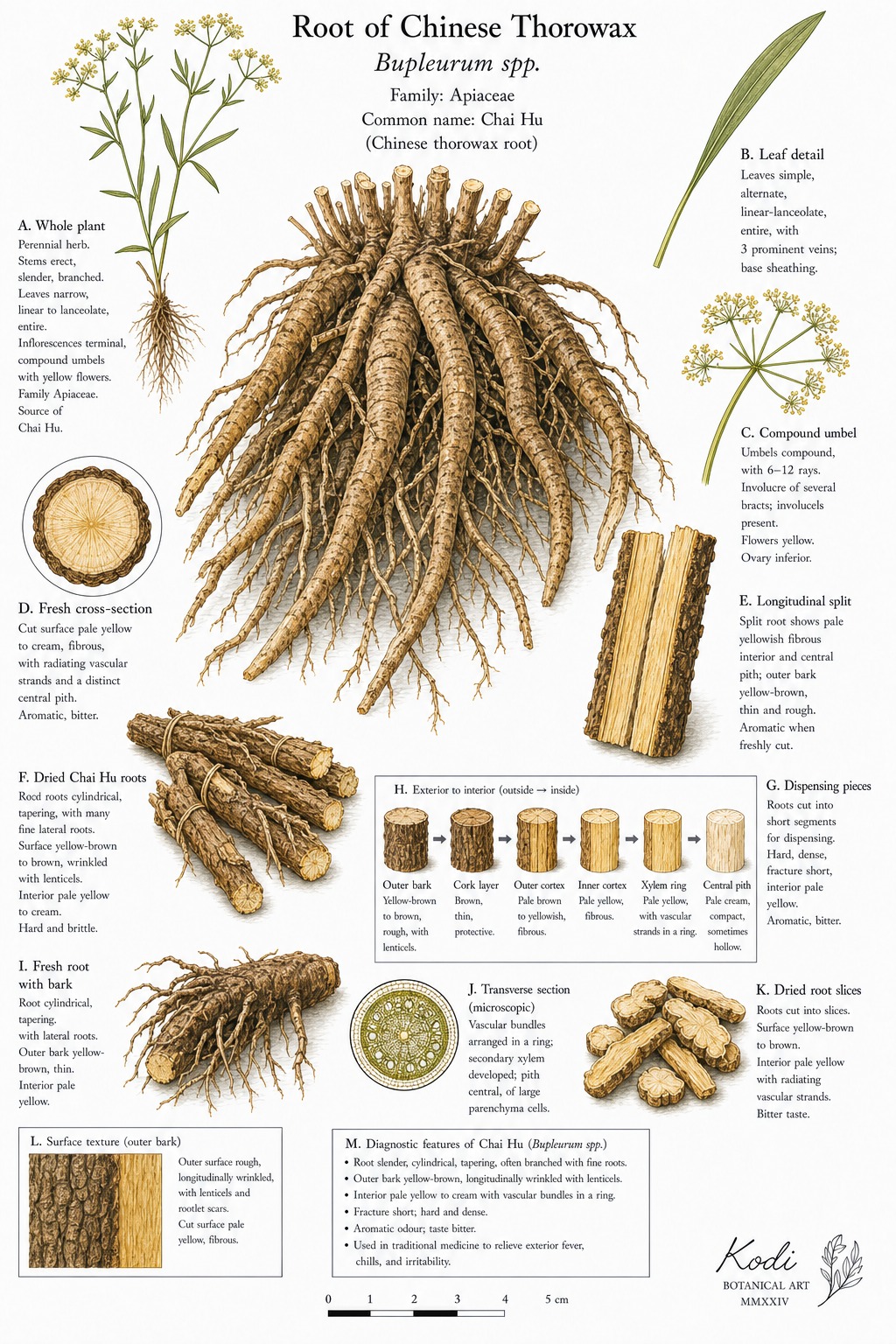
Known in TCM as Chai Hu (柴胡), this bitter and acrid, slightly cold herb enters the Gallbladder, Liver, and Pericardium. Traditionally, it harmonizes Shaoyang disorders ... Chai Hu is one of the classic herbs for alternating fever and chills, bitter taste, rib-side fullness, and the half-exterior half-interior pattern that is neither fully released nor fully internalized, most often applied for fever, common cold, and liver qi stagnation. Modern research has identified Saikosaponins, among its active constituents.
Part used: Root
Also Known As
Latin: Radix Bupleuri | Pinyin: Chai Hu | Chinese: 柴胡
TCM Properties
- Taste
- bitter, acrid
- Temperature
- slightly cold
- Channels
- Gallbladder, Liver, Pericardium
Traditional Use
Primary Actions
- Harmonizes Shaoyang disorders ... Chai Hu is one of the classic herbs for alternating fever and chills, bitter taste, rib-side fullness, and the half-exterior half-interior pattern that is neither fully released nor fully internalized.
- Spreads Liver qi and relieves constraint ... it is used for flank distention, emotional frustration, poor appetite from constrained qi, and some menstrual or digestive patterns where stagnation rather than deficiency dominates.
- Raises clear yang and lifts sinking qi ... in appropriate formulas it helps treat prolapse, chronic diarrhea, and fatigue patterns where the middle burner fails to lift.
Secondary Actions
- This page should stay on the canonical Chai Hu lane and not be confused with Yin Chai Hu or other Bupleurum-related folk materials that serve different clinical roles.
- Bupleurum is highly formula-dependent ... Chai Hu is often pivotal in harmonizing or coursing prescriptions, but much less appropriate when there is no real Shaoyang pattern or qi constraint.
Classic Formulas
- Xiao Chai Hu Tang ... the signature Shaoyang-harmonizing formula built around Chai Hu.
- Si Ni San ... classic course-the-Liver and regulate-qi formula when internal constraint affects the limbs, chest, or digestion.
- Bu Zhong Yi Qi Tang and Chai Hu Shu Gan San ... examples of its lifting and qi-course functions in very different formula settings.
Classical References
- Materia medica tradition treats Chai Hu as the key herb for harmonizing Shaoyang and spreading constrained Liver qi rather than as a simple general antipyretic.
- Its dual ability to course and to lift explains why it appears in both exterior-interior harmonizing formulas and middle-qi lifting formulas.
Modern Research
Active Compounds
- Saikosaponins, especially saikosaponins a, c, and d ... the best-known Bupleurum triterpene saponins
- Polysaccharides ... increasingly studied for immunomodulatory and hepatoprotective relevance
- Volatile oils, lignans, and polyacetylenes ... supportive constituent groups discussed in broader Bupleurum pharmacology
Studied Effects
- A 2017 review summarized the traditional uses, botany, phytochemistry, pharmacology, and toxicology of Radix Bupleuri, reinforcing why Chai Hu remains one of the defining harmonizing herbs in Chinese medicine rather than a single-purpose fever herb (PMID 28593176).
- A 2017 systematic review focused on active saikosaponins and Bupleurum extracts, highlighting anti-inflammatory, immunomodulatory, hepatoprotective, and other major research directions tied to Chai Hu chemistry (PMID 27951737).
- A 2018 review examined the pharmacology and toxicology of saikosaponins in more depth, supporting a modern view of Chai Hu as a potent saponin-rich herb whose benefits and risks both deserve respect (PMID 30466994).
PubMed References
- Radix Bupleuri: A Review of Traditional Uses, Botany, Phytochemistry, Pharmacology, and Toxicology. (2017)
- A systematic review of the active saikosaponins and extracts isolated from Radix Bupleuri and their applications. (2017)
- A comprehensive review and perspectives on pharmacology and toxicology of saikosaponins. (2018)
Safety & Interactions
Contraindications
- Ascending Liver yang, yin deficiency with heat, or headache from hyperactivity rather than Shaoyang or constrained qi
- Patterns with no real exterior-interior disharmony, sinking qi, or Liver constraint
Cautions
- Chai Hu is often used inside formulas rather than as a stand-alone herb, and broad claims about it can become inaccurate when the underlying pattern is not actually Shaoyang or constrained Liver qi.
- Saikosaponin-rich extracts are pharmacologically active enough that concentrated modern products should not be treated like ordinary decoction doses.
Conditions
- Fever Traditional ★★★☆☆ JSON
- Common Cold Traditional ★★☆☆☆ JSON
- Liver Qi Stagnation Traditional ★★★☆☆ JSON
- Headache Traditional ★★☆☆☆ JSON
Frequently Asked Questions
What is Chinese Thorowax Root used for?
Chinese Thorowax Root is traditionally used to Harmonizes Shaoyang disorders ... Chai Hu is one of the classic herbs for alternating fever and chills, bitter taste, rib-side fullness, and the half-exterior half-interior pattern that is neither fully released nor fully internalized., Spreads Liver qi and relieves constraint ... it is used for flank distention, emotional frustration, poor appetite from constrained qi, and some menstrual or digestive patterns where stagnation rather than deficiency dominates., Raises clear yang and lifts sinking qi ... in appropriate formulas it helps treat prolapse, chronic diarrhea, and fatigue patterns where the middle burner fails to lift.. Research has investigated its effects on: A 2017 review summarized the traditional uses, botany, phytochemistry, pharmacology, and toxicology of Radix Bupleuri, reinforcing why Chai Hu remains one of the defining harmonizing herbs in Chinese medicine rather than a single-purpose fever herb (PMID 28593176).; A 2017 systematic review focused on active saikosaponins and Bupleurum extracts, highlighting anti-inflammatory, immunomodulatory, hepatoprotective, and other major research directions tied to Chai Hu chemistry (PMID 27951737)..
What are other names for Chinese Thorowax Root?
Chinese Thorowax Root is also known as Bupleurum Root, Bupleuri Radix, Bupleurum spp.. In TCM: 柴胡 (Chai Hu); Radix Bupleuri.
Is Chinese Thorowax Root safe during pregnancy?
The safety of Chinese Thorowax Root during pregnancy has not been established. Consult a qualified healthcare provider before use.
What are the contraindications for Chinese Thorowax Root?
Chinese Thorowax Root should not be used in: Ascending Liver yang, yin deficiency with heat, or headache from hyperactivity rather than Shaoyang or constrained qi; Patterns with no real exterior-interior disharmony, sinking qi, or Liver constraint. Consult a qualified healthcare provider before use.