Cherokee Rose Root
- Chinese
- 金樱根
- Pinyin
- Jin Ying Gen
- Latin
- Radix Rosae Laevigatae
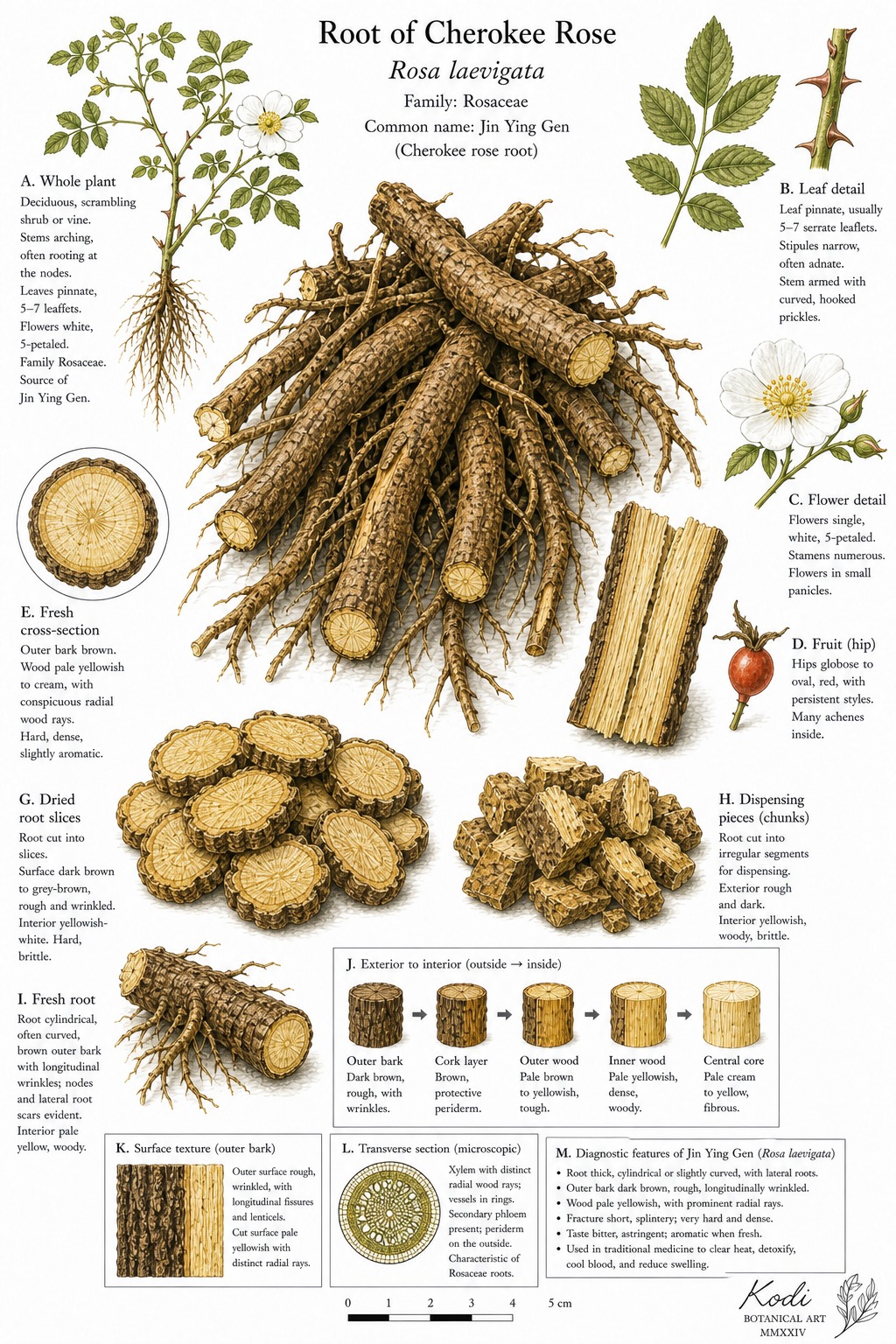
Known in TCM as Jin Ying Gen (金樱根), this sour and astringent, neutral herb enters the Kidney and Large Intestine. Traditionally, it stabilizes the intestines and stops chronic diarrhea ... Jin Ying Gen is used when leakage and weakness affect the bowel rather than when heat or toxin is driving the stool, most often applied for diarrhea, frequent urination, and kidney deficiency. Modern research has identified Triterpenoid among its active constituents.
Part used: Root
Also Known As
Latin: Radix Rosae Laevigatae | Pinyin: Jin Ying Gen | Chinese: 金樱根
TCM Properties
- Taste
- sour, astringent
- Temperature
- neutral
- Channels
- Kidney, Large Intestine
Traditional Use
Primary Actions
- Stabilizes the intestines and stops chronic diarrhea ... Jin Ying Gen is used when leakage and weakness affect the bowel rather than when heat or toxin is driving the stool.
- Restrains lower-burner leakage ... traditional use includes frequent urination and patterns of weakness where containment is more important than draining or purging.
- Supports chronic lower-body weakness and soreness ... the root is used when leakage disorders coexist with fatigue, low-back weakness, or longstanding depletion.
Secondary Actions
- This page should stay distinct from Jin Ying Zi fruit ... same plant family, but the medicinal root lane emphasizes chronic leakage and lower-body support rather than the fruit's better-known astringent-fruit identity alone.
- Jin Ying Gen works best when there is a need to secure and contain ... it is not a first-line herb for acute damp-heat, infectious diarrhea, or fresh exterior disease.
Classic Formulas
- Chronic diarrhea and intestinal-leakage formulas ... used where sour astringency is needed to secure the bowel.
- Lower-burner leakage combinations with supportive Kidney herbs ... selected when frequent urination and weakness coexist.
- Low-back and deficiency-support strategies ... the root is added when containment needs deeper lower-body support.
Classical References
- Traditional descriptions emphasize its sour astringent nature and Kidney-Large-Intestine direction, matching its role in chronic leakage disorders.
- Its best use is for chronicity and deficiency ... not for acute excess heat patterns that still need venting.
Modern Research
Active Compounds
- Triterpenoid saponins ... a major research focus in Rosa laevigata root
- Triterpene glucosides isolated specifically from the roots
- Other root fractions under investigation for anti-inflammatory and neuroprotective potential
Studied Effects
- A 2025 study optimized extraction of two triterpenoid saponins from Rosa laevigata root and reported protective effects in an acute lung-injury model, supporting ongoing pharmacology interest in the root rather than only the fruit (PMID 40006066).
- A 2008 study identified new triterpene glucosides from Rosa laevigata roots, helping define the root's species-specific chemistry (PMID 18830152).
- A 2026 study reported neuroprotective in-vitro findings for triterpenoids from Rosa laevigata root in an Alzheimer's-disease research context, showing that the root remains an active modern research target (PMID 41237058).
PubMed References
- Study on the Optimization of an Extraction Process of Two Triterpenoid Saponins in the Root of Rosa laevigata Michx. and Their Protective Effect on Acute Lung Injury. (2025)
- New triterpene glucosides from the roots of Rosa laevigata Michx. (2008)
- Neuroprotective Effects of Triterpenoids From Rosa laevigata Root: Identification, Molecular Docking, and In Vitro Evaluation for Alzheimer's Disease Treatment. (2026)
Safety & Interactions
Contraindications
- Acute damp-heat or infectious diarrhea not yet cleared
- Constipation or trapped pathogen situations where astringing would be premature
Cautions
- Astringent herbs can trap pathogens or damp-heat if used too early in an acute disorder.
- Do not assume the root and fruit are interchangeable just because they come from the same plant.
Conditions
- Diarrhea Traditional ★★★☆☆ JSON
- Frequent Urination Traditional ★★★☆☆ JSON
- Kidney Deficiency Traditional ★★☆☆☆ JSON
- Low Back Pain Traditional ★★☆☆☆ JSON
Frequently Asked Questions
What is Cherokee Rose Root used for?
Cherokee Rose Root is traditionally used to Stabilizes the intestines and stops chronic diarrhea ... Jin Ying Gen is used when leakage and weakness affect the bowel rather than when heat or toxin is driving the stool., Restrains lower-burner leakage ... traditional use includes frequent urination and patterns of weakness where containment is more important than draining or purging., Supports chronic lower-body weakness and soreness ... the root is used when leakage disorders coexist with fatigue, low-back weakness, or longstanding depletion.. Research has investigated its effects on: A 2025 study optimized extraction of two triterpenoid saponins from Rosa laevigata root and reported protective effects in an acute lung-injury model, supporting ongoing pharmacology interest in the root rather than only the fruit (PMID 40006066).; A 2008 study identified new triterpene glucosides from Rosa laevigata roots, helping define the root's species-specific chemistry (PMID 18830152)..
What are other names for Cherokee Rose Root?
Cherokee Rose Root is also known as Rosa laevigata Root, Root of Jin Ying, Rosa Root. In TCM: 金樱根 (Jin Ying Gen); Radix Rosae Laevigatae.
Is Cherokee Rose Root safe during pregnancy?
The safety of Cherokee Rose Root during pregnancy has not been established. Consult a qualified healthcare provider before use.
What are the contraindications for Cherokee Rose Root?
Cherokee Rose Root should not be used in: Acute damp-heat or infectious diarrhea not yet cleared; Constipation or trapped pathogen situations where astringing would be premature. Consult a qualified healthcare provider before use.