Antifebrile Dichroa Root
- Chinese
- 常山
- Pinyin
- Chang Shan
- Latin
- Radix Dichroae
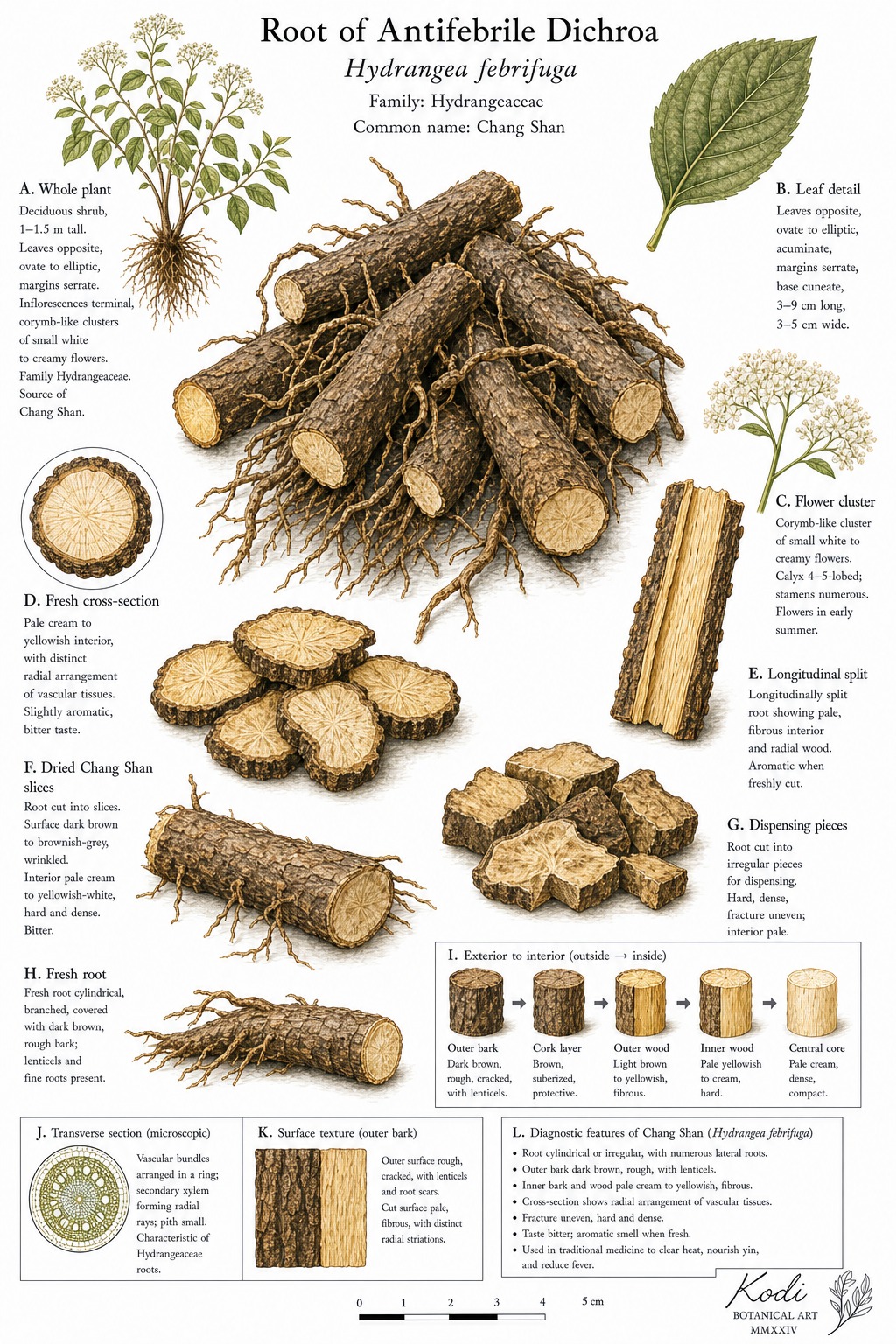
Known in TCM as Chang Shan (常山), this bitter and acrid, cold herb enters the Liver and Lung. Traditionally, it induces vomiting to expel phlegm and stop malaria ... Chang Shan is one of the classic strong herbs for intermittent fever patterns with phlegm retention or lurking pathogen logic, most often applied for malaria, fever, and phlegm accumulation. Modern research has identified Febrifugine among its active constituents.
Part used: Root
Also Known As
Latin: Radix Dichroae | Pinyin: Chang Shan | Chinese: 常山
TCM Properties
- Taste
- bitter, acrid
- Temperature
- cold
- Channels
- Liver, Lung
Traditional Use
Primary Actions
- Induces vomiting to expel phlegm and stop malaria ... Chang Shan is one of the classic strong herbs for intermittent fever patterns with phlegm retention or lurking pathogen logic.
- Cuts recurrent cyclical fever patterns ... the herb is historically valued not as a general antipyretic but as a targeted medicine for severe intermittent disorders.
- Transforms stubborn phlegm-fluid congestion ... traditional use includes cases where nausea and upward discharge are accepted consequences of a strong therapeutic intention.
Secondary Actions
- This is a toxicology-first herb ... its traditional value is real, but so is its reputation for severe nausea and vomiting.
- Chang Shan should not be reframed as a casual modern fever remedy ... the classical lane is narrow, forceful, and highly pattern-dependent.
Classic Formulas
- Chang Shan Yin and related intermittent-fever formulas ... used when cyclical malarial patterns are the core target.
- Phlegm-retention fever combinations with Cao Guo, Hou Po, or Ban Xia logic ... selected when obstruction and lurking pathogen patterns coexist.
- Historically strong single-herb or small-formula use where emesis is intentionally accepted as part of treatment.
Classical References
- Materia medica tradition consistently describes Chang Shan as bitter, cold, and emetic, with an especially narrow role in intermittent fever and phlegm-related disorders.
- Its use is strong enough that many classical discussions focus as much on tolerance and caution as on efficacy.
Modern Research
Active Compounds
- Febrifugine ... the best-known antimalarial alkaloid from Dichroa febrifuga
- Halofuginone and related febrifugine analog scaffolds ... major modern drug-development interest
- Other quinazolinone alkaloids associated with efficacy and toxicity
Studied Effects
- A 2024 review summarized the botany, traditional use, phytochemistry, pharmacology, toxicology, and toxicity-reduction efforts around Dichroa febrifuga, confirming that Chang Shan remains clinically interesting but safety constrained (PMID 38537842).
- A 2020 toxicological evaluation of Dichroae radix ultrasonic extract in mice and rats reinforced the herb's narrow safety margin and the importance of dose caution (PMID 33097762).
- A 2022 review on halofuginone highlighted the continuing antiprotozoal value of Chang Shan-derived chemistry even as medicinal chemistry tries to separate efficacy from toxicity (PMID 35636724).
PubMed References
- Dichroa febrifuga Lour.: A review of its botany, traditional use, phytochemistry, pharmacological activities, toxicology, and progress in reducing toxicity. (2024)
- Toxicological evaluation of the ultrasonic extract from Dichroae radix in mice and wistar rats. (2020)
- Prospects of halofuginone as an antiprotozoal drug scaffold. (2022)
Safety & Interactions
Contraindications
- Pregnancy
- Weak constitution, fragile digestion, or active dehydration
- Patients without a clear intermittent-fever or phlegm-retention indication
Cautions
- Severe nausea and vomiting are part of this herb's classic reputation and not a minor side note.
- The therapeutic and toxic doses are close enough that unsupervised self-use is inappropriate.
- Modern interest in febrifugine and halofuginone exists precisely because the crude herb is effective but difficult to tolerate safely.
Conditions
- Malaria Traditional ★★★★☆ JSON
- Fever Traditional ★★★☆☆ JSON
- Phlegm Accumulation Traditional ★★☆☆☆ JSON
- Productive Cough Traditional ★☆☆☆☆ JSON
Frequently Asked Questions
What is Antifebrile Dichroa Root used for?
Antifebrile Dichroa Root is traditionally used to Induces vomiting to expel phlegm and stop malaria ... Chang Shan is one of the classic strong herbs for intermittent fever patterns with phlegm retention or lurking pathogen logic., Cuts recurrent cyclical fever patterns ... the herb is historically valued not as a general antipyretic but as a targeted medicine for severe intermittent disorders., Transforms stubborn phlegm-fluid congestion ... traditional use includes cases where nausea and upward discharge are accepted consequences of a strong therapeutic intention.. Research has investigated its effects on: A 2024 review summarized the botany, traditional use, phytochemistry, pharmacology, toxicology, and toxicity-reduction efforts around Dichroa febrifuga, confirming that Chang Shan remains clinically interesting but safety constrained (PMID 38537842).; A 2020 toxicological evaluation of Dichroae radix ultrasonic extract in mice and rats reinforced the herb's narrow safety margin and the importance of dose caution (PMID 33097762)..
What are other names for Antifebrile Dichroa Root?
Antifebrile Dichroa Root is also known as Hydrangea febrifuga Root, Dichroa Root, Changshan Root. In TCM: 常山 (Chang Shan); Radix Dichroae.
Is Antifebrile Dichroa Root safe during pregnancy?
Antifebrile Dichroa Root is not recommended during pregnancy.
What are the contraindications for Antifebrile Dichroa Root?
Antifebrile Dichroa Root should not be used in: Pregnancy; Weak constitution, fragile digestion, or active dehydration; Patients without a clear intermittent-fever or phlegm-retention indication. Consult a qualified healthcare provider before use.