Amur Barberry Root
- Chinese
- 小檗
- Pinyin
- Xiao Bo
- Latin
- Radix Berberidis
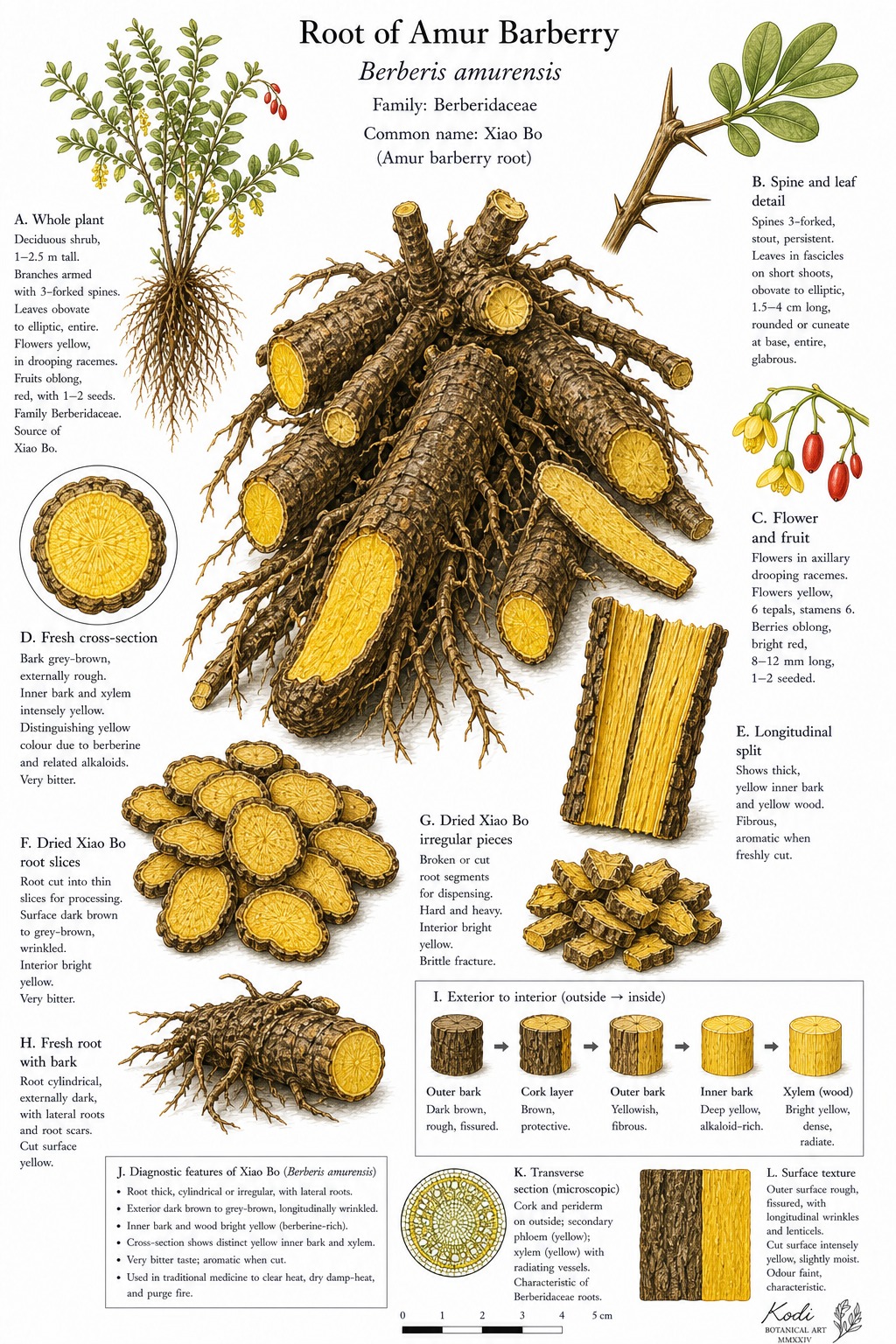
Known in TCM as Xiao Bo (小檗), this bitter, cold herb enters the Large Intestine, Liver, and Stomach. Traditionally, it clears heat and dries damp ... Xiao Bo is used in regional bitter-cold herb traditions for bowel heat, damp-heat diarrhea, and hot toxic accumulations, most often applied for dysentery, jaundice, and eczema. Modern research has identified Berberine among its active constituents.
Part used: Root
Also Known As
Latin: Radix Berberidis | Pinyin: Xiao Bo | Chinese: 小檗
TCM Properties
- Taste
- bitter
- Temperature
- cold
- Channels
- Large Intestine, Liver, Stomach
Traditional Use
Primary Actions
- Clears heat and dries damp ... Xiao Bo is used in regional bitter-cold herb traditions for bowel heat, damp-heat diarrhea, and hot toxic accumulations.
- Resolves toxicity and reduces inflammatory lesions ... the yellow alkaloid-rich root is directed toward sores, skin eruptions, and heat-driven irritative patterns.
- Supports treatment of damp-heat in the lower burner and digestive tract ... traditional use extends to dysentery, jaundice, and urinary irritation where cold bitter draining is appropriate.
Secondary Actions
- This page should stay on the barberry-root lane rather than being collapsed into Huang Lian or Huang Bai ... the functional neighborhood overlaps, but the source material and regional usage are distinct.
- Direct indexed modern literature on Xiao Bo as a named TCM drug is sparse, so the modern section leans on barberry-family alkaloid and related constituent research rather than claiming species-specific clinical proof.
Classic Formulas
- Regional damp-heat bowel formulas ... paired with other bitter-cold herbs when dysentery, burning stool, or foul diarrhea dominate.
- Heat-toxin and skin-lesion wash logic ... used where bitter draining and local detoxification are needed.
- Jaundice and lower-burner damp-heat combinations ... selected when yellow coating, heat, and irritative dampness are clear.
Classical References
- Traditional use keeps Xiao Bo in the bitter-cold, yellow-alkaloid root family associated with damp-heat and toxicity rather than tonification.
- Its strongest logic is bowel, skin, and lower-burner heat patterns that need downward draining and detoxifying support.
Modern Research
Active Compounds
- Berberine ... the best-known barberry-family isoquinoline alkaloid
- Berbamine and related bisbenzylisoquinoline alkaloids ... relevant to anti-inflammatory and signaling studies
- Other protoberberine alkaloids and yellow bitter constituents characteristic of Berberis-type roots
Studied Effects
- A 2025 study found berberine disrupted a high-affinity iron-transport system to reverse fluconazole resistance in Candida albicans, illustrating the continuing antimicrobial interest around barberry-family alkaloids (PMID 39929396).
- A 2017 study reported anti-inflammatory effects of berbamine through NF-kB and MAPK signaling inhibition, giving a modern mechanistic lens for the traditional heat-clearing lane associated with yellow alkaloid roots (PMID 28456802).
- A 2007 phototoxicity study on alkaloids from goldenseal is included here as a cautionary alkaloid-family reference rather than as direct Xiao Bo evidence, reminding us that berberine-rich botanicals can carry safety complexity alongside therapeutic promise (PMID 17645667).
PubMed References
- Berberine disrupts the high-affinity iron transport system to reverse the fluconazole-resistance in Candida albicans. (2025)
- Berbamine Exerts Anti-Inflammatory Effects via Inhibition of NF-kB and MAPK Signaling Pathways. (2017)
- Photochemistry and photocytotoxicity of alkaloids from Goldenseal (Hydrastis canadensis L.) 3: effect on human lens and retinal pigment epithelial cells. (2007)
Safety & Interactions
Contraindications
- Cold deficiency diarrhea or weak digestion without damp-heat
- Patterns without clear heat or toxin
Cautions
- Species-specific human safety data are limited, so concentrated alkaloid-rich extracts deserve a more conservative approach than ordinary decoction logic.
- Related berberine-rich botanicals can cause gastrointestinal upset and may have phototoxicity concerns under some conditions.
Conditions
Frequently Asked Questions
What is Amur Barberry Root used for?
Amur Barberry Root is traditionally used to Clears heat and dries damp ... Xiao Bo is used in regional bitter-cold herb traditions for bowel heat, damp-heat diarrhea, and hot toxic accumulations., Resolves toxicity and reduces inflammatory lesions ... the yellow alkaloid-rich root is directed toward sores, skin eruptions, and heat-driven irritative patterns., Supports treatment of damp-heat in the lower burner and digestive tract ... traditional use extends to dysentery, jaundice, and urinary irritation where cold bitter draining is appropriate.. Research has investigated its effects on: A 2025 study found berberine disrupted a high-affinity iron-transport system to reverse fluconazole resistance in Candida albicans, illustrating the continuing antimicrobial interest around barberry-family alkaloids (PMID 39929396).; A 2017 study reported anti-inflammatory effects of berbamine through NF-kB and MAPK signaling inhibition, giving a modern mechanistic lens for the traditional heat-clearing lane associated with yellow alkaloid roots (PMID 28456802)..
What are other names for Amur Barberry Root?
Amur Barberry Root is also known as Berberis amurensis Root, Barberry Root, Berberidis Root. In TCM: 小檗 (Xiao Bo); Radix Berberidis.
Is Amur Barberry Root safe during pregnancy?
The safety of Amur Barberry Root during pregnancy has not been established. Consult a qualified healthcare provider before use.
What are the contraindications for Amur Barberry Root?
Amur Barberry Root should not be used in: Cold deficiency diarrhea or weak digestion without damp-heat; Patterns without clear heat or toxin. Consult a qualified healthcare provider before use.