Wu Jia Pi Root Bark
- Chinese
- 五加皮
- Pinyin
- Wu Jia Pi
- Latin
- Cortex Acanthopanacis Radicis
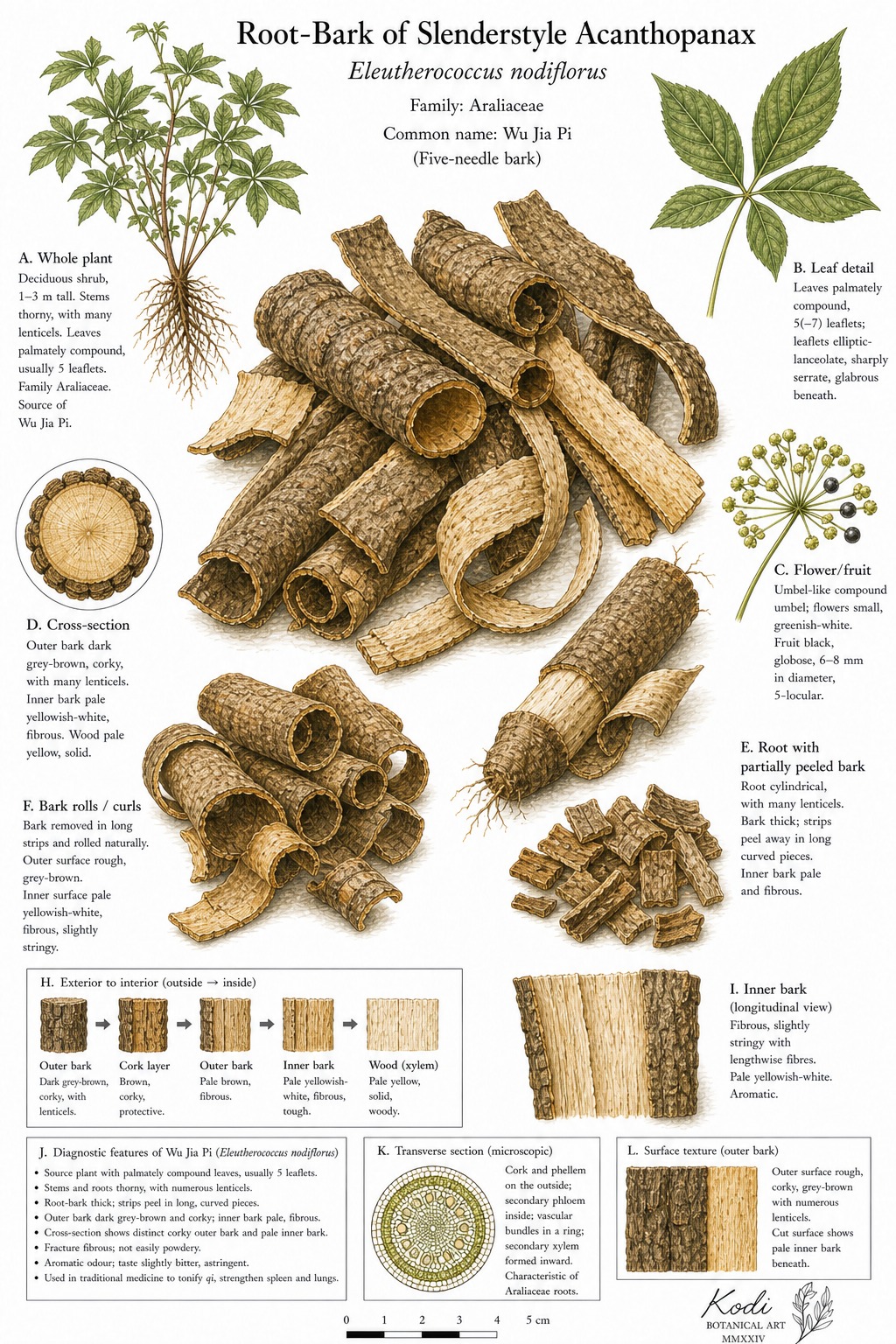
Known in TCM as Wu Jia Pi (五加皮), this bitter and acrid and sweet, warm herb enters the Liver and Kidney. Traditionally, it dispels wind-damp and relieves painful obstruction ... Wu Jia Pi is used for chronic aching joints, lower-limb weakness, and limited mobility when cold-damp obstruction has settled into the channels, most often applied for joint pain, rheumatism, and low back pain. Modern research has identified Kaurenoic among its active constituents.
Part used: Bark
Also Known As
Latin: Cortex Acanthopanacis Radicis | Pinyin: Wu Jia Pi | Chinese: 五加皮
TCM Properties
- Taste
- bitter, acrid, sweet
- Temperature
- warm
- Channels
- Liver, Kidney
Traditional Use
Primary Actions
- Dispels wind-damp and relieves painful obstruction ... Wu Jia Pi is used for chronic aching joints, lower-limb weakness, and limited mobility when cold-damp obstruction has settled into the channels.
- Tonifies the Liver and Kidneys and strengthens sinews and bones ... it is especially suited to patients who have chronic bi pain together with low back soreness, weak knees, slow recovery, or constitutional depletion.
- Promotes urination and reduces edema ... classical use extends beyond musculoskeletal pain into damp swelling of the lower body when warming movement and mild drainage are both needed.
Secondary Actions
- This record should be read as the accepted genuine Wu Jia Pi lane and as a close sibling of the already-live Bei Wu Jia Pi page ... they overlap heavily in traditional use and both belong on authenticated Acanthopanacis root bark logic.
- Authentication matters ... this herb must stay clearly separate from toxic Xiang Jia Pi or other Periploca materials that can be sold under overlapping trade names.
Classic Formulas
- Wu Jia Pi medicinal-wine traditions ... a classic strategy for chronic wind-damp pain, weak tendons, poor mobility, and recovery after strain or trauma.
- Wu Jia Pi San pattern logic ... paired with Du Zhong, Niu Xi, and related supports when obstruction and Liver-Kidney weakness coexist.
- Wu Pi San type edema logic ... included when damp swelling and lower-body stagnation need a warm draining herb rather than a cold water-purging approach.
Classical References
- Materia medica teaching consistently places Wu Jia Pi among the warm herbs that treat both obstruction and weakness ... a valuable combination in older or chronically depleted patients.
- Regional trade names vary, but the clinical requirement stays the same ... confirm true Acanthopanacis root bark and do not substitute toxic look-alikes.
Modern Research
Active Compounds
- Kaurenoic acid and related diterpenoids ... major active markers in authenticated Acanthopanacis root bark
- Ent-kaurane and pimarane diterpenoids ... anti-inflammatory constituent classes isolated from the bark
- Root-bark monoterpenoids ... newer constituents with enzyme-inhibition interest in inflammatory models
- Saponin fractions reported in older platelet and thrombosis work
Studied Effects
- A 2014 study isolated anti-inflammatory diterpenoids from Acanthopanax gracilistylus root bark and showed inhibition of inflammatory cytokine signaling, supporting the traditional wind-damp and pain-relief profile (PMID 25338180).
- A 2023 study identified multiple monoterpenoids from the root bark and reported inhibition of neutrophil elastase, 5-lipoxygenase, and cyclooxygenase-2 in vitro, giving a modern correlate for joint-pain use (PMID 37683990).
- An older in-vitro study found Acanthopanax gracilistylus saponins inhibited platelet aggregation and thrombosis-related markers, suggesting one pathway by which the bark may intersect with movement and obstruction patterns (PMID 9863147).
- A 2024 transcriptome study reinforced kaurenoic-acid-centered pharmacology in Acanthopanax gracilistylus root bark and clarified parts of its biosynthetic pathway (PMID 38633273).
PubMed References
- Anti-inflammatory diterpenoids from the root bark of Acanthopanax gracilistylus. (2014)
- Monoterpenoids from the root bark of Acanthopanax gracilistylus and their inhibitory effects on neutrophil elastase, 5-lipoxygenase, andcyclooxygenase-2 in vitro. (2023)
- Inhibitory effects of Acanthopanax gracilistylus saponins on human platelet aggregation and platelet factor 4 liberation in vitro. (1996)
- Full-length transcriptome profiling of Acanthopanax gracilistylus provides new insight into the kaurenoic acid biosynthesis pathway. (2024)
Safety & Interactions
Contraindications
- Pregnancy
- Yin deficiency with heat or marked dryness
- Cases without true wind-damp obstruction or lower-body weakness
- Unverified or mixed-source trade material
Cautions
- The major safety issue is botanical confusion ... Periploca-derived Xiang Jia Pi is not interchangeable and has a much more serious cardiotoxicity profile.
- Preclinical antiplatelet findings are interesting but not enough to justify casual pairing with bleeding-prone patients or perioperative use.
- Its warm drying nature can aggravate heat, dryness, or depletion if the pattern is misidentified.
Conditions
- Joint Pain Traditional ★★★★☆ JSON
- Rheumatism Traditional ★★★★☆ JSON
- Low Back Pain Traditional ★★★☆☆ JSON
- Edema Traditional ★★☆☆☆ JSON
- Kidney Yang Deficiency Traditional ★★☆☆☆ JSON
Frequently Asked Questions
What is Wu Jia Pi Root Bark used for?
Wu Jia Pi Root Bark is traditionally used to Dispels wind-damp and relieves painful obstruction ... Wu Jia Pi is used for chronic aching joints, lower-limb weakness, and limited mobility when cold-damp obstruction has settled into the channels., Tonifies the Liver and Kidneys and strengthens sinews and bones ... it is especially suited to patients who have chronic bi pain together with low back soreness, weak knees, slow recovery, or constitutional depletion., Promotes urination and reduces edema ... classical use extends beyond musculoskeletal pain into damp swelling of the lower body when warming movement and mild drainage are both needed.. Research has investigated its effects on: A 2014 study isolated anti-inflammatory diterpenoids from Acanthopanax gracilistylus root bark and showed inhibition of inflammatory cytokine signaling, supporting the traditional wind-damp and pain-relief profile (PMID 25338180).; A 2023 study identified multiple monoterpenoids from the root bark and reported inhibition of neutrophil elastase, 5-lipoxygenase, and cyclooxygenase-2 in vitro, giving a modern correlate for joint-pain use (PMID 37683990)..
What are other names for Wu Jia Pi Root Bark?
Wu Jia Pi Root Bark is also known as Acanthopanax Root Bark, Bei Wu Jia Pi, Eleutherococcus nodiflorus. In TCM: 五加皮 (Wu Jia Pi); Cortex Acanthopanacis Radicis.
Is Wu Jia Pi Root Bark safe during pregnancy?
Wu Jia Pi Root Bark is not recommended during pregnancy.
What are the contraindications for Wu Jia Pi Root Bark?
Wu Jia Pi Root Bark should not be used in: Pregnancy; Yin deficiency with heat or marked dryness; Cases without true wind-damp obstruction or lower-body weakness; Unverified or mixed-source trade material. Consult a qualified healthcare provider before use.