Wine-Processed Rhubarb Root
- Chinese
- 酒大黄
- Pinyin
- Jiu Da Huang
- Latin
- Radix et Rhizoma Rhei
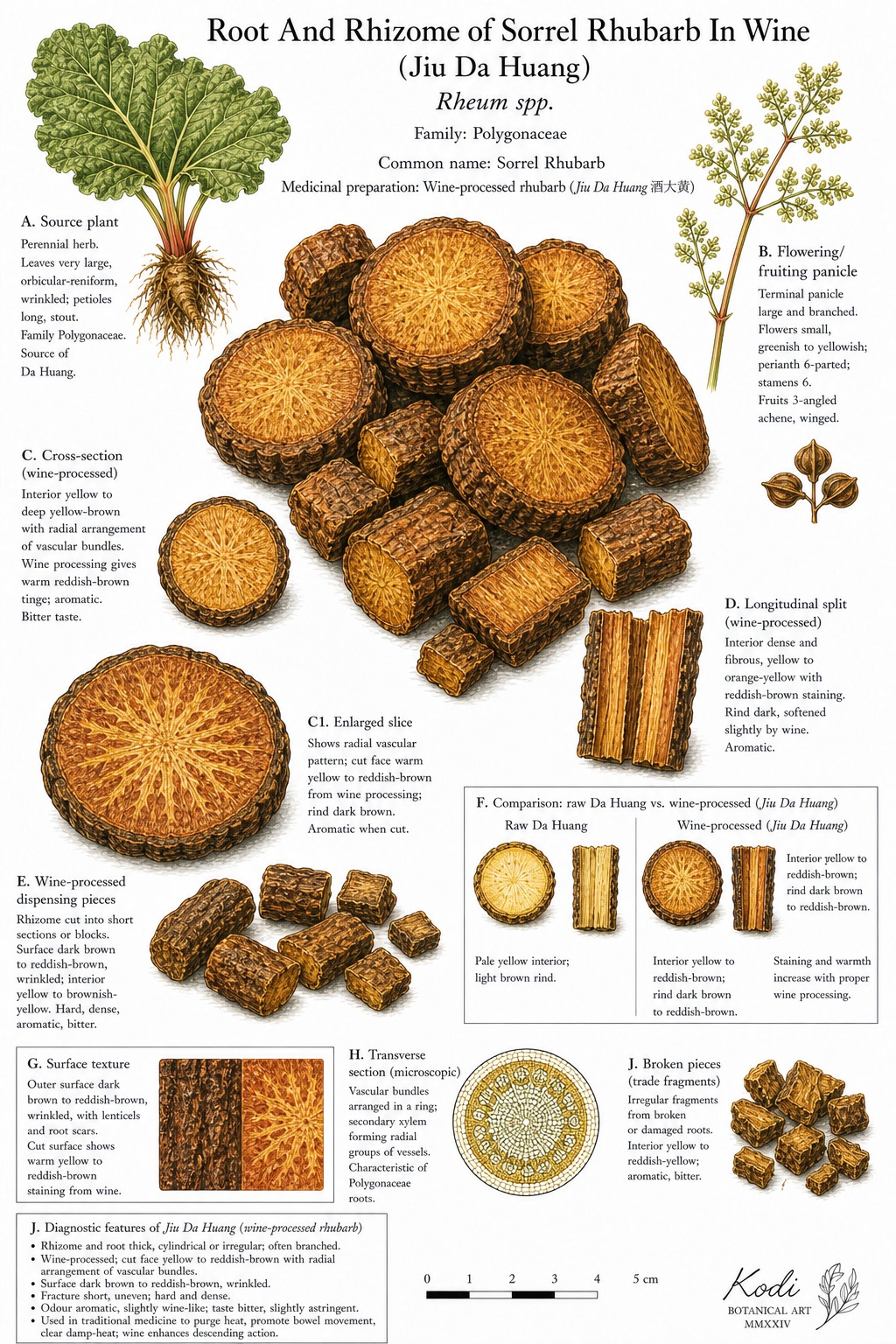
Known in TCM as Jiu Da Huang (酒大黄), this bitter, slightly cold herb enters the Heart, Large Intestine, Liver, and Stomach. Traditionally, it moderates the harsh purgative force of raw Da Huang while retaining bowel-opening ability ... Jiu Da Huang is chosen when a formula still needs descending action but not the full offensiveness of the raw herb, most often applied for constipation, blood stasis, and dysmenorrhea. Modern research has identified Anthraquinones among its active constituents.
Part used: Root
Also Known As
Latin: Radix et Rhizoma Rhei | Pinyin: Jiu Da Huang | Chinese: 酒大黄
TCM Properties
- Taste
- bitter
- Temperature
- slightly cold
- Channels
- Heart, Large Intestine, Liver, Stomach
Traditional Use
Primary Actions
- Moderates the harsh purgative force of raw Da Huang while retaining bowel-opening ability ... Jiu Da Huang is chosen when a formula still needs descending action but not the full offensiveness of the raw herb.
- Invigorates blood and disperses stasis ... wine processing makes this lane especially relevant when trauma, menstrual pain, or congealed heat and blood are central concerns.
- Uses wine to guide and enliven the rhubarb action ... the processing shifts the emphasis toward circulation, upward distribution, and blood-level patterns more than simple catharsis.
Secondary Actions
- This page should stay distinct from both raw Da Huang and the broader prepared Zhi Da Huang page ... Jiu Da Huang is the specific wine-processed rhubarb lane.
- Clinically, it is often chosen when the practitioner wants some rhubarb movement without letting the bowel-purging axis dominate the whole prescription.
Classic Formulas
- Trauma and blood-stasis formulas ... wine processing supports the use of rhubarb when moving congealed blood matters as much as bowel opening.
- Modified Cheng Qi and blood-stasis formulas ... used when a milder but still mobile rhubarb action is preferred.
- Upper-body heat and blood-level applications in which wine processing traditionally alters direction and liveliness.
Classical References
- Paozhi teaching consistently separates Jiu Da Huang from both raw and generally prepared rhubarb because wine processing changes emphasis and temperament.
- Its hallmark is balance ... still active, still descending, but more circulation-oriented and less brutally purgative than raw Da Huang.
Modern Research
Active Compounds
- Anthraquinones such as emodin, rhein, aloe-emodin, and chrysophanol
- Tannins and stilbene-related compounds shaped by processing changes
- Multi-component rhubarb fractions whose balance can be altered by wine processing
Studied Effects
- A 2024 review of rhubarb concoctions directly supports distinguishing wine-processed rhubarb from raw and other processed lanes because traditional processing meaningfully shifts clinical emphasis (PMID 39170703).
- A 2020 comprehensive review provides the broad pharmacology base for rhubarb while leaving room for clinically meaningful processing distinctions (PMID 32863857).
- A 2020 review on hepatoprotection and hepatotoxicity supports cautious use of all rhubarb forms, including wine-processed lanes that may be perceived as gentler than they actually are (PMID 32559851).
PubMed References
- The application of rhubarb concoctions in traditional Chinese medicine and its compounds, processing methods, pharmacology, toxicology and clinical research. (2024)
- What we already know about rhubarb: a comprehensive review. (2020)
- Hepatoprotection and hepatotoxicity of Chinese herb Rhubarb (Dahuang): How to properly control the "General (Jiang Jun)" in Chinese medical herb. (2020)
Safety & Interactions
Contraindications
- Pregnancy unless specifically prescribed
- Loose stool, dehydration, bowel obstruction from non-heat causes, or marked deficiency
- Long-term unsupervised use
Cautions
- Wine processing does not make rhubarb casual or universally safe ... it remains an active herb with bowel and blood-level effects.
- Because alcohol is part of the processing logic, patients sensitive to alcohol exposure or heat signs still need extra caution.
Drug Interactions
- Stimulant laxatives or bowel-cleansing agents ... additive purgative effect
- Diuretics or other potassium-lowering therapies ... possible additive electrolyte disturbance
- Anticoagulant or antiplatelet regimens ... bleeding patterns should be monitored when blood-moving use is involved
Conditions
- Constipation Traditional ★★★☆☆ JSON
- Blood Stasis Traditional ★★★☆☆ JSON
- Dysmenorrhea Traditional ★★☆☆☆ JSON
- Traumatic Injury Traditional ★★☆☆☆ JSON
Frequently Asked Questions
What is Wine-Processed Rhubarb Root used for?
Wine-Processed Rhubarb Root is traditionally used to Moderates the harsh purgative force of raw Da Huang while retaining bowel-opening ability ... Jiu Da Huang is chosen when a formula still needs descending action but not the full offensiveness of the raw herb., Invigorates blood and disperses stasis ... wine processing makes this lane especially relevant when trauma, menstrual pain, or congealed heat and blood are central concerns., Uses wine to guide and enliven the rhubarb action ... the processing shifts the emphasis toward circulation, upward distribution, and blood-level patterns more than simple catharsis.. Research has investigated its effects on: A 2024 review of rhubarb concoctions directly supports distinguishing wine-processed rhubarb from raw and other processed lanes because traditional processing meaningfully shifts clinical emphasis (PMID 39170703).; A 2020 comprehensive review provides the broad pharmacology base for rhubarb while leaving room for clinically meaningful processing distinctions (PMID 32863857)..
What are other names for Wine-Processed Rhubarb Root?
Wine-Processed Rhubarb Root is also known as Wine Da Huang, Wine-Fried Rhubarb, Alcohol-Processed Rhubarb. In TCM: 酒大黄 (Jiu Da Huang); Radix et Rhizoma Rhei.
Is Wine-Processed Rhubarb Root safe during pregnancy?
Wine-Processed Rhubarb Root is not recommended during pregnancy.
What are the contraindications for Wine-Processed Rhubarb Root?
Wine-Processed Rhubarb Root should not be used in: Pregnancy unless specifically prescribed; Loose stool, dehydration, bowel obstruction from non-heat causes, or marked deficiency; Long-term unsupervised use. Consult a qualified healthcare provider before use.
Does Wine-Processed Rhubarb Root interact with any medications?
Wine-Processed Rhubarb Root may interact with: Stimulant laxatives or bowel-cleansing agents ... additive purgative effect; Diuretics or other potassium-lowering therapies ... possible additive electrolyte disturbance; Anticoagulant or antiplatelet regimens ... bleeding patterns should be monitored when blood-moving use is involved. Always inform your healthcare provider of any herbal supplements you are taking.