Raw Rhubarb Root
- Chinese
- 大黄
- Pinyin
- Da Huang
- Latin
- Radix et Rhizoma Rhei
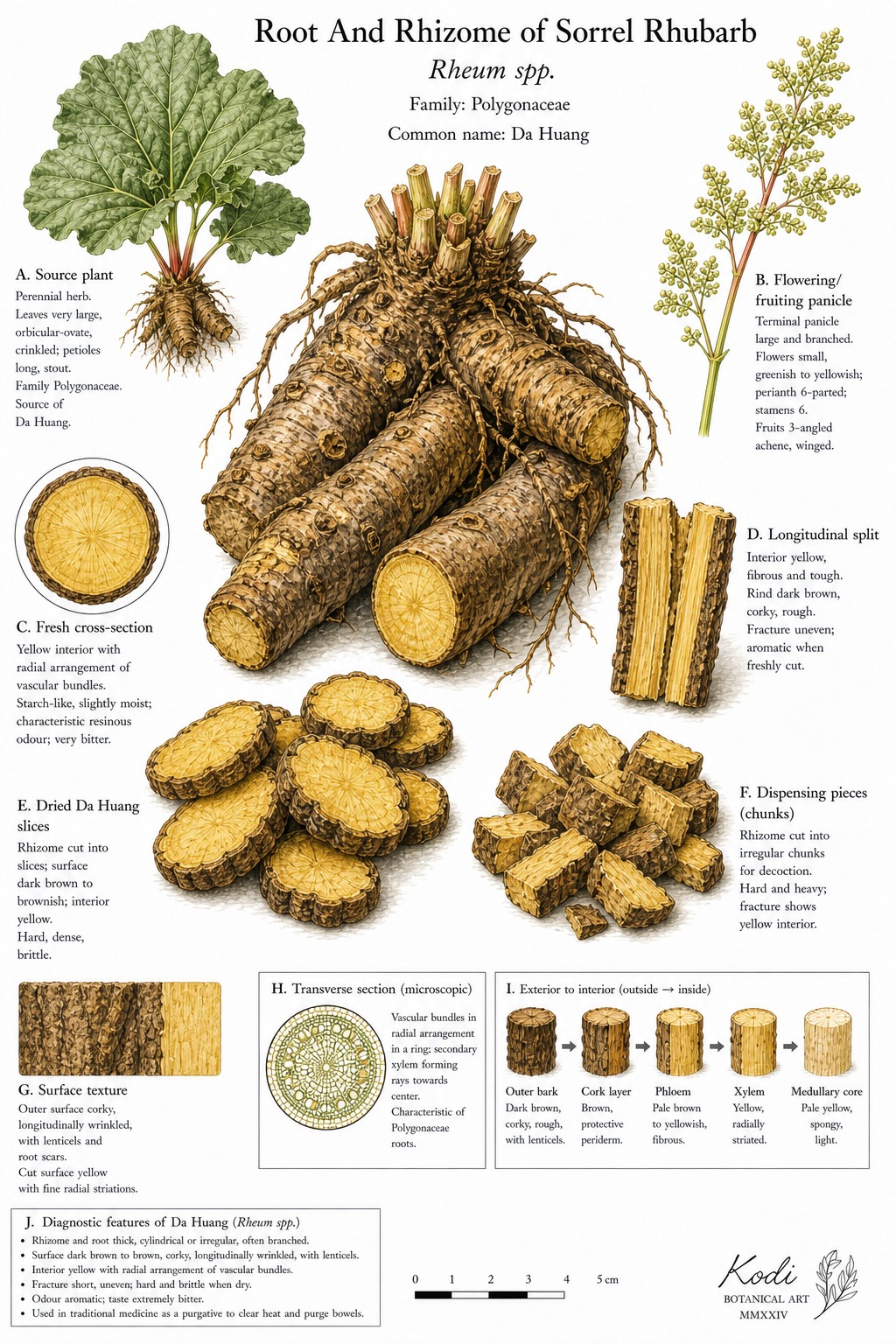
Known in TCM as Da Huang (大黄), this bitter, cold herb enters the Heart, Large Intestine, Liver, and Stomach. Traditionally, it drains heat and purges accumulation ... raw Da Huang is one of the classic offensive purgatives for constipation with heat, abdominal fullness, and fecal retention, most often applied for constipation, jaundice, and dysmenorrhea. Modern research has identified Anthraquinones among its active constituents.
Part used: Root
Also Known As
Latin: Radix et Rhizoma Rhei | Pinyin: Da Huang | Chinese: 大黄
TCM Properties
- Taste
- bitter
- Temperature
- cold
- Channels
- Heart, Large Intestine, Liver, Stomach
Traditional Use
Primary Actions
- Drains heat and purges accumulation ... raw Da Huang is one of the classic offensive purgatives for constipation with heat, abdominal fullness, and fecal retention.
- Clears damp-heat and fire toxicity ... beyond bowel unblocking, it is used for jaundice, damp-heat dysentery, and heat-toxin patterns where internal accumulation must be opened rather than merely cooled.
- Invigorates blood and dispels stasis ... traditional use extends to fixed abdominal pain, traumatic injury, and menstrual disorders when stasis and heat or obstruction are intertwined.
Secondary Actions
- This page should stay distinct from both the prepared Zhi Da Huang page and the wine-processed Jiu Da Huang page ... raw Da Huang is the strongest purgative lane in the family.
- The classic teaching is that this is not a gentle detox herb ... if the bowels are not actually blocked or heat-laden, raw rhubarb can be the wrong tool.
Classic Formulas
- Da Cheng Qi Tang ... the canonical severe heat-accumulation bowel-opening formula.
- Tao He Cheng Qi Tang ... combines Da Huang with blood-stasis logic when accumulation and congealing blood overlap.
- Xie Xin Tang and related heat-draining formulas ... use Da Huang to descend and vent internal heat.
Classical References
- Materia medica tradition treats raw Da Huang as the strongest and most direct purgative member of the rhubarb family.
- Its scope is wider than constipation alone ... heat, damp-heat, toxin, and blood stasis all appear in the classical rationale.
Modern Research
Active Compounds
- Anthraquinones such as emodin, rhein, aloe-emodin, and chrysophanol ... hallmark rhubarb constituents
- Tannins and stilbene-related compounds ... important secondary chemistry in raw rhubarb
- Polysaccharides and other broader multi-component fractions studied in whole-rhubarb pharmacology
Studied Effects
- A 2024 review summarized rhubarb compounds, processing methods, pharmacology, toxicology, and clinical research, directly supporting the need to keep raw and processed Da Huang pages separate (PMID 39170703).
- A 2020 comprehensive review gathered evidence on rhubarb's anti-inflammatory, antimicrobial, antifibrotic, and gastrointestinal actions while emphasizing its pharmacologic complexity (PMID 32863857).
- A 2020 review of hepatoprotection and hepatotoxicity highlighted both the herb's therapeutic interest and the importance of dose, duration, and preparation in safety assessment (PMID 32559851).
PubMed References
- The application of rhubarb concoctions in traditional Chinese medicine and its compounds, processing methods, pharmacology, toxicology and clinical research. (2024)
- What we already know about rhubarb: a comprehensive review. (2020)
- Hepatoprotection and hepatotoxicity of Chinese herb Rhubarb (Dahuang): How to properly control the "General (Jiang Jun)" in Chinese medical herb. (2020)
Safety & Interactions
Contraindications
- Pregnancy unless specifically prescribed
- Loose stool, dehydration, bowel obstruction from non-heat causes, or marked deficiency
- Long-term unsupervised use
Cautions
- Raw Da Huang is substantially harsher than processed rhubarb lanes and should not be treated as a casual cleanse.
- Overuse can cause diarrhea, cramping, and electrolyte disturbance.
- The literature supports real concern about prolonged or excessive rhubarb exposure, including liver-related safety questions.
Drug Interactions
- Stimulant laxatives or bowel-cleansing agents ... additive purgative effect
- Diuretics or other potassium-lowering therapies ... possible additive electrolyte disturbance
- Anticoagulant or antiplatelet regimens ... bleeding patterns should be monitored when blood-moving use is involved
Conditions
- Constipation Traditional ★★★★☆ JSON
- Jaundice Traditional ★★☆☆☆ JSON
- Dysmenorrhea Traditional ★★☆☆☆ JSON
- Traumatic Injury Traditional ★★☆☆☆ JSON
Frequently Asked Questions
What is Raw Rhubarb Root used for?
Raw Rhubarb Root is traditionally used to Drains heat and purges accumulation ... raw Da Huang is one of the classic offensive purgatives for constipation with heat, abdominal fullness, and fecal retention., Clears damp-heat and fire toxicity ... beyond bowel unblocking, it is used for jaundice, damp-heat dysentery, and heat-toxin patterns where internal accumulation must be opened rather than merely cooled., Invigorates blood and dispels stasis ... traditional use extends to fixed abdominal pain, traumatic injury, and menstrual disorders when stasis and heat or obstruction are intertwined.. Research has investigated its effects on: A 2024 review summarized rhubarb compounds, processing methods, pharmacology, toxicology, and clinical research, directly supporting the need to keep raw and processed Da Huang pages separate (PMID 39170703).; A 2020 comprehensive review gathered evidence on rhubarb's anti-inflammatory, antimicrobial, antifibrotic, and gastrointestinal actions while emphasizing its pharmacologic complexity (PMID 32863857)..
What are other names for Raw Rhubarb Root?
Raw Rhubarb Root is also known as Raw Da Huang, Rheum Root and Rhizome, Unprocessed Rhubarb. In TCM: 大黄 (Da Huang); Radix et Rhizoma Rhei.
Is Raw Rhubarb Root safe during pregnancy?
Raw Rhubarb Root is not recommended during pregnancy.
What are the contraindications for Raw Rhubarb Root?
Raw Rhubarb Root should not be used in: Pregnancy unless specifically prescribed; Loose stool, dehydration, bowel obstruction from non-heat causes, or marked deficiency; Long-term unsupervised use. Consult a qualified healthcare provider before use.
Does Raw Rhubarb Root interact with any medications?
Raw Rhubarb Root may interact with: Stimulant laxatives or bowel-cleansing agents ... additive purgative effect; Diuretics or other potassium-lowering therapies ... possible additive electrolyte disturbance; Anticoagulant or antiplatelet regimens ... bleeding patterns should be monitored when blood-moving use is involved. Always inform your healthcare provider of any herbal supplements you are taking.