Iron-Wire Ling Xian Root
- Chinese
- 铁丝威灵仙
- Pinyin
- Tie Si Wei Ling Xian
- Latin
- Radix Smilacis
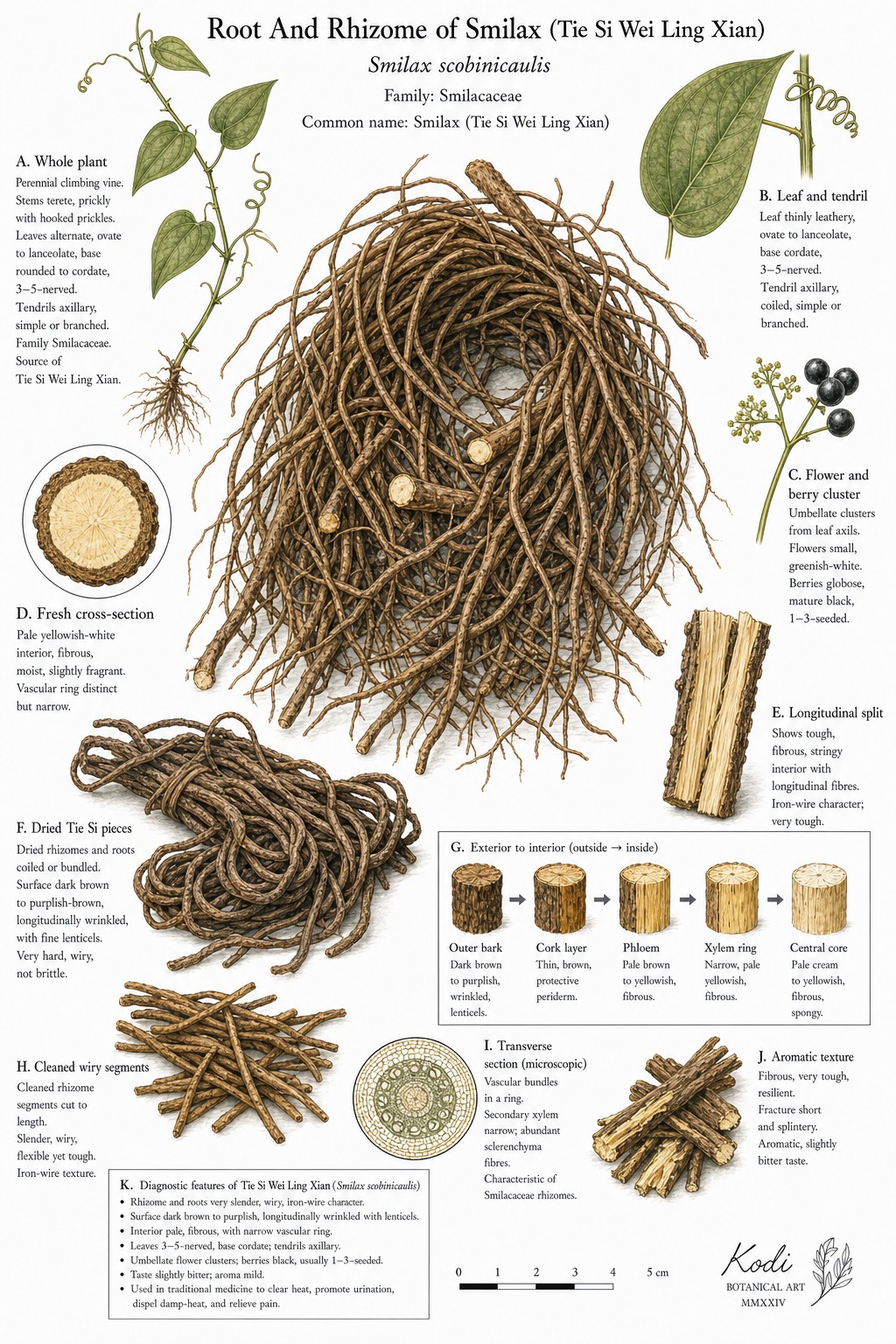
Known in TCM as Tie Si Wei Ling Xian (铁丝威灵仙), this acrid and salty, warm herb enters the Kidney and Liver. Traditionally, it dispels wind-damp and relieves stubborn pain ... Tie Si Wei Ling Xian is a fibrous wire-like Smilax trade lane used for chronic joint pain, difficult mobility, and deep-seated obstruction, most often applied for joint pain, rheumatism, and low back pain. Modern research has identified Flavonoid among its active constituents.
Part used: Root
Also Known As
Latin: Radix Smilacis | Pinyin: Tie Si Wei Ling Xian | Chinese: 铁丝威灵仙
TCM Properties
- Taste
- acrid, salty
- Temperature
- warm
- Channels
- Kidney, Liver
Traditional Use
Primary Actions
- Dispels wind-damp and relieves stubborn pain ... Tie Si Wei Ling Xian is a fibrous wire-like Smilax trade lane used for chronic joint pain, difficult mobility, and deep-seated obstruction.
- Strengthens the sinew and lower-body pain lane ... compared with more superficial exterior herbs, this material is used when low-back pain, tendon tightness, and old obstruction dominate.
- Supports circulation in chronic injury and rheumatic patterns ... it appears in folk formulas when pain is fixed, recurrent, and resistant to lighter herbs.
Secondary Actions
- This page should stay distinct from both the Clematis Wei Ling Xian page and the broader Smilax china Ling Xian page ... the trade identity here is the tougher wire-root lane tied to Smilax scobinicaulis.
- The stronger fibrous trade presentation matters clinically and visually ... this is not just a prettier duplicate of the preceding Smilax page.
Classic Formulas
- Regional rheumatic-pain combinations with Du Huo, Fang Feng, and tendon-strengthening herbs ... used when obstruction is longstanding and recurrent.
- Medicinal wines and steeped root preparations ... folk use emphasizes chronic low-back pain, weakness, and cold-damp soreness.
- Trauma-recovery and channel-opening formulas ... selected where pain and stiffness outlast the acute inflammatory phase.
Classical References
- Traditional formula lists and regional materia medica references treat Tie Si Wei Ling Xian as a specific trade lane rather than as a generic synonym for every Wei Ling Xian page.
- Its identity is rooted in tough wire-like Smilax source material used for musculoskeletal obstruction, especially in chronic patterns.
Modern Research
Active Compounds
- Flavonoid glycosides isolated from the rhizomes and roots of Smilax scobinicaulis
- Furostanol saponins ... a key constituent class in species-specific work
- Other steroidal saponins and polyphenolic fractions likely relevant to folk anti-inflammatory use
Studied Effects
- A 2014 study reported a new flavonoid glycoside from the rhizomes and roots of Smilax scobinicaulis, helping confirm that this Tie Si Wei Ling Xian lane has its own species-level chemistry rather than being only a trade-label variant (PMID 24483603).
- Another 2014 study isolated four new furostanol saponins from Smilax scobinicaulis and assessed cytotoxicity, supporting the idea that this wire-root lane has distinct bioactive chemistry worth keeping separate in the dataset (PMID 25517339).
PubMed References
Safety & Interactions
Contraindications
- Cases without wind-damp or painful obstruction
- Unverified source material sold under broad Wei Ling Xian naming
Cautions
- Do not assume Tie Si Wei Ling Xian is interchangeable with Clematis-based Wei Ling Xian ... the name overlap is exactly why this page needs to exist separately.
- Species-level chemistry is active enough to justify conservative dosing and careful source confirmation.
Conditions
- Joint Pain Traditional ★★★☆☆ JSON
- Rheumatism Traditional ★★★☆☆ JSON
- Low Back Pain Traditional ★★★☆☆ JSON
- Traumatic Injury Traditional ★★☆☆☆ JSON
Frequently Asked Questions
What is Iron-Wire Ling Xian Root used for?
Iron-Wire Ling Xian Root is traditionally used to Dispels wind-damp and relieves stubborn pain ... Tie Si Wei Ling Xian is a fibrous wire-like Smilax trade lane used for chronic joint pain, difficult mobility, and deep-seated obstruction., Strengthens the sinew and lower-body pain lane ... compared with more superficial exterior herbs, this material is used when low-back pain, tendon tightness, and old obstruction dominate., Supports circulation in chronic injury and rheumatic patterns ... it appears in folk formulas when pain is fixed, recurrent, and resistant to lighter herbs.. Research has investigated its effects on: A 2014 study reported a new flavonoid glycoside from the rhizomes and roots of Smilax scobinicaulis, helping confirm that this Tie Si Wei Ling Xian lane has its own species-level chemistry rather than being only a trade-label variant (PMID 24483603).; Another 2014 study isolated four new furostanol saponins from Smilax scobinicaulis and assessed cytotoxicity, supporting the idea that this wire-root lane has distinct bioactive chemistry worth keeping separate in the dataset (PMID 25517339)..
What are other names for Iron-Wire Ling Xian Root?
Iron-Wire Ling Xian Root is also known as Smilax scobinicaulis Root, Tie Si Ling Xian, Wire-Vine Ling Xian. In TCM: 铁丝威灵仙 (Tie Si Wei Ling Xian); Radix Smilacis.
Is Iron-Wire Ling Xian Root safe during pregnancy?
The safety of Iron-Wire Ling Xian Root during pregnancy has not been established. Consult a qualified healthcare provider before use.
What are the contraindications for Iron-Wire Ling Xian Root?
Iron-Wire Ling Xian Root should not be used in: Cases without wind-damp or painful obstruction; Unverified source material sold under broad Wei Ling Xian naming. Consult a qualified healthcare provider before use.