Ling Xian Smilax Root
- Chinese
- 灵仙
- Pinyin
- Ling Xian
- Latin
- Radix Smilacis
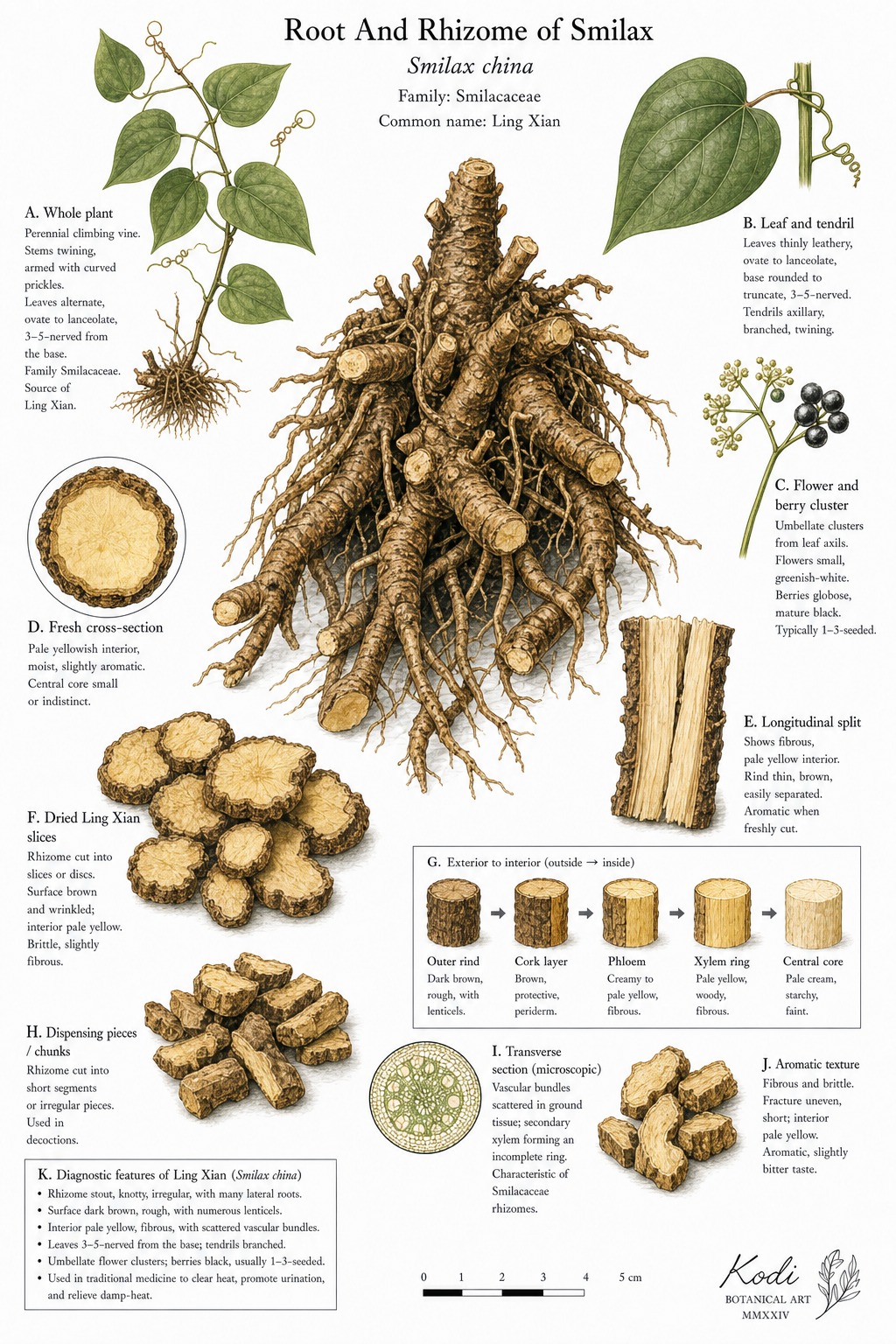
Known in TCM as Ling Xian (灵仙), this acrid and salty, warm herb enters the Kidney and Liver. Traditionally, it dispels wind-damp and opens the channels ... this Ling Xian lane is used in regional and folk practice for chronic joint pain, stiffness, and difficult flexion or extension, most often applied for joint pain, rheumatism, and low back pain. Modern research has identified Steroidal among its active constituents.
Part used: Root
Also Known As
Latin: Radix Smilacis | Pinyin: Ling Xian | Chinese: 灵仙
TCM Properties
- Taste
- acrid, salty
- Temperature
- warm
- Channels
- Kidney, Liver
Traditional Use
Primary Actions
- Dispels wind-damp and opens the channels ... this Ling Xian lane is used in regional and folk practice for chronic joint pain, stiffness, and difficult flexion or extension.
- Relieves pain in the sinews, lower back, and limbs ... it is particularly relevant when longstanding obstruction combines with weakness rather than with a fresh acute exterior pattern.
- Supports circulation through stubborn musculoskeletal patterns ... traditional use includes rheumatic pain, low-back ache, and old traumatic discomfort where a mobile vine-root medicine is preferred.
Secondary Actions
- This record must stay distinct from the already-live Clematis-based Wei Ling Xian page ... same broad pain-relief family role, different source plant and different trade identity.
- It should also stay distinct from Tu Fu Ling ... both are Smilax materials, but this page follows the Ling Xian folk-medicine lane rather than the damp-toxin and syphilitic-disorder lane usually associated with Smilax glabra.
Classic Formulas
- Regional wind-damp pain combinations with Du Huo, Qin Jiao, and Sang Ji Sheng ... used when chronic obstruction and weakness coexist.
- Folk medicinal-wine logic ... Smilax-root materials are steeped for low-back pain, chronic aching, and cold-damp mobility problems.
- Trauma and sinew-recovery formulas ... selected when pain is lingering, stiff, and not well served by purely blood-moving herbs.
Classical References
- North-China and regional trade usage recognize Ling Xian as a Smilax pain-medicine lane rather than as the canonical Clematis Wei Ling Xian lane.
- The practical theme is channel opening with a tougher, root-based folk material used for rheumatic and lower-body pain patterns.
Modern Research
Active Compounds
- Steroidal saponins ... a major chemistry class in Smilax china
- Flavonoids and flavonoid glycosides ... repeatedly highlighted in modern Smilax china reviews
- Phenylpropanoids and broader polyphenolic constituents with anti-inflammatory interest
Studied Effects
- A 2024 review summarized the botany, ethnopharmacology, phytochemistry, pharmacological activities, and applications of Smilax china, supporting its broad regional reputation as an anti-inflammatory and pain-oriented medicinal plant (PMID 37541403).
- A 2007 study isolated steroidal saponins from Smilax china and reported anti-inflammatory activity, giving a plausible modern correlate for the traditional wind-damp pain lane (PMID 17166529).
- A 2022 mouse study reported that a Smilax china flavonoid alleviated HFHS-induced inflammation through gut-liver-axis regulation, adding systemic anti-inflammatory context to the plant's folk use (PMID 34561124).
PubMed References
- Smilax china L.: A review of its botany, ethnopharmacology, phytochemistry, pharmacological activities, actual and potential applications. (2024)
- Steroidal saponins from Smilax china and their anti-inflammatory activities. (2007)
- Smilax china L. flavonoid alleviates HFHS-induced inflammation by regulating the gut-liver axis in mice. (2022)
Safety & Interactions
Contraindications
- Cases without wind-damp or painful obstruction
- Unverified or mixed Smilax source material
Cautions
- Identity matters here more than with common high-volume herbs ... this page follows a regional Smilax Ling Xian lane and should not be substituted automatically for Clematis Wei Ling Xian.
- Long-term self-use for chronic pain can blur pattern assessment and mask conditions that need fuller evaluation.
Conditions
- Joint Pain Traditional ★★★☆☆ JSON
- Rheumatism Traditional ★★★☆☆ JSON
- Low Back Pain Traditional ★★☆☆☆ JSON
- Traumatic Injury Traditional ★★☆☆☆ JSON
Frequently Asked Questions
What is Ling Xian Smilax Root used for?
Ling Xian Smilax Root is traditionally used to Dispels wind-damp and opens the channels ... this Ling Xian lane is used in regional and folk practice for chronic joint pain, stiffness, and difficult flexion or extension., Relieves pain in the sinews, lower back, and limbs ... it is particularly relevant when longstanding obstruction combines with weakness rather than with a fresh acute exterior pattern., Supports circulation through stubborn musculoskeletal patterns ... traditional use includes rheumatic pain, low-back ache, and old traumatic discomfort where a mobile vine-root medicine is preferred.. Research has investigated its effects on: A 2024 review summarized the botany, ethnopharmacology, phytochemistry, pharmacological activities, and applications of Smilax china, supporting its broad regional reputation as an anti-inflammatory and pain-oriented medicinal plant (PMID 37541403).; A 2007 study isolated steroidal saponins from Smilax china and reported anti-inflammatory activity, giving a plausible modern correlate for the traditional wind-damp pain lane (PMID 17166529)..
What are other names for Ling Xian Smilax Root?
Ling Xian Smilax Root is also known as Smilax china Root, Regional Ling Xian, China Root Smilax. In TCM: 灵仙 (Ling Xian); Radix Smilacis.
Is Ling Xian Smilax Root safe during pregnancy?
The safety of Ling Xian Smilax Root during pregnancy has not been established. Consult a qualified healthcare provider before use.
What are the contraindications for Ling Xian Smilax Root?
Ling Xian Smilax Root should not be used in: Cases without wind-damp or painful obstruction; Unverified or mixed Smilax source material. Consult a qualified healthcare provider before use.