Manyleaf Meadowrue Root and Rhizome
- Chinese
- 马尾连
- Pinyin
- Ma Wei Lian
- Latin
- Radix et Rhizoma Thalictri
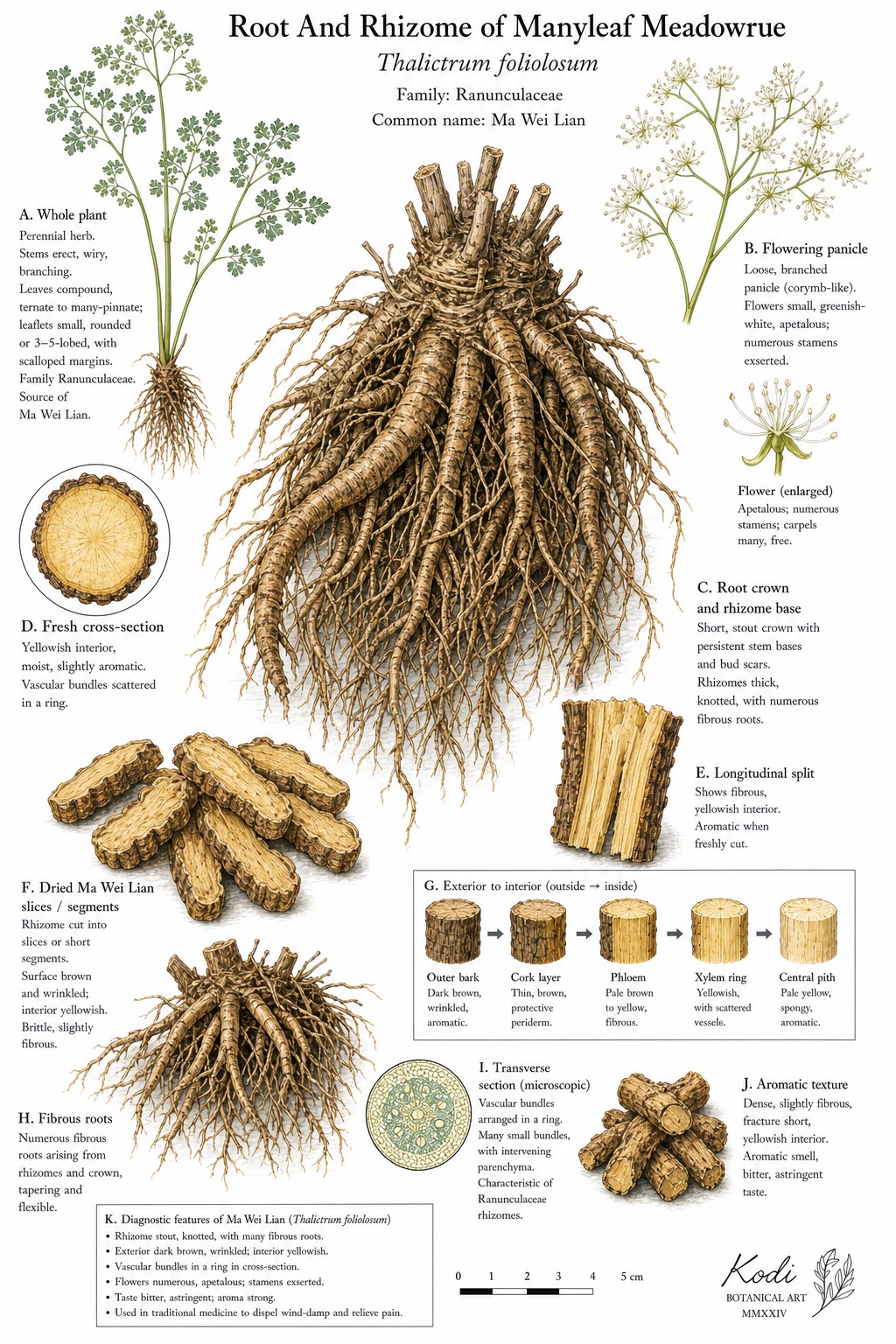
Known in TCM as Ma Wei Lian (马尾连), this bitter, cold herb enters the Heart, Large Intestine, and Liver. Traditionally, it clears heat and resolves toxicity ... Ma Wei Lian is used in regional materia medica for hot dysentery, toxic sores, swollen throat, and inflammatory heat patterns, most often applied for dysentery, diarrhea, and hepatitis. Modern research has identified Benzyl among its active constituents.
Part used: Root
Also Known As
Latin: Radix et Rhizoma Thalictri | Pinyin: Ma Wei Lian | Chinese: 马尾连
TCM Properties
- Taste
- bitter
- Temperature
- cold
- Channels
- Heart, Large Intestine, Liver
Traditional Use
Primary Actions
- Clears heat and resolves toxicity ... Ma Wei Lian is used in regional materia medica for hot dysentery, toxic sores, swollen throat, and inflammatory heat patterns.
- Dries damp and stops dysenteric diarrhea ... one of its clearest traditional lanes is intestinal heat-damp with tenesmus, abdominal urgency, or foul loose stool.
- Reduces inflammatory swelling in the eyes and skin ... local traditions extend its use to conjunctival redness, boils, and other obvious heat-toxin manifestations.
Secondary Actions
- This herb overlaps in flavor and heat-clearing logic with Huang Lian-like medicinals, but it should stay clearly on its own Thalictrum lane rather than being flattened into a generic goldthread substitute.
- The strongest traditional material is regional and practical ... dysentery, hepatitis, sore lesions, and inflammatory conditions ... rather than the classical high-canon formula lane of more famous heat-clearing roots.
Classic Formulas
- Regional dysentery and enteritis decoctions ... Ma Wei Lian is paired with bitter-cold damp-heat herbs when urgent bowel heat dominates.
- Hepatitis and jaundice folk-formula logic ... used where bitter cold clearing of heat-damp and toxicity is desired.
- Wash or poultice traditions for boils, sores, and inflammatory skin eruptions.
Classical References
- Regional materia medica sources consistently describe Ma Wei Lian as bitter and cold with a heat-clearing, toxicity-resolving, and damp-drying profile.
- Its practical pattern range centers on bowel heat, toxic swelling, red eyes, and inflammatory lesions rather than on tonic or dispersing work.
Modern Research
Active Compounds
- Benzyl isoquinoline alkaloids ... the core phytochemical reason Thalictrum foliolosum attracts modern pharmacology interest
- Cytotoxic isoquinoline alkaloids and related secondary metabolites ... repeatedly isolated from the roots
- Other alkaloid-rich fractions relevant to antiplasmodial and antimicrobial screening
Studied Effects
- A 2020 review positioned Thalictrum foliolosum as an underexplored medicinal source of valuable benzyl isoquinoline alkaloids, helping explain why Ma Wei Lian draws chemistry-focused attention (PMID 32135243).
- A 2021 study isolated cytotoxic isoquinoline alkaloids from the roots of Thalictrum foliolosum, reinforcing the biologically active and potentially strong nature of the material (PMID 31773979).
- A 2020 study reported antiplasmodial potential of Thalictrum foliolosum in a lethal murine-malaria model, which fits its regional reputation for intense heat-clearing activity even if direct clinical relevance remains limited (PMID 34472503).
PubMed References
- Thalictrum foliolosum: A lesser unexplored medicinal herb from the Himalayan region as a source of valuable benzyl isoquinoline alkaloids. (2020)
- Cytotoxic isoquinoline alkaloids from the roots of Thalictrum foliolosum. (2021)
- Antiplasmodial potential of Thalictrum foliolosum (Ranunculaceae) against lethal murine malaria. (2020)
Safety & Interactions
Contraindications
- Pregnancy unless specifically prescribed
- Cold deficiency diarrhea or weak digestion without heat-damp
- Patients depleted by chronic illness who do not have a clear heat-toxin pattern
Cautions
- The alkaloid-rich chemistry and cytotoxicity-focused literature support a conservative dosing posture rather than casual food-like use.
- Its bitter cold nature can easily aggravate weak digestion if the bowel problem is deficiency rather than toxic damp-heat.
Conditions
Frequently Asked Questions
What is Manyleaf Meadowrue Root and Rhizome used for?
Manyleaf Meadowrue Root and Rhizome is traditionally used to Clears heat and resolves toxicity ... Ma Wei Lian is used in regional materia medica for hot dysentery, toxic sores, swollen throat, and inflammatory heat patterns., Dries damp and stops dysenteric diarrhea ... one of its clearest traditional lanes is intestinal heat-damp with tenesmus, abdominal urgency, or foul loose stool., Reduces inflammatory swelling in the eyes and skin ... local traditions extend its use to conjunctival redness, boils, and other obvious heat-toxin manifestations.. Research has investigated its effects on: A 2020 review positioned Thalictrum foliolosum as an underexplored medicinal source of valuable benzyl isoquinoline alkaloids, helping explain why Ma Wei Lian draws chemistry-focused attention (PMID 32135243).; A 2021 study isolated cytotoxic isoquinoline alkaloids from the roots of Thalictrum foliolosum, reinforcing the biologically active and potentially strong nature of the material (PMID 31773979)..
What are other names for Manyleaf Meadowrue Root and Rhizome?
Manyleaf Meadowrue Root and Rhizome is also known as Maweilian, Thalictrum foliolosum Root, Meadowrue Root and Rhizome. In TCM: 马尾连 (Ma Wei Lian); Radix et Rhizoma Thalictri.
Is Manyleaf Meadowrue Root and Rhizome safe during pregnancy?
Manyleaf Meadowrue Root and Rhizome is not recommended during pregnancy.
What are the contraindications for Manyleaf Meadowrue Root and Rhizome?
Manyleaf Meadowrue Root and Rhizome should not be used in: Pregnancy unless specifically prescribed; Cold deficiency diarrhea or weak digestion without heat-damp; Patients depleted by chronic illness who do not have a clear heat-toxin pattern. Consult a qualified healthcare provider before use.