Notopterygium Root and Rhizome
- Chinese
- 羌活
- Pinyin
- Qiang Huo
- Latin
- Radix et Rhizoma Notopterygii
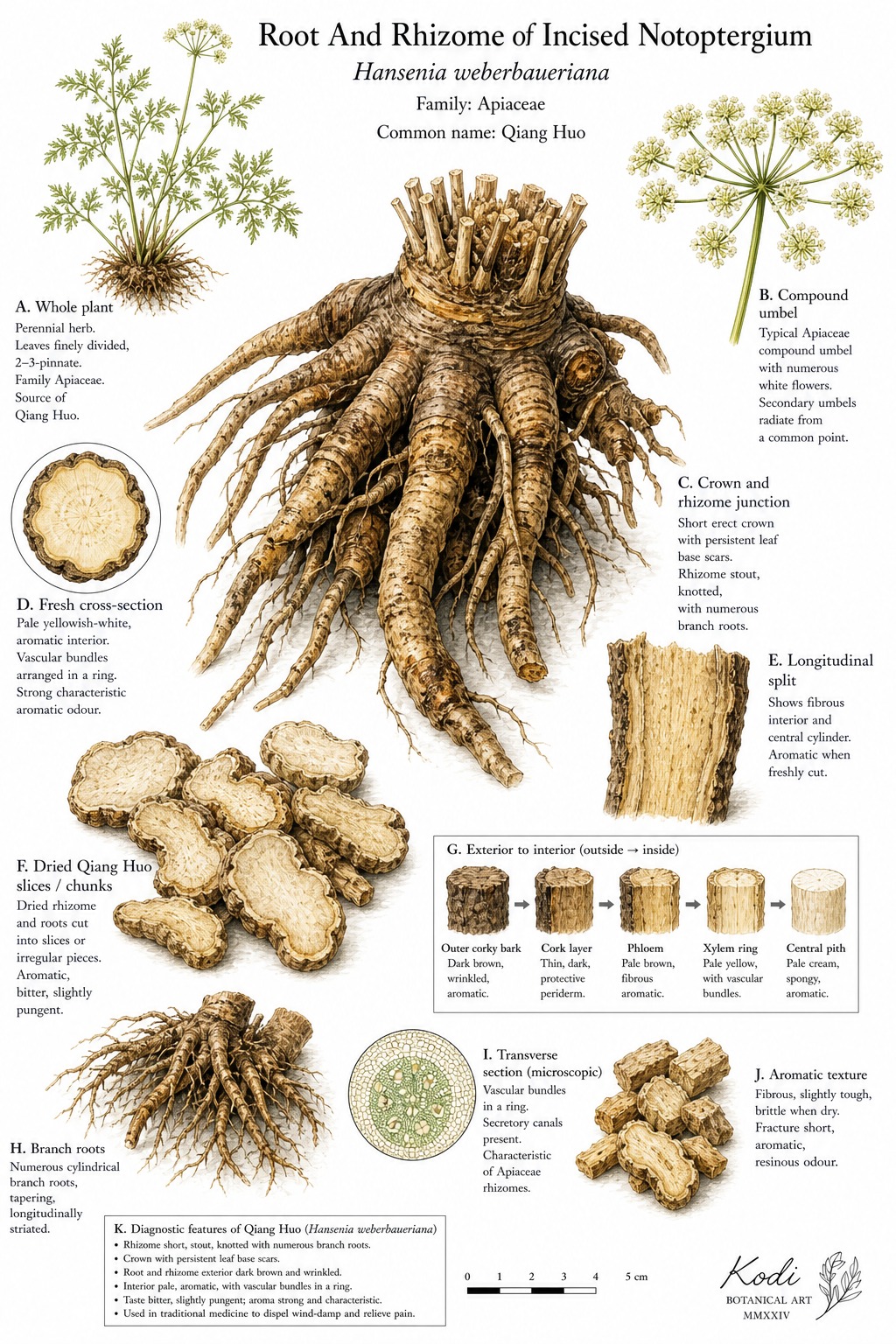
Known in TCM as Qiang Huo (羌活), this acrid and bitter, warm herb enters the Bladder and Kidney. Traditionally, it releases the exterior and dispels wind-cold-damp ... Qiang Huo is a classic choice when a cold painful exterior pattern includes body aches, chills, and heavy soreness, most often applied for common cold, headache, and joint pain. Modern research has identified Notopterol among its active constituents.
Part used: Root
Also Known As
Latin: Radix et Rhizoma Notopterygii | Pinyin: Qiang Huo | Chinese: 羌活
TCM Properties
- Taste
- acrid, bitter
- Temperature
- warm
- Channels
- Bladder, Kidney
Traditional Use
Primary Actions
- Releases the exterior and dispels wind-cold-damp ... Qiang Huo is a classic choice when a cold painful exterior pattern includes body aches, chills, and heavy soreness.
- Relieves pain in the head, neck, and upper back ... it is especially valued for Taiyang-pattern occipital headache, cervical stiffness, and aching of the upper body.
- Unblocks the channels for wind-damp painful obstruction ... beyond acute exterior illness, it appears in formulas for wandering or fixed joint pain when cold-damp predominates.
Secondary Actions
- Qiang Huo is the upper-body counterpart in the classic Qiang Huo and Du Huo pairing ... it is chosen when the pain pattern sits high rather than sinking into the low back and legs.
- This page should stay on the true Qiang Huo lane anchored to accepted Hansenia or Notopterygium trade identity ... not on a generic tonic root interpretation.
Classic Formulas
- Jiu Wei Qiang Huo Tang ... classic exterior wind-cold-damp release formula with strong body-ache and headache logic.
- Qiang Huo Sheng Shi Tang ... used when dampness and heaviness burden the upper body with headache and aching.
- Bi-syndrome combinations with Du Huo, Qin Jiao, and Sang Zhi ... traditional logic when obstructive pain lingers after the acute exterior stage.
Classical References
- Materia medica teaching consistently emphasizes Qiang Huo for the Taiyang region ... head, neck, upper back, and shoulders.
- Its strength lies in combining exterior release with pain relief, making it more than a simple cold herb and more mobile than a plain warming analgesic.
Modern Research
Active Compounds
- Notopterol and related coumarins ... hallmark constituents repeatedly discussed in Qiang Huo research
- Other furanocoumarins and phenylpropanoid-type constituents ... broader anti-inflammatory interest
- Polysaccharide fractions with anti-rheumatoid-arthritis study relevance
Studied Effects
- A 2017 review summarized the ethnopharmacology, phytochemistry, and pharmacology of Notopterygium incisum, providing a broad modern overview of why Qiang Huo remains a high-interest wind-damp herb (PMID 28336469).
- A 2024 study reported that Notopterygium incisum roots extract alleviated neuroinflammation pathology in an Alzheimer's-disease model through the TLR4-NF-kB pathway, extending the herb's anti-inflammatory profile beyond joint pain alone (PMID 39094757).
- A 2023 study characterized a polysaccharide from Notopterygium incisum and reported anti-rheumatoid-arthritis activity, giving a contemporary correlate for traditional painful-obstruction use (PMID 37143438).
PubMed References
- A review of the ethnopharmacology, phytochemistry and pharmacology of Notopterygium incisum. (2017)
- Notopterygium incisum roots extract (NRE) alleviates neuroinflammation pathology in Alzheimer's disease through TLR4-NF-κB pathway. (2024)
- Structure Characterization and Anti-Rheumatoid Arthritis Activity of a Polysaccharide from Notopterygium incisum. (2023)
Safety & Interactions
Contraindications
- Yin deficiency with heat signs
- Blood deficiency or headache from depletion rather than exterior cold-damp
- Dryness patterns that would be aggravated by a warm dispersing herb
Cautions
- Qiang Huo is drying and dispersing ... it is a good pattern match for cold-damp obstruction but not for long unsupervised use in depleted patients.
- Source authentication matters because the Qiang Huo trade includes closely related regional species.
Conditions
- Common Cold Traditional ★★★☆☆ JSON
- Headache Traditional ★★★☆☆ JSON
- Joint Pain Traditional ★★★☆☆ JSON
- Rheumatism Traditional ★★★☆☆ JSON
Frequently Asked Questions
What is Notopterygium Root and Rhizome used for?
Notopterygium Root and Rhizome is traditionally used to Releases the exterior and dispels wind-cold-damp ... Qiang Huo is a classic choice when a cold painful exterior pattern includes body aches, chills, and heavy soreness., Relieves pain in the head, neck, and upper back ... it is especially valued for Taiyang-pattern occipital headache, cervical stiffness, and aching of the upper body., Unblocks the channels for wind-damp painful obstruction ... beyond acute exterior illness, it appears in formulas for wandering or fixed joint pain when cold-damp predominates.. Research has investigated its effects on: A 2017 review summarized the ethnopharmacology, phytochemistry, and pharmacology of Notopterygium incisum, providing a broad modern overview of why Qiang Huo remains a high-interest wind-damp herb (PMID 28336469).; A 2024 study reported that Notopterygium incisum roots extract alleviated neuroinflammation pathology in an Alzheimer's-disease model through the TLR4-NF-kB pathway, extending the herb's anti-inflammatory profile beyond joint pain alone (PMID 39094757)..
What are other names for Notopterygium Root and Rhizome?
Notopterygium Root and Rhizome is also known as Qiang Huo Root, Hansenia weberbaueriana, Incised Notopterygium Root. In TCM: 羌活 (Qiang Huo); Radix et Rhizoma Notopterygii.
Is Notopterygium Root and Rhizome safe during pregnancy?
The safety of Notopterygium Root and Rhizome during pregnancy has not been established. Consult a qualified healthcare provider before use.
What are the contraindications for Notopterygium Root and Rhizome?
Notopterygium Root and Rhizome should not be used in: Yin deficiency with heat signs; Blood deficiency or headache from depletion rather than exterior cold-damp; Dryness patterns that would be aggravated by a warm dispersing herb. Consult a qualified healthcare provider before use.