Rice-Grain Sprout
- Chinese
- 稻芽
- Pinyin
- Dao Ya
- Latin
- Fructus Oryzae Germinatus
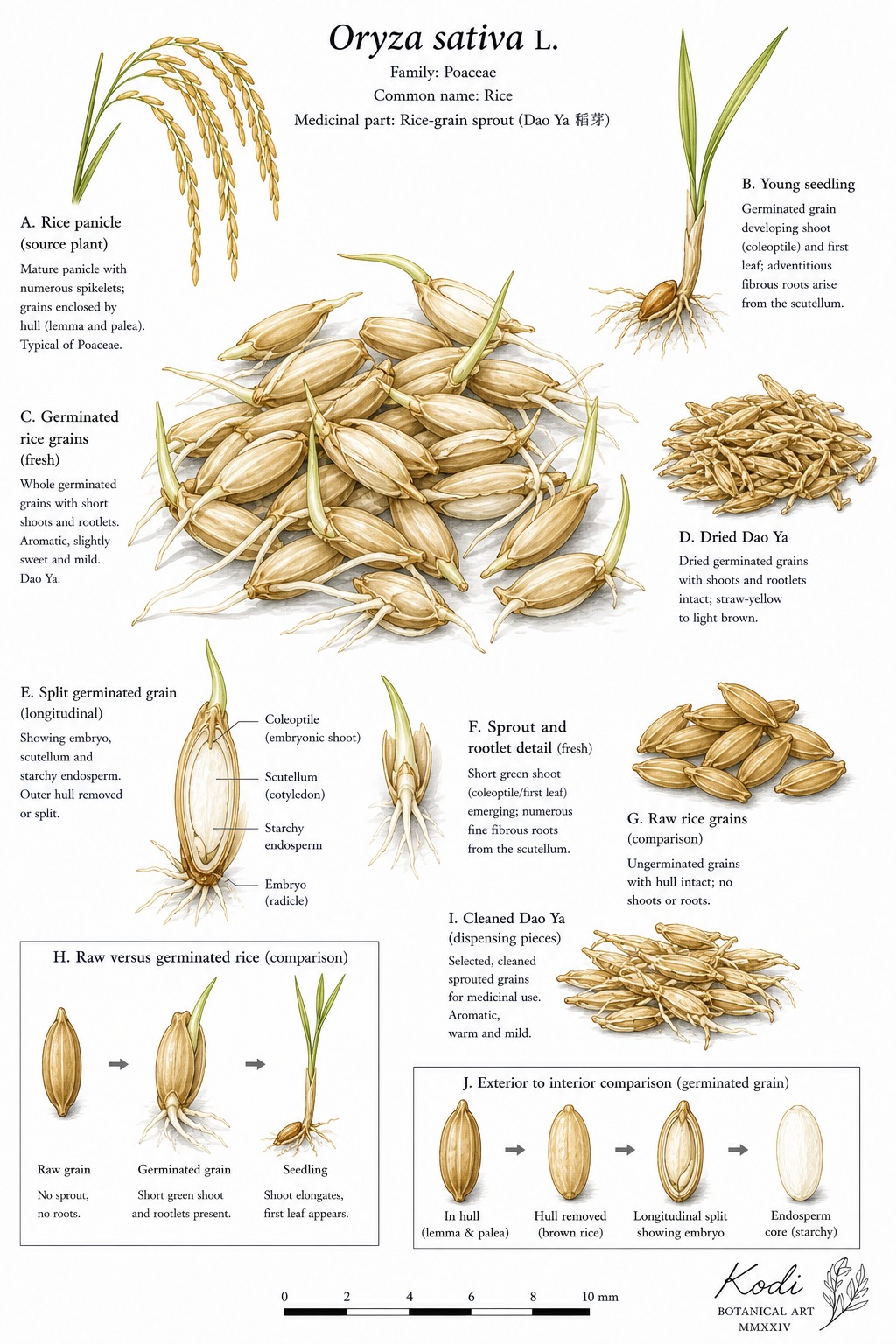
Known in TCM as Dao Ya (稻芽), this sweet, neutral herb enters the Spleen and Stomach. Traditionally, it reduces food stagnation from grain and starch accumulation ... Dao Ya is used when porridges, rice, or other cereals sit heavily and lead to fullness, belching, or poor appetite, most often applied for poor appetite, indigestion, and digestive weakness. Modern research has identified Gamma-aminobutyric among its active constituents.
Part used: Fruit
Also Known As
Latin: Fructus Oryzae Germinatus | Pinyin: Dao Ya | Chinese: 稻芽
TCM Properties
- Taste
- sweet
- Temperature
- neutral
- Channels
- Spleen, Stomach
Traditional Use
Primary Actions
- Reduces food stagnation from grain and starch accumulation ... Dao Ya is used when porridges, rice, or other cereals sit heavily and lead to fullness, belching, or poor appetite.
- Strengthens the Spleen and improves appetite ... beyond simple reduction of accumulation, sprouted rice is valued when digestion is weak and the patient needs a gentler food-medicine support rather than a harsh descending herb.
- Supports pediatric, convalescent, or dietary recovery patterns ... rice sprout is often the mildest choice when the problem is underpowered grain digestion rather than severe heat or toxin.
Secondary Actions
- Dao Ya overlaps with Mai Ya and Shen Qu in food-stagnation work, but it stays especially relevant when the stagnation is rice or grain centered and the formula needs a softer touch.
- This page should remain distinct from plain rice and from rice wine ... sprouting changes the material toward digestion support rather than nourishment alone or alcohol-mediated warmth.
Classic Formulas
- Bao He Wan modification logic ... sprouted grains are added when starchy food retention and poor appetite dominate the pattern.
- Digestive powder combinations with Mai Ya and Shen Qu ... classic triad logic for mixed food stagnation in adults and children.
- Convalescent gruels and medicinal porridges ... Dao Ya is used when the patient can eat but does not yet transform grains efficiently.
Classical References
- Traditional teaching places Dao Ya among the gentler digestant sprout medicinals used to harmonize the middle rather than forcefully purge.
- Its classic niche is grain stagnation with weak appetite ... especially when the patient would be overtaxed by colder or more aggressive reducing herbs.
Modern Research
Active Compounds
- Gamma-aminobutyric acid and related sprouting-induced metabolites ... often increased in germinated rice products
- Gamma-oryzanol and ferulic-acid-related phenolics ... studied for metabolic and antioxidant interest
- Dietary fiber and altered starch fractions ... relevant to satiety and glycemic response
- Vitamins and small bioactive peptides enriched during germination
Studied Effects
- A 2013 review summarized germinated brown rice and its broader human-health relevance, supporting the idea that sprouting creates a materially different food from ordinary polished rice (PMID 23391013).
- A 2014 clinical study in Vietnamese women with impaired glucose tolerance reported reductions in blood glucose concentration and body weight after pre-germinated brown rice intake, suggesting a modest metabolic-health research signal around germinated rice products (PMID 25078374).
- A 2022 mouse study found germinated brown rice influenced metabolism, inflammation, and gut microbiome markers in a high-fat-diet insulin-resistance model, adding mechanistic support to the traditional food-medicine interest in sprouted rice (PMID 36283033).
PubMed References
- Germinated brown rice and its role in human health. (2013)
- Pre-germinated brown rice reduced both blood glucose concentration and body weight in Vietnamese women with impaired glucose tolerance. (2014)
- Impact of Germinated Brown Rice and Brown Rice on Metabolism, Inflammation, and Gut Microbiome in High Fat Diet-Induced Insulin Resistant Mice. (2022)
Safety & Interactions
Cautions
- Dao Ya is usually a gentle food-medicine, but concentrated extracts or heavily processed supplements should not be assumed equivalent to traditional decoction or porridge use.
- People using germinated-rice products specifically for glucose management should monitor expectations carefully ... the modern evidence is promising but still limited.
Conditions
- Poor Appetite Traditional ★★★☆☆ JSON
- Indigestion Traditional ★★★☆☆ JSON
- Digestive Weakness Traditional ★★☆☆☆ JSON
- Type 2 Diabetes Research ★☆☆☆☆ JSON
Frequently Asked Questions
What is Rice-Grain Sprout used for?
Rice-Grain Sprout is traditionally used to Reduces food stagnation from grain and starch accumulation ... Dao Ya is used when porridges, rice, or other cereals sit heavily and lead to fullness, belching, or poor appetite., Strengthens the Spleen and improves appetite ... beyond simple reduction of accumulation, sprouted rice is valued when digestion is weak and the patient needs a gentler food-medicine support rather than a harsh descending herb., Supports pediatric, convalescent, or dietary recovery patterns ... rice sprout is often the mildest choice when the problem is underpowered grain digestion rather than severe heat or toxin.. Research has investigated its effects on: A 2013 review summarized germinated brown rice and its broader human-health relevance, supporting the idea that sprouting creates a materially different food from ordinary polished rice (PMID 23391013).; A 2014 clinical study in Vietnamese women with impaired glucose tolerance reported reductions in blood glucose concentration and body weight after pre-germinated brown rice intake, suggesting a modest metabolic-health research signal around germinated rice products (PMID 25078374)..
What are other names for Rice-Grain Sprout?
Rice-Grain Sprout is also known as Germinated Rice, Sprouted Rice Grain, Oryza sativa Sprout. In TCM: 稻芽 (Dao Ya); Fructus Oryzae Germinatus.
Is Rice-Grain Sprout safe during pregnancy?
The safety of Rice-Grain Sprout during pregnancy has not been established. Consult a qualified healthcare provider before use.