Polished Rice
- Pinyin
- Jing Mi
- Latin
- Semen Oryzae Sativae
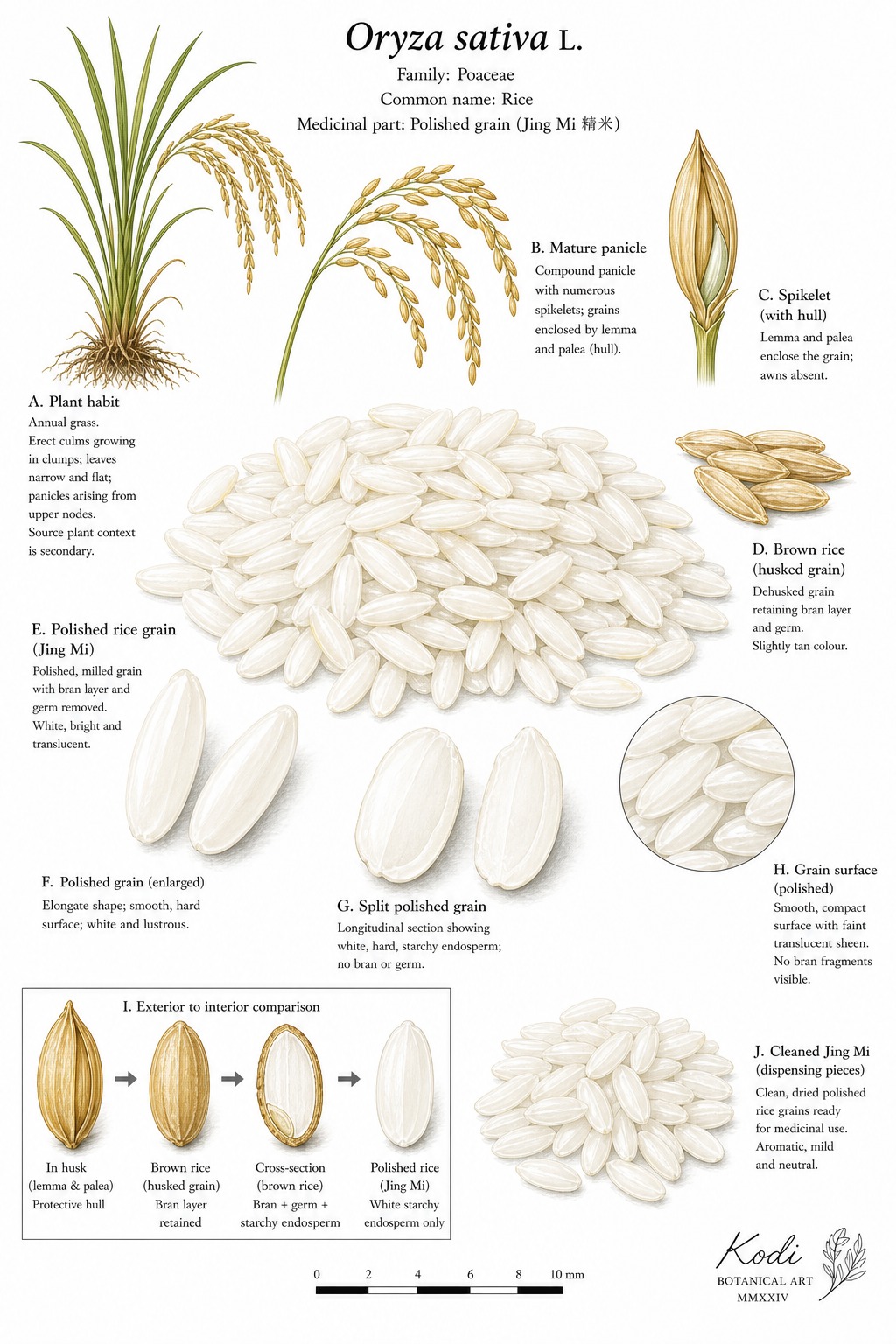
This sweet, neutral herb enters the Spleen and Stomach. Traditionally, it tonifies the middle and gently nourishes qi ... Jing Mi is the polished-rice lane used in congee, rice water, and supportive dietetics when the digestion is weak and a bland easy grain is needed, most often applied for poor appetite, diarrhea, and digestive weakness. Modern research has identified Starch-rich among its active constituents.
Part used: Seed
Also Known As
Latin: Semen Oryzae Sativae | Pinyin: Jing Mi
TCM Properties
- Taste
- sweet
- Temperature
- neutral
- Channels
- Spleen, Stomach
Traditional Use
Primary Actions
- Tonifies the middle and gently nourishes qi ... Jing Mi is the polished-rice lane used in congee, rice water, and supportive dietetics when the digestion is weak and a bland easy grain is needed.
- Generates fluids and harmonizes the Stomach ... polished rice is often chosen in recovery foods because it is smoother, simpler, and easier to digest than rougher grain preparations.
- Helps stop diarrhea and settle the intestines ... traditional use includes weak-digestion patterns where bland nourishment is preferred over stronger medicinal intervention.
Secondary Actions
- This page should stay clearly polished-grain-forward and distinct from the broader `rice` / Da Mi page ... Jing Mi emphasizes white refined rice rather than bran-retaining grain.
- Polishing makes the grain gentler and easier to cook for recovery use, but it also reduces the richer fiber and polyphenol profile found in less-refined rice.
Classic Formulas
- Tao Hua Tang ... polished rice helps stabilize and protect the intestines in a classic chronic-dysentery context.
- Bai Hu Tang and Zhu Ye Shi Gao Tang ... rice moderates strong heat-clearing formulas while helping protect fluids and the Stomach.
- Rice congee and rice water ... classic supportive preparations for weak appetite, nausea, or post-illness recovery.
Classical References
- Traditional medicine treats Jing Mi as a bland protective grain that supports the Spleen and Stomach without burdening digestion.
- Its main value is tolerability and recovery support rather than dramatic stand-alone pharmacologic effect.
Modern Research
Active Compounds
- Starch-rich endosperm ... the dominant fraction of polished white rice
- Reduced-fiber grain matrix ... relevant to glycemic and satiety discussion compared with less-refined rice
- Lower retained polyphenol and bran-associated micronutrient content ... a key nutritional distinction from whole-grain rice
Studied Effects
- A 2019 review on rice and global nutrition noted that polished rice has a higher glycemic load than less-refined forms, which is important context for modern reading of Jing Mi as a food rather than a tonic extract (PMID 31619630).
- A 2019 review on processing of wholegrain brown rice helps clarify what polishing removes, making it useful background for distinguishing Jing Mi from broader Da Mi in modern nutritional terms (PMID 29993273).
- A 2025 review on whole grains emphasized that fiber structure and phytochemicals materially affect health outcomes, which explains why polished white rice should not simply be assumed nutritionally identical to less-refined grain (PMID 40856522).
PubMed References
- Rice: Importance for Global Nutrition. (2019)
- Innovative processing techniques for altering the physicochemical properties of wholegrain brown rice (Oryza sativa L.) - opportunities for enhancing food quality and health attributes. (2019)
- Whole grains are not equal: the role of fiber structure and phytochemicals in health. (2025)
Safety & Interactions
Cautions
- This page covers polished rice as a medicinal food support, not as a substitute for medical care in severe digestive illness or dehydration.
- Modern nutrition concerns depend on portion, preparation, and total diet, especially for people watching glycemic load.
Conditions
- Poor Appetite Traditional ★★★☆☆ JSON
- Diarrhea Traditional ★★★☆☆ JSON
- Digestive Weakness Traditional ★★☆☆☆ JSON
- Nausea Traditional ★★☆☆☆ JSON
Frequently Asked Questions
What is Polished Rice used for?
Polished Rice is traditionally used to Tonifies the middle and gently nourishes qi ... Jing Mi is the polished-rice lane used in congee, rice water, and supportive dietetics when the digestion is weak and a bland easy grain is needed., Generates fluids and harmonizes the Stomach ... polished rice is often chosen in recovery foods because it is smoother, simpler, and easier to digest than rougher grain preparations., Helps stop diarrhea and settle the intestines ... traditional use includes weak-digestion patterns where bland nourishment is preferred over stronger medicinal intervention.. Research has investigated its effects on: A 2019 review on rice and global nutrition noted that polished rice has a higher glycemic load than less-refined forms, which is important context for modern reading of Jing Mi as a food rather than a tonic extract (PMID 31619630).; A 2019 review on processing of wholegrain brown rice helps clarify what polishing removes, making it useful background for distinguishing Jing Mi from broader Da Mi in modern nutritional terms (PMID 29993273)..
What are other names for Polished Rice?
Polished Rice is also known as Jing Mi, White Rice, Polished Oryza sativa Grain. In TCM: Semen Oryzae Sativae.
Is Polished Rice safe during pregnancy?
The safety of Polished Rice during pregnancy has not been established. Consult a qualified healthcare provider before use.