Rhizome of Swordlike Atractylodes
- Pinyin
- Cang Zhu
- Latin
- Rhizoma Atractylodis
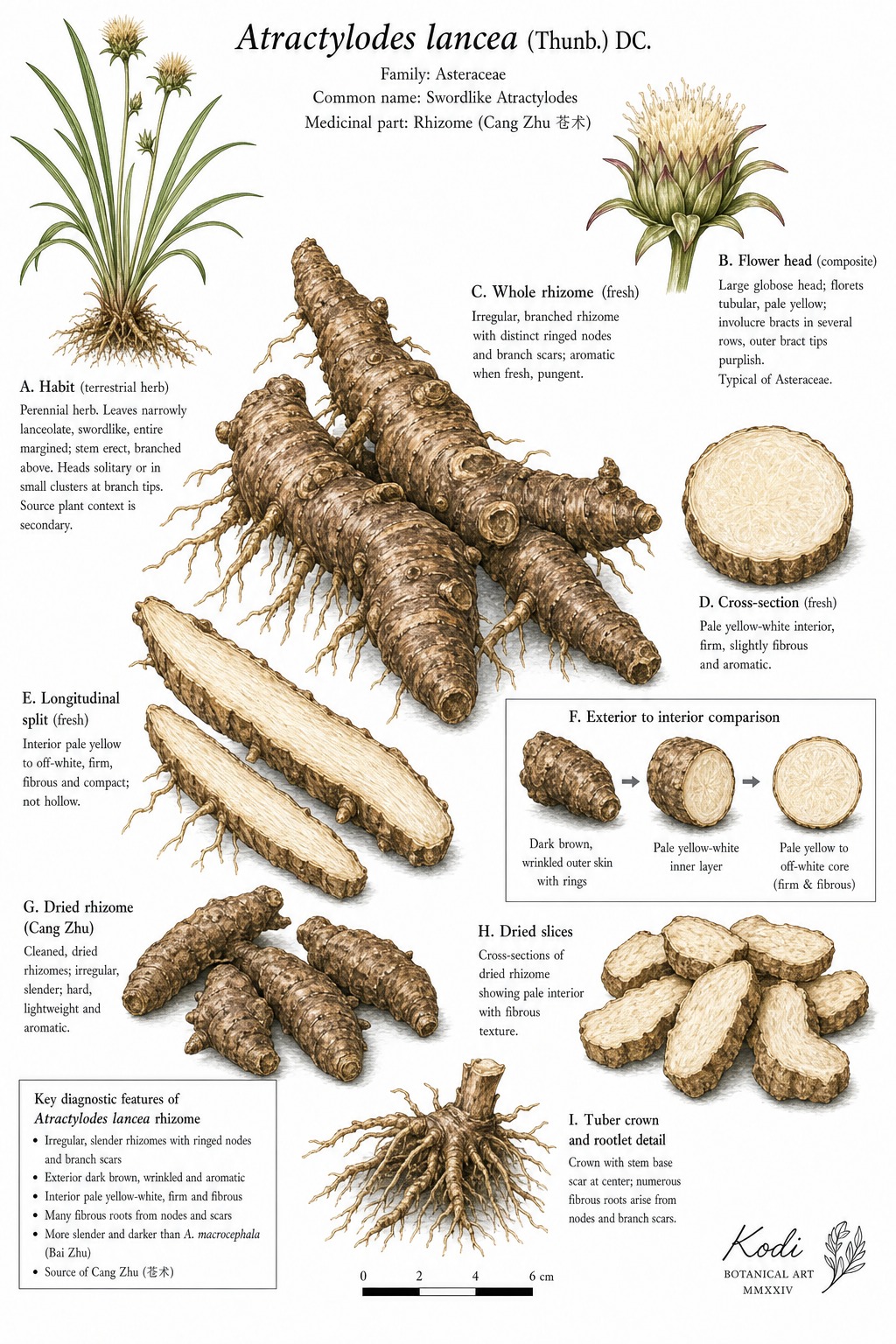
This acrid and bitter, warm herb enters the Spleen, Stomach, and Liver. Traditionally, it strongly dries dampness and strengthens the Spleen ... Cang Zhu is used for heaviness, poor appetite, loose stool, foggy head, and damp obstruction of the middle burner, most often applied for poor appetite, diarrhea, and rheumatism. Modern research has identified Atractylodin among its active constituents.
Part used: Rhizome
Also Known As
Latin: Rhizoma Atractylodis | Pinyin: Cang Zhu
TCM Properties
- Taste
- acrid, bitter
- Temperature
- warm
- Channels
- Spleen, Stomach, Liver
Traditional Use
Primary Actions
- Strongly dries dampness and strengthens the Spleen ... Cang Zhu is used for heaviness, poor appetite, loose stool, foggy head, and damp obstruction of the middle burner.
- Expels wind-damp and relieves painful obstruction ... textbook use includes body aches, swollen painful joints, and damp-cold patterns affecting mobility.
- Induces sweating and improves vision clouded by dampness ... older teaching includes exterior-damp patterns and visual dullness linked with damp obstruction.
Secondary Actions
- This page should stay distinct from `rhizome-of-largehead-atractylodes` / Bai Zhu ... Cang Zhu is more drying, aromatic, and dispersing, with less pure tonifying emphasis.
- Raw Cang Zhu and processed Zhi Cang Zhu overlap, but the raw lane is broader for exterior-damp and painful-obstruction use.
Classic Formulas
- Ping Wei San ... classic formula for dampness obstructing the middle burner with fullness, heaviness, and poor appetite.
- Er Miao San ... pairs Cang Zhu with Huang Bai for damp-heat pouring downward into the legs or lower burner.
- Exterior-damp combinations with Qiang Huo or Fang Feng ... used when heaviness, body pain, and damp obstruction travel together.
Classical References
- Traditional herbology describes Cang Zhu as acrid, bitter, and warm, entering the Spleen, Stomach, and Liver to dry dampness, strengthen the Spleen, dispel wind-damp, and improve vision.
- Its clinical personality is more drying and dispersing than Bai Zhu, which is why the two Atractylodes medicinals are not interchangeable.
Modern Research
Active Compounds
- Atractylodin ... one of the best-known marker compounds of Atractylodes lancea
- Hinesol and beta-eudesmol ... major sesquiterpenoid fractions in Cang Zhu research
- Atractylon and related volatile-oil constituents ... important aromatic compounds in pharmacology studies
Studied Effects
- A 2024 review summarized the biological functions of Atractylodes lancea and its modern applications, showing how broad the contemporary pharmacology literature has become around the Cang Zhu source species (PMID 39867604).
- A 2021 review of Atractylodis Rhizoma covered traditional uses, phytochemistry, pharmacology, toxicology, and quality control, giving a direct modern overview for Cang Zhu and related market material (PMID 32987126).
- A 2014 review described the therapeutic potential and pharmacological activities of Atractylodes lancea, reinforcing its anti-inflammatory, gastrointestinal, and broader medicinal research relevance (PMID 25066389).
PubMed References
- The biological function of Atractylodes lancea and its application in animal husbandry: a review. (2024)
- Atractylodis Rhizoma: A review of its traditional uses, phytochemistry, pharmacology, toxicology and quality control. (2021)
- Therapeutic potential and pharmacological activities of Atractylodes lancea (Thunb.) DC. (2014)
Safety & Interactions
Contraindications
- Yin deficiency dryness or fluid depletion without dampness
- Dry heat patterns without middle-burner damp obstruction
Cautions
- Cang Zhu is warm and drying enough to aggravate thirst or dryness if used in the wrong pattern.
- Modern pharmacology often studies extracts and purified compounds that are not equivalent to ordinary crude-herb dosing.
Conditions
- Poor Appetite Traditional ★★★★☆ JSON
- Diarrhea Traditional ★★★☆☆ JSON
- Rheumatism Traditional ★★★☆☆ JSON
- Joint Pain Traditional ★★★☆☆ JSON
Frequently Asked Questions
What is Rhizome of Swordlike Atractylodes used for?
Rhizome of Swordlike Atractylodes is traditionally used to Strongly dries dampness and strengthens the Spleen ... Cang Zhu is used for heaviness, poor appetite, loose stool, foggy head, and damp obstruction of the middle burner., Expels wind-damp and relieves painful obstruction ... textbook use includes body aches, swollen painful joints, and damp-cold patterns affecting mobility., Induces sweating and improves vision clouded by dampness ... older teaching includes exterior-damp patterns and visual dullness linked with damp obstruction.. Research has investigated its effects on: A 2024 review summarized the biological functions of Atractylodes lancea and its modern applications, showing how broad the contemporary pharmacology literature has become around the Cang Zhu source species (PMID 39867604).; A 2021 review of Atractylodis Rhizoma covered traditional uses, phytochemistry, pharmacology, toxicology, and quality control, giving a direct modern overview for Cang Zhu and related market material (PMID 32987126)..
What are other names for Rhizome of Swordlike Atractylodes?
Rhizome of Swordlike Atractylodes is also known as Cang Zhu, Atractylodes lancea Rhizome, Black Atractylodes. In TCM: Rhizoma Atractylodis.
Is Rhizome of Swordlike Atractylodes safe during pregnancy?
The safety of Rhizome of Swordlike Atractylodes during pregnancy has not been established. Consult a qualified healthcare provider before use.
What are the contraindications for Rhizome of Swordlike Atractylodes?
Rhizome of Swordlike Atractylodes should not be used in: Yin deficiency dryness or fluid depletion without dampness; Dry heat patterns without middle-burner damp obstruction. Consult a qualified healthcare provider before use.