Rhizome of Pilose Asiabell
- Pinyin
- Dang Shen Lu Tou
- Latin
- Rhizoma Codonopsis Pilosulae
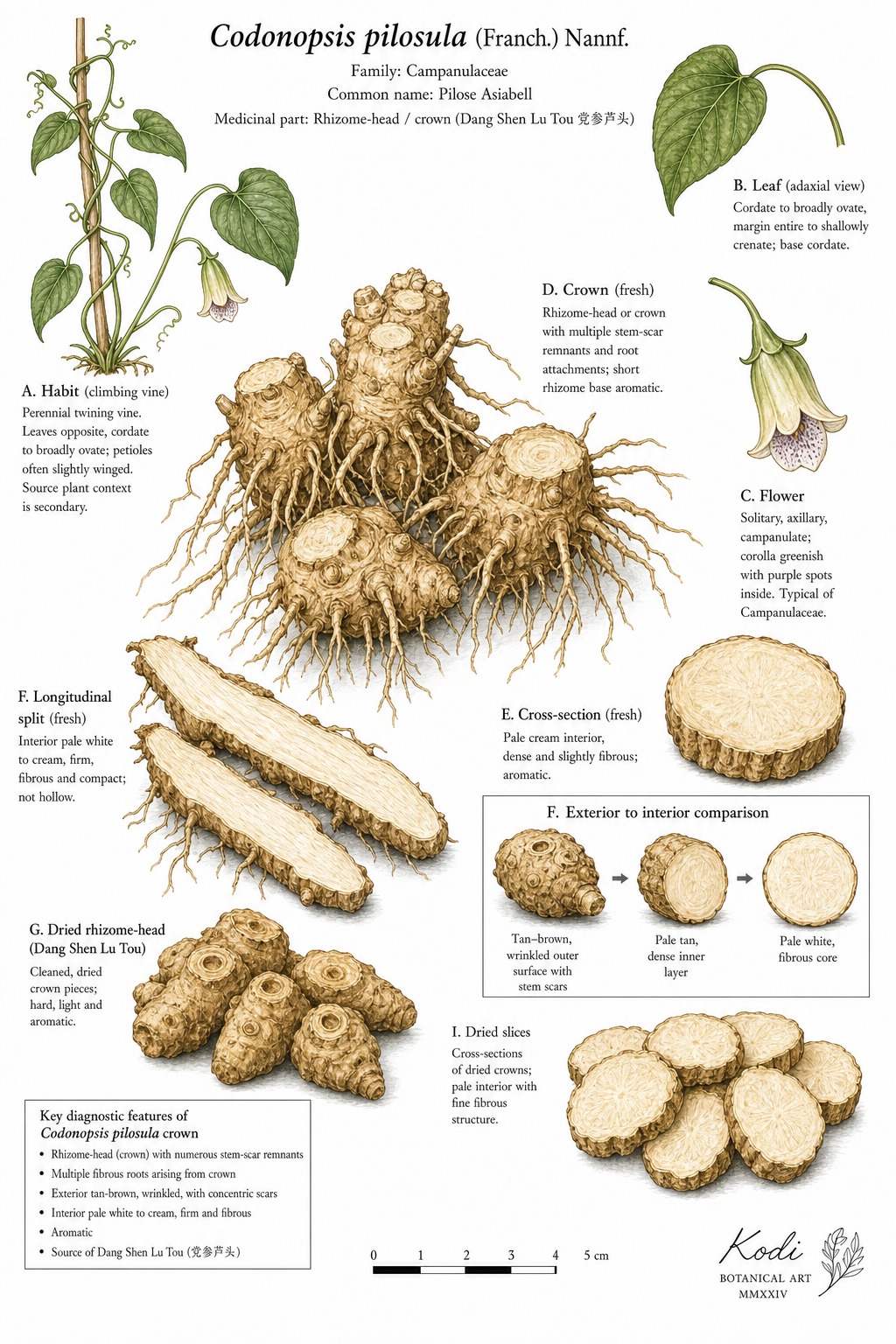
This sweet, neutral herb enters the Spleen and Lung. Traditionally, it gently supports Spleen and Lung qi as the crown or root-head lane of Dang Shen trade material ... used when poor appetite, loose stool, and mild fatigue suggest a lighter tonic approach, most often applied for poor appetite, digestive weakness, and diarrhea. Modern research has identified Codonopsis among its active constituents.
Part used: Rhizome
Also Known As
Latin: Rhizoma Codonopsis Pilosulae | Pinyin: Dang Shen Lu Tou
TCM Properties
- Taste
- sweet
- Temperature
- neutral
- Channels
- Spleen, Lung
Traditional Use
Primary Actions
- Gently supports Spleen and Lung qi as the crown or root-head lane of Dang Shen trade material ... used when poor appetite, loose stool, and mild fatigue suggest a lighter tonic approach.
- Helps generate fluids and support recovery after illness ... this follows the broader Codonopsis tradition, though crown material is less prized than the full root.
- Functions more as a lower-grade or secondary Dang Shen lane than as a separate major classical herb ... some trade traditions keep it for decoction use, while others trim it away during grading.
Secondary Actions
- This page must stay distinct from the still-stub `root-pilose-asiabell` / Dang Shen full-root page ... the identity here is crown or rhizome-head material with stem scars, not premium smooth tonic root.
- Modern inference ... most research is on Codonopsis Radix as a whole, not specifically on Dang Shen Lu Tou, so the claims here are intentionally conservative.
Classic Formulas
- Codonopsis-type Spleen-qi support formulas adapted from Si Jun Zi Tang or Shen Ling Bai Zhu San ... used when a milder qi-tonic component is acceptable.
- Recovery decoctions pairing Dang Shen material with Shan Yao, Bai Zhu, or Huang Qi ... traditional tonifying logic for weak digestion and depleted qi.
- Lung-Spleen support combinations with Mai Dong or Wu Wei Zi ... used when weak qi and mild dry cough overlap.
Classical References
- Trade and materia medica conventions treat Dang Shen Lu Tou as crown or head material of Codonopsis rather than a different species or separate tonic family.
- It is generally considered rougher and lower-grade than full Dang Shen root, which is why premium tonic products often emphasize removal or grading of the crown.
Modern Research
Active Compounds
- Codonopsis polysaccharides ... the best-known modern research fraction across the Dang Shen family
- Tangshenoside I and lobetyolin ... marker compounds commonly used in Codonopsis quality and mechanism studies
- Saponins and smaller phenolic constituents ... supportive fractions in broader Codonopsis pharmacology
Studied Effects
- A 2024 review summarized the biological activities of Codonopsis Radix as a traditional tonic plant, offering the broadest modern context for this crown-material page even though it is not specific to Dang Shen Lu Tou alone (PMID 38740108).
- A 2024 systematic review examined the mechanisms and medicinal value of Codonopsis pilosula in disease models, reinforcing the species' strong modern tonic and anti-inflammatory research profile (PMID 38803438).
- A 2021 polysaccharide review highlighted the structural characteristics and biological properties of Codonopsis pilosula polysaccharides, which helps explain why most modern Codonopsis research centers on the root as a whole rather than on crown material alone (PMID 33766352).
PubMed References
- Review of Codonopsis Radix biological activities: A plant of traditional Chinese tonic. (2024)
- A systematic review of the mechanism of action and potential medicinal value of codonopsis pilosula in diseases. (2024)
- Extraction, purification, structural characteristics and biological properties of the polysaccharides from Codonopsis pilosula: A review. (2021)
Safety & Interactions
Contraindications
- Acute excess patterns or thick damp obstruction without qi deficiency
Cautions
- Most direct modern evidence concerns full Codonopsis root rather than the trimmed crown material represented on this page.
- Because this is a lower-grade or secondary Dang Shen lane, it should not be assumed equivalent in quality to premium full-root tonic material.
Conditions
- Poor Appetite Traditional ★★★☆☆ JSON
- Digestive Weakness Traditional ★★★☆☆ JSON
- Diarrhea Traditional ★★☆☆☆ JSON
- Dry Cough Traditional ★☆☆☆☆ JSON
Frequently Asked Questions
What is Rhizome of Pilose Asiabell used for?
Rhizome of Pilose Asiabell is traditionally used to Gently supports Spleen and Lung qi as the crown or root-head lane of Dang Shen trade material ... used when poor appetite, loose stool, and mild fatigue suggest a lighter tonic approach., Helps generate fluids and support recovery after illness ... this follows the broader Codonopsis tradition, though crown material is less prized than the full root., Functions more as a lower-grade or secondary Dang Shen lane than as a separate major classical herb ... some trade traditions keep it for decoction use, while others trim it away during grading.. Research has investigated its effects on: A 2024 review summarized the biological activities of Codonopsis Radix as a traditional tonic plant, offering the broadest modern context for this crown-material page even though it is not specific to Dang Shen Lu Tou alone (PMID 38740108).; A 2024 systematic review examined the mechanisms and medicinal value of Codonopsis pilosula in disease models, reinforcing the species' strong modern tonic and anti-inflammatory research profile (PMID 38803438)..
What are other names for Rhizome of Pilose Asiabell?
Rhizome of Pilose Asiabell is also known as Dang Shen Lu Tou, Codonopsis Crown Material, Codonopsis pilosula Crown. In TCM: Rhizoma Codonopsis Pilosulae.
Is Rhizome of Pilose Asiabell safe during pregnancy?
The safety of Rhizome of Pilose Asiabell during pregnancy has not been established. Consult a qualified healthcare provider before use.
What are the contraindications for Rhizome of Pilose Asiabell?
Rhizome of Pilose Asiabell should not be used in: Acute excess patterns or thick damp obstruction without qi deficiency. Consult a qualified healthcare provider before use.