Rhizome of Pedate Pinellia
- Pinyin
- Zhang Ye Ban Xia
- Latin
- Rhizoma Pinelliae Pedatisectae
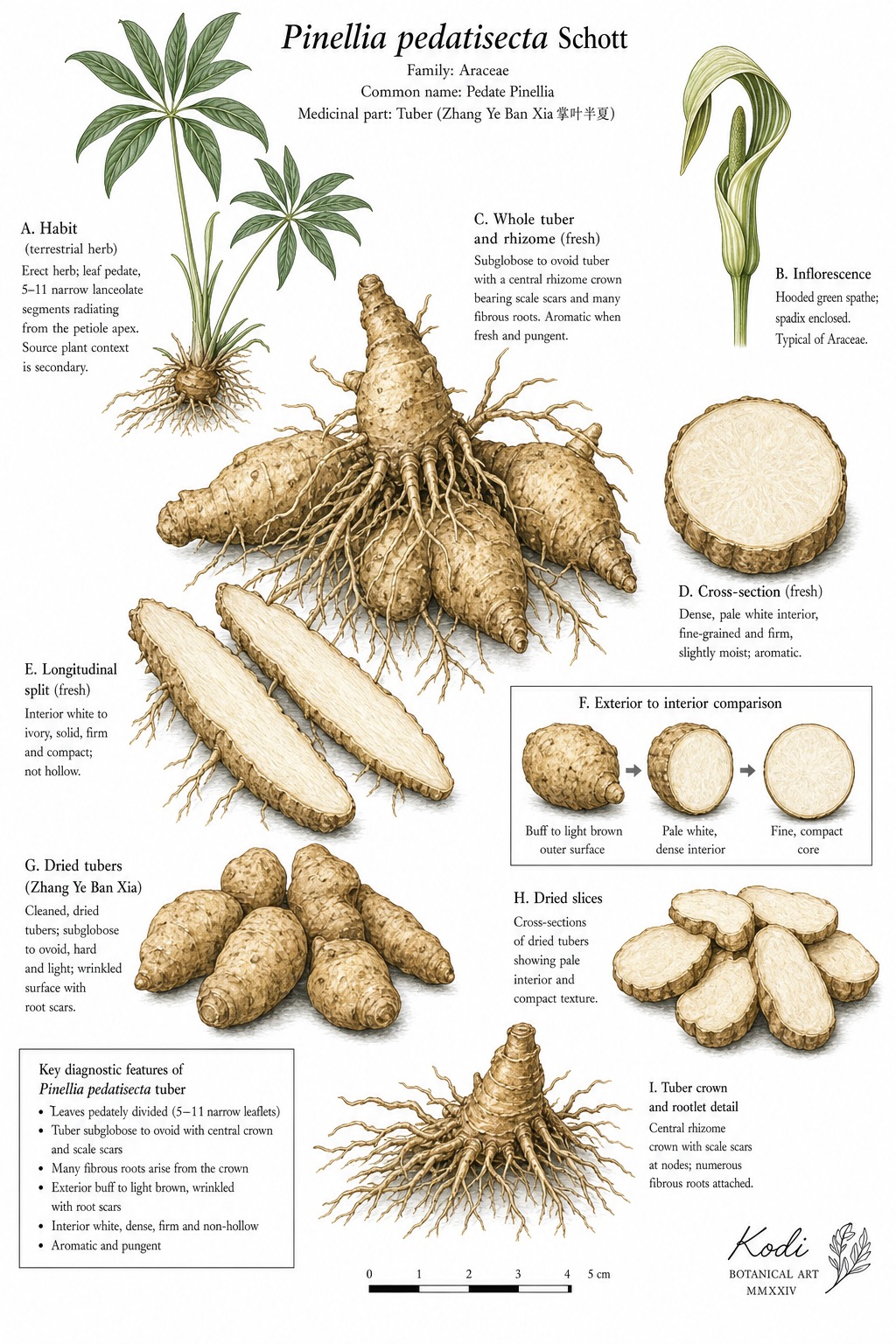
This acrid, warm herb enters the Lung, Spleen, and Stomach. Traditionally, it dries dampness and transforms stubborn phlegm ... Zhang Ye Ban Xia belongs to the toxic Pinellia family and is used for thick phlegm, obstruction, and difficult expectoration patterns, most often applied for phlegm accumulation, nausea, and productive cough. Modern research has identified Alkaloids among its active constituents.
Part used: Rhizome
Also Known As
Latin: Rhizoma Pinelliae Pedatisectae | Pinyin: Zhang Ye Ban Xia
TCM Properties
- Taste
- acrid
- Temperature
- warm
- Channels
- Lung, Spleen, Stomach
Traditional Use
Primary Actions
- Dries dampness and transforms stubborn phlegm ... Zhang Ye Ban Xia belongs to the toxic Pinellia family and is used for thick phlegm, obstruction, and difficult expectoration patterns.
- Dissipates swelling and reduces nodules ... traditional use extends to masses, scrofula-type nodulation, and toxic swellings where a stronger phlegm-resolving underground material was desired.
- Redirects rebellious qi and helps stop vomiting ... this follows the broader Ban Xia medicinal tradition, though the raw pedate species is a more specialized and more cautious lane than common processed Ban Xia.
Secondary Actions
- This page must stay distinct from Pinellia ternata, `prepared-pinellia-tuber`, `prepared-tuber-of-pinellia`, and `pinellia-tuber-leaven` ... species identity and raw-versus-processed status matter here.
- The pedate leaves identify the source plant, but the clinical identity is the toxic underground material rather than a casual home anti-nausea herb.
Classic Formulas
- Phlegm-nodule pairings with Zhe Bei Mu, Hai Zao, or Kun Bu ... traditional strategy when swelling and phlegm binding coexist.
- Phlegm-obstruction combinations with Chen Pi and Fu Ling ... used when expert sourcing and preparation support internal use.
- External swelling applications in the broader Ban Xia and Tian Nan Xing family ... traditional use aimed at reducing hard or toxic accumulations.
Classical References
- Regional and later materia medica describe Zhang Ye Ban Xia as a toxic Pinellia-family herb used for phlegm, swelling, and masses rather than as a gentle tonic.
- Because raw Pinellia-family medicinals irritate the throat and mucosa, identity and processing cannot be treated casually.
Modern Research
Active Compounds
- Alkaloids isolated from Pinellia pedatisecta tubers ... expanding current species-specific chemistry research
- Pinellia pedatisecta lectin ... a key bioactive and toxicity-linked protein fraction
- Lipid-soluble extracts and broader secondary-metabolite fractions ... main modern antitumor research focus
Studied Effects
- A 2025 paper identified alkaloids from the tubers of Pinellia pedatisecta, extending the chemistry map for this exact species-specific herb lane (PMID 40543641).
- A 2019 study found that Pinellia pedatisecta lectin exerted proinflammatory activity through ROS, MAPK, NF-kappaB, and inflammasome pathways, which directly supports the need for strong safety framing around raw material (PMID 30415189).
- A 2018 mouse-model study reported immune modulation by a lipid-soluble extract of Pinellia pedatisecta in an HPV-positive tumor setting, showing why the species attracts oncologic research even though that does not make it safe for self-use (PMID 29783020).
PubMed References
- Alkaloids from the tubers of Pinellia pedatisecta. (2025)
- Pinellia pedatisecta lectin exerts a proinflammatory activity correlated with ROS-MAPKs/NF-κB pathways and the NLRP3 inflammasome in RAW264.7 cells accompanied by cell pyroptosis. (2019)
- Immune modulation of a lipid-soluble extract of Pinellia pedatisecta Schott in the tumor microenvironment of an HPV(+) tumor-burdened mouse model. (2018)
Safety & Interactions
Contraindications
- Pregnancy
- Dry cough or yin deficiency without phlegm-damp obstruction
- Unsupervised internal use of raw material
Cautions
- Raw Pinellia-family herbs can be irritant and toxic, especially to the mouth, throat, and gastrointestinal tract.
- Species confusion with ordinary Ban Xia or casual substitution for processed Pinellia can create real safety problems.
- Modern antitumor research does not override the need for expert identification, processing judgment, and supervision.
Conditions
- Phlegm Accumulation Traditional ★★★☆☆ JSON
- Nausea Traditional ★★☆☆☆ JSON
- Productive Cough Traditional ★★☆☆☆ JSON
- Thyroid Nodule Traditional ★★☆☆☆ JSON
Frequently Asked Questions
What is Rhizome of Pedate Pinellia used for?
Rhizome of Pedate Pinellia is traditionally used to Dries dampness and transforms stubborn phlegm ... Zhang Ye Ban Xia belongs to the toxic Pinellia family and is used for thick phlegm, obstruction, and difficult expectoration patterns., Dissipates swelling and reduces nodules ... traditional use extends to masses, scrofula-type nodulation, and toxic swellings where a stronger phlegm-resolving underground material was desired., Redirects rebellious qi and helps stop vomiting ... this follows the broader Ban Xia medicinal tradition, though the raw pedate species is a more specialized and more cautious lane than common processed Ban Xia.. Research has investigated its effects on: A 2025 paper identified alkaloids from the tubers of Pinellia pedatisecta, extending the chemistry map for this exact species-specific herb lane (PMID 40543641).; A 2019 study found that Pinellia pedatisecta lectin exerted proinflammatory activity through ROS, MAPK, NF-kappaB, and inflammasome pathways, which directly supports the need for strong safety framing around raw material (PMID 30415189)..
What are other names for Rhizome of Pedate Pinellia?
Rhizome of Pedate Pinellia is also known as Zhang Ye Ban Xia, Pinellia pedatisecta Rhizome, Pedate Pinellia. In TCM: Rhizoma Pinelliae Pedatisectae.
Is Rhizome of Pedate Pinellia safe during pregnancy?
Rhizome of Pedate Pinellia is not recommended during pregnancy.
What are the contraindications for Rhizome of Pedate Pinellia?
Rhizome of Pedate Pinellia should not be used in: Pregnancy; Dry cough or yin deficiency without phlegm-damp obstruction; Unsupervised internal use of raw material. Consult a qualified healthcare provider before use.