Rhizome of Obscured Homalomena
- Pinyin
- Qian Nian Jian
- Latin
- Rhizoma Homalomenae Occultae
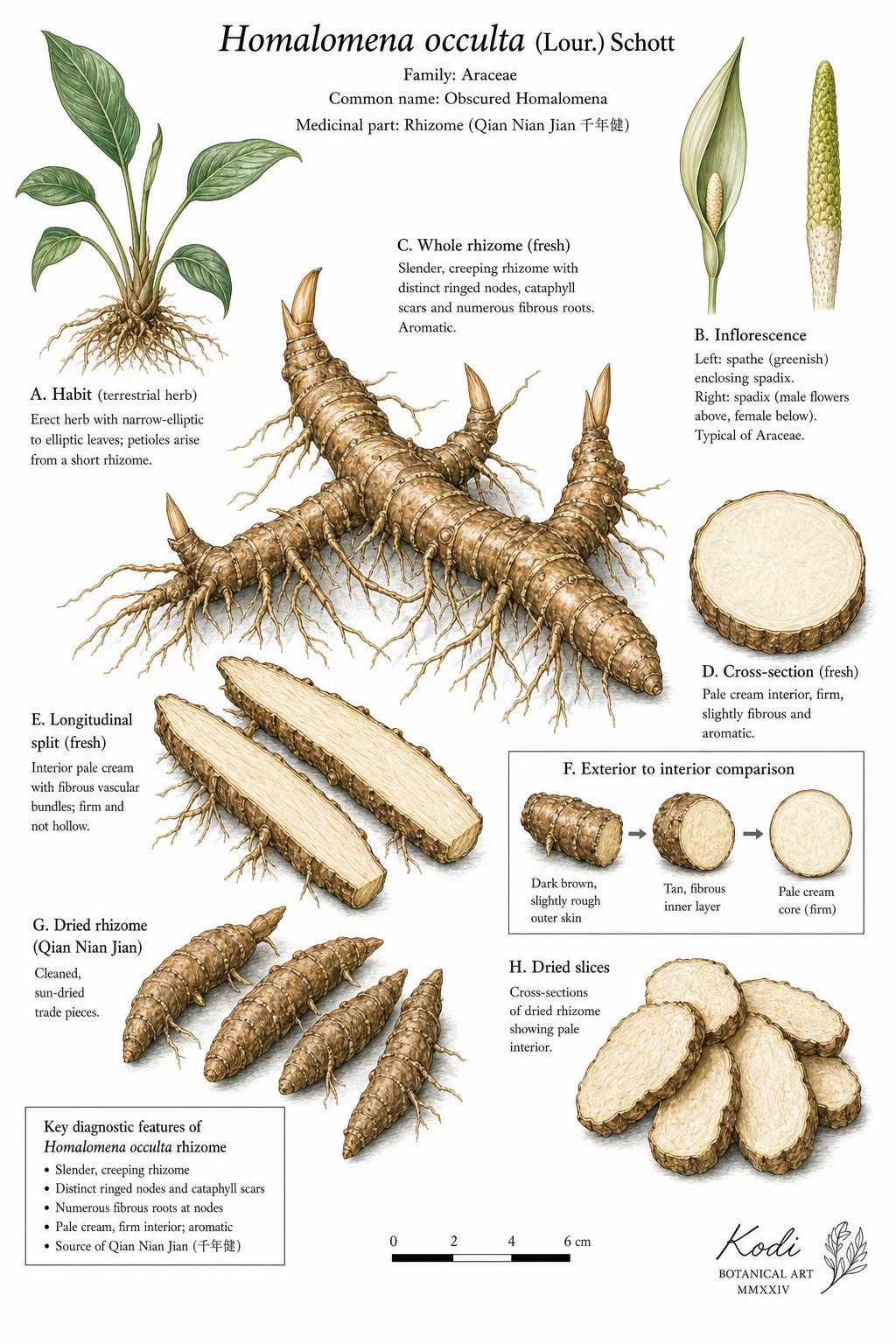
This bitter and acrid, warm herb enters the Liver and Kidney. Traditionally, it dispels wind-damp and unblocks the channels ... Qian Nian Jian is used for chronic joint pain, numbness, stiffness, and difficult mobility aggravated by cold-damp obstruction, most often applied for rheumatism, joint pain, and low back pain. Modern research has identified Sesquiterpenoids among its active constituents.
Part used: Rhizome
Also Known As
Latin: Rhizoma Homalomenae Occultae | Pinyin: Qian Nian Jian
TCM Properties
- Taste
- bitter, acrid
- Temperature
- warm
- Channels
- Liver, Kidney
Traditional Use
Primary Actions
- Dispels wind-damp and unblocks the channels ... Qian Nian Jian is used for chronic joint pain, numbness, stiffness, and difficult mobility aggravated by cold-damp obstruction.
- Strengthens sinews and bones ... traditional use includes low-back and knee weakness, chronic limb pain, and weakness that follows years of damp painful obstruction.
- Relieves pain in chronic obstructive or post-traumatic patterns ... its aromatic warming rhizome is remembered especially for deep aching and difficult movement.
Secondary Actions
- This page should stay distinct from the already-live `rhizome-of-gigantic-homalomena` sibling ... both are Homalomena-family medicinals, but the accepted identity here is specifically Homalomena occulta.
- Qian Nian Jian is more of a chronic wind-damp and sinew-bone mobility herb than a broad detox or digestive rhizome.
Classic Formulas
- Wind-damp pain combinations with Du Huo, Wei Ling Xian, or Qin Jiao ... used when chronic aching and stiffness dominate.
- Lower-back and knee weakness formulas with Sang Ji Sheng or Niu Xi ... traditional approach when obstruction and deficiency overlap.
- Trauma and chronic obstruction pairings with Ru Xiang or Mo Yao ... used when pain remains fixed and movement is restricted.
Classical References
- Traditional materia medica describes Qian Nian Jian as a warming aromatic rhizome that dispels wind-damp and strengthens sinews and bones.
- Its main clinical lane is musculoskeletal and mobility-focused rather than broadly tonic.
Modern Research
Active Compounds
- Sesquiterpenoids ... the dominant modern chemistry focus in Homalomena occulta rhizomes
- Volatile oils ... long-recognized aromatic fractions of Qian Nian Jian
- Osteoblast- and anti-inflammatory-active rhizome fractions ... supportive modern research targets
Studied Effects
- A 2019 paper reported further sesquiterpenoids from the rhizomes of Homalomena occulta and identified anti-inflammatory activity, matching the herb's classic pain-relief lane (PMID 30928195).
- A 2008 study found that sesquiterpenoids from Homalomena occulta affected osteoblast proliferation, differentiation, and mineralization in vitro, giving a useful modern correlate for the herb's sinew-and-bone reputation (PMID 18649899).
- An older volatile-oil paper mapped aromatic constituents of Homalomena occulta rhizome, reinforcing the identity-specific chemistry of Qian Nian Jian as an aromatic medicinal rhizome (PMID 17226172).
PubMed References
- Further sesquiterpenoids from the rhizomes of Homalomena occulta and their anti-inflammatory activity. (2019)
- Sesquiterpenoids from Homalomena occulta affect osteoblast proliferation, differentiation and mineralization in vitro. (2008)
- Volatile Constituents of the Rhizome of Homalomena occulta. (1991)
Safety & Interactions
Contraindications
- Yin deficiency heat or dryness without cold-damp painful obstruction
Cautions
- Most modern evidence is chemistry- and cell-model-heavy rather than large clinical trials.
- As with many warming aromatic rhizomes, Qian Nian Jian is a poor fit for hot inflamed pain without cold-damp or weakness.
Conditions
- Rheumatism Traditional ★★★★☆ JSON
- Joint Pain Traditional ★★★☆☆ JSON
- Low Back Pain Traditional ★★★☆☆ JSON
- Traumatic Injury Traditional ★★☆☆☆ JSON
Frequently Asked Questions
What is Rhizome of Obscured Homalomena used for?
Rhizome of Obscured Homalomena is traditionally used to Dispels wind-damp and unblocks the channels ... Qian Nian Jian is used for chronic joint pain, numbness, stiffness, and difficult mobility aggravated by cold-damp obstruction., Strengthens sinews and bones ... traditional use includes low-back and knee weakness, chronic limb pain, and weakness that follows years of damp painful obstruction., Relieves pain in chronic obstructive or post-traumatic patterns ... its aromatic warming rhizome is remembered especially for deep aching and difficult movement.. Research has investigated its effects on: A 2019 paper reported further sesquiterpenoids from the rhizomes of Homalomena occulta and identified anti-inflammatory activity, matching the herb's classic pain-relief lane (PMID 30928195).; A 2008 study found that sesquiterpenoids from Homalomena occulta affected osteoblast proliferation, differentiation, and mineralization in vitro, giving a useful modern correlate for the herb's sinew-and-bone reputation (PMID 18649899)..
What are other names for Rhizome of Obscured Homalomena?
Rhizome of Obscured Homalomena is also known as Qian Nian Jian, Homalomena occulta Rhizome, Obscured Homalomena Rhizome. In TCM: Rhizoma Homalomenae Occultae.
Is Rhizome of Obscured Homalomena safe during pregnancy?
The safety of Rhizome of Obscured Homalomena during pregnancy has not been established. Consult a qualified healthcare provider before use.
What are the contraindications for Rhizome of Obscured Homalomena?
Rhizome of Obscured Homalomena should not be used in: Yin deficiency heat or dryness without cold-damp painful obstruction. Consult a qualified healthcare provider before use.