Rhizome of Nutgrass Galingale
- Pinyin
- Zhi Xiang Fu
- Latin
- Rhizoma Cyperi Praeparata
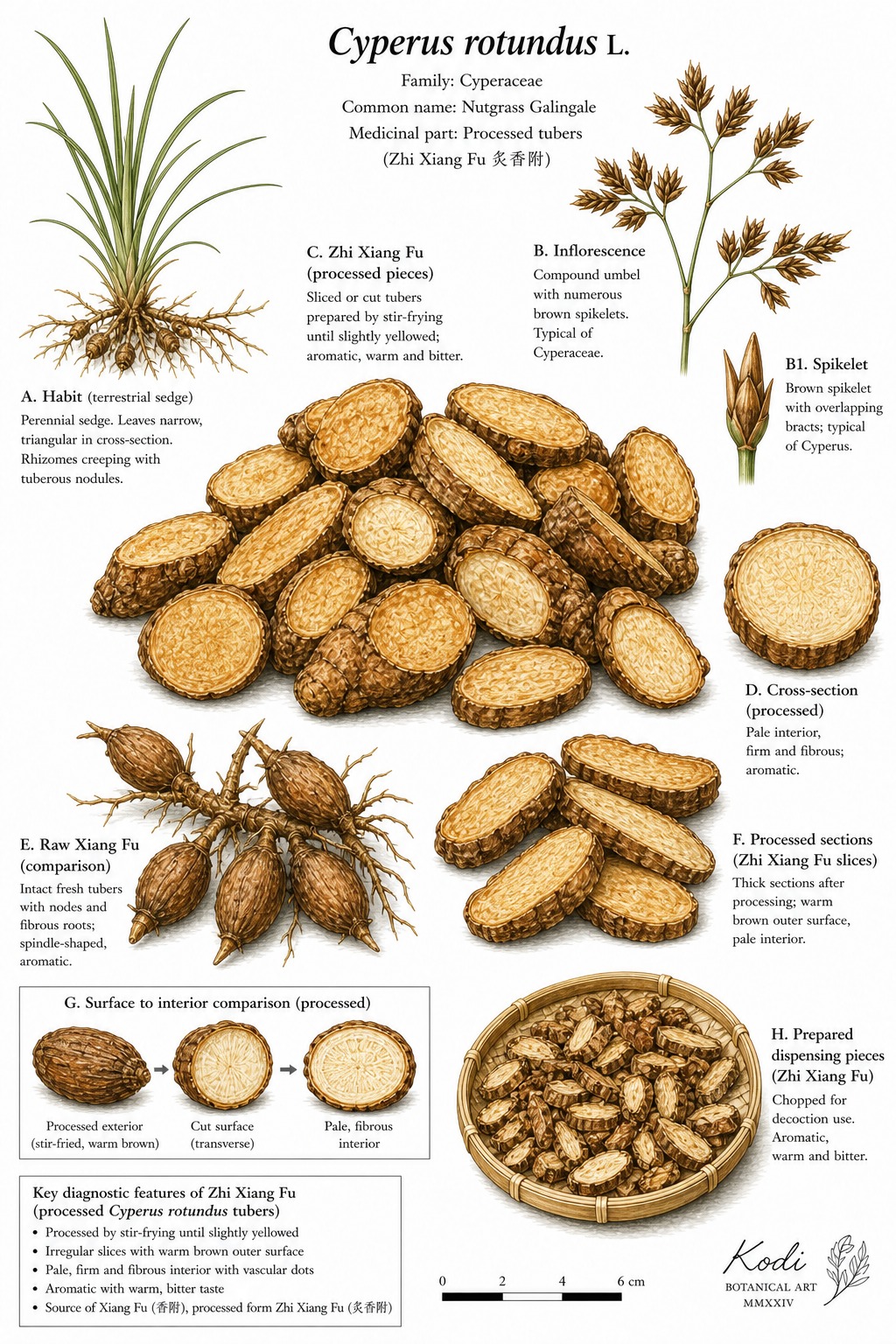
This acrid and slightly bitter and slightly sweet, neutral herb enters the Liver and Triple Burner. Traditionally, it regulates Liver qi and relieves pain with a stronger gynecologic emphasis ... Zhi Xiang Fu is commonly used for menstrual pain, irregular cycles, flank tension, and constrained Liver patterns, most often applied for dysmenorrhea, menstrual irregularities, and liver qi stagnation. Modern research has identified Sesquiterpenes among its active constituents.
Part used: Rhizome
Also Known As
Latin: Rhizoma Cyperi Praeparata | Pinyin: Zhi Xiang Fu
TCM Properties
- Taste
- acrid, slightly bitter, slightly sweet
- Temperature
- neutral
- Channels
- Liver, Triple Burner
Traditional Use
Primary Actions
- Regulates Liver qi and relieves pain with a stronger gynecologic emphasis ... Zhi Xiang Fu is commonly used for menstrual pain, irregular cycles, flank tension, and constrained Liver patterns.
- Enhances the menstrual and blood-regulating lane of Xiang Fu through processing ... in practice it is often chosen when pain and cycle disturbance are more prominent than broad digestive use alone.
- Harmonizes the middle burner and eases qi-stagnation distension ... it still helps epigastric discomfort and abdominal fullness when constraint affects digestion.
Secondary Actions
- This page follows the processed Zhi Xiang Fu dispensing lane rather than the raw aromatic-tuber identity in `rhizome-of-nutgrass-galingale`.
- Modern literature seldom separates pharmacy-grade processed Xiang Fu cleanly from raw Cyperi Rhizoma, so the processing distinction here follows traditional dispensing logic more than a separate research corpus.
Classic Formulas
- Menstrual-pain pairings with Chai Hu, Bai Shao, or Dang Gui ... traditional strategy when constrained Liver qi disrupts the cycle.
- Vinegar-processed Xiang Fu combinations for breast, flank, or lower-abdominal pain ... common gynecology-facing dispensing logic in later practice.
- Qi-regulating formulas with Chen Pi or Fo Shou ... used when processed Xiang Fu is chosen to reduce distension while still keeping a Liver focus.
Classical References
- Traditional pharmacy practice treats Zhi Xiang Fu as a processed extension of Xiang Fu with stronger menstrual-pain and Liver-channel emphasis.
- The processing distinction matters clinically even when modern papers discuss Cyperi Rhizoma more generally.
Modern Research
Active Compounds
- Sesquiterpenes such as cyperene, cyperotundone, and related volatile-oil constituents ... major modern markers of the Xiang Fu family
- Flavonoids and phenolics ... supportive antioxidant and anti-inflammatory fractions
- Broader essential-oil fractions ... the main source of modern pharmacologic interest
Studied Effects
- A 2015 review summarized the traditional uses, phytochemistry, and pharmacological activities of Cyperus rotundus, providing the main modern overview that also informs processed Xiang Fu discussion (PMID 26297840).
- A 2022 systematic review focused on Cyperi Rhizoma ethnomedicine and pharmacology, reinforcing the herb's longstanding association with pain, gynecology, and gastrointestinal regulation (PMID 36278199).
- A 2021 Cyperus-species review highlighted the phytochemical diversity and health-promoting activity of the genus, although it did not cleanly isolate the processed Zhi Xiang Fu market lane from raw material (PMID 34539969).
PubMed References
Safety & Interactions
Contraindications
- Yin deficiency heat without qi stagnation
- Heavy menstrual bleeding from deficiency rather than constrained pain patterns
Cautions
- Processed Xiang Fu is still a pattern-based qi-regulating herb and should not be used casually for undiagnosed pelvic or abdominal pain.
- Modern studies often examine Cyperus rotundus broadly and do not always distinguish processed Zhi Xiang Fu from raw Xiang Fu.
Conditions
- Dysmenorrhea Traditional ★★★★☆ JSON
- Menstrual Irregularities Traditional ★★★★☆ JSON
- Liver Qi Stagnation Traditional ★★★☆☆ JSON
- Abdominal Pain Traditional ★★★☆☆ JSON
Frequently Asked Questions
What is Rhizome of Nutgrass Galingale used for?
Rhizome of Nutgrass Galingale is traditionally used to Regulates Liver qi and relieves pain with a stronger gynecologic emphasis ... Zhi Xiang Fu is commonly used for menstrual pain, irregular cycles, flank tension, and constrained Liver patterns., Enhances the menstrual and blood-regulating lane of Xiang Fu through processing ... in practice it is often chosen when pain and cycle disturbance are more prominent than broad digestive use alone., Harmonizes the middle burner and eases qi-stagnation distension ... it still helps epigastric discomfort and abdominal fullness when constraint affects digestion.. Research has investigated its effects on: A 2015 review summarized the traditional uses, phytochemistry, and pharmacological activities of Cyperus rotundus, providing the main modern overview that also informs processed Xiang Fu discussion (PMID 26297840).; A 2022 systematic review focused on Cyperi Rhizoma ethnomedicine and pharmacology, reinforcing the herb's longstanding association with pain, gynecology, and gastrointestinal regulation (PMID 36278199)..
What are other names for Rhizome of Nutgrass Galingale?
Rhizome of Nutgrass Galingale is also known as Zhi Xiang Fu, Processed Cyperus Rhizome, Prepared Nutgrass Tuber. In TCM: Rhizoma Cyperi Praeparata.
Is Rhizome of Nutgrass Galingale safe during pregnancy?
The safety of Rhizome of Nutgrass Galingale during pregnancy has not been established. Consult a qualified healthcare provider before use.
What are the contraindications for Rhizome of Nutgrass Galingale?
Rhizome of Nutgrass Galingale should not be used in: Yin deficiency heat without qi stagnation; Heavy menstrual bleeding from deficiency rather than constrained pain patterns. Consult a qualified healthcare provider before use.