Rhizome of Nutgrass Galingale
- Pinyin
- Xiang Fu
- Latin
- Rhizoma Cyperi
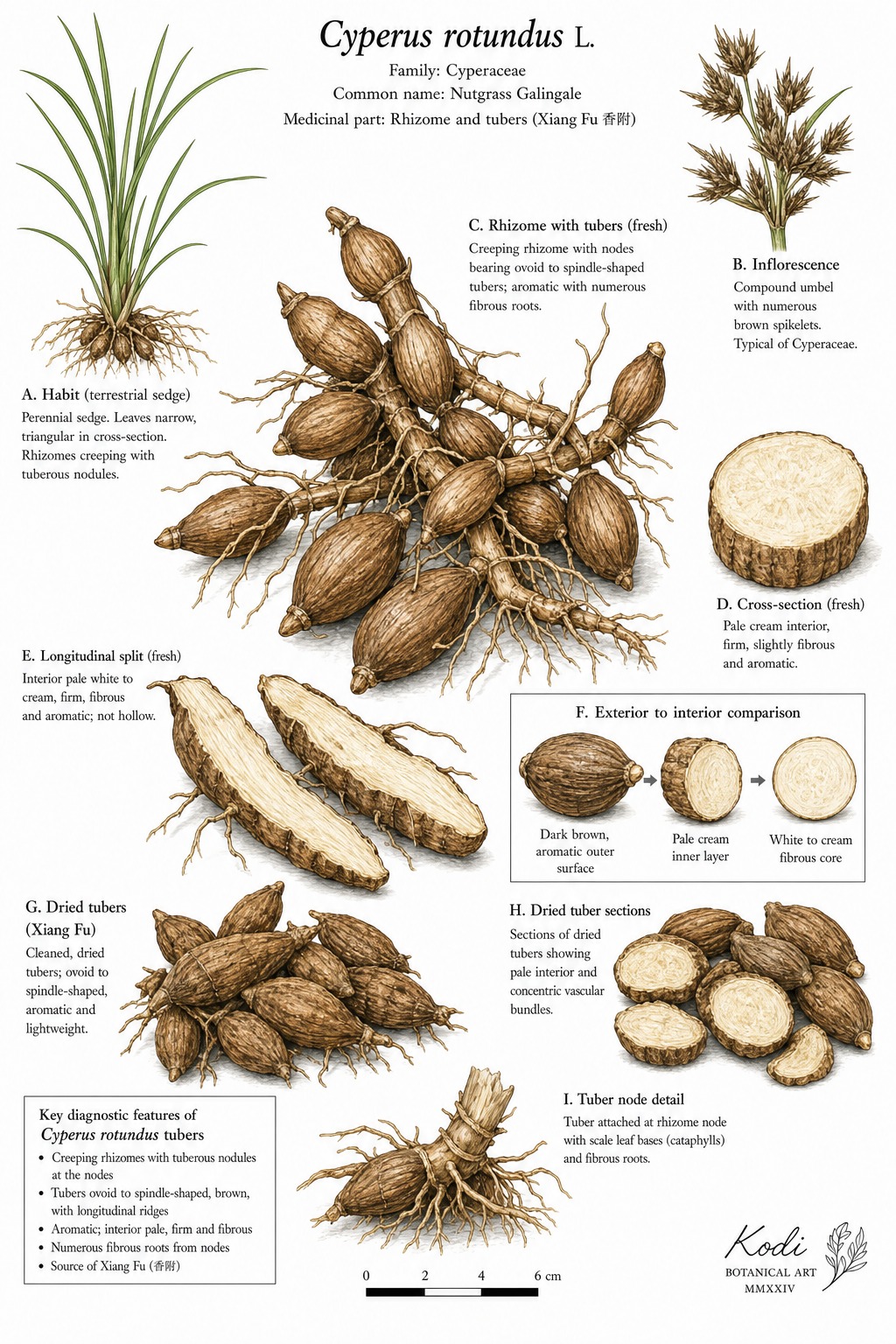
This acrid and slightly bitter and slightly sweet, neutral herb enters the Liver and Triple Burner. Traditionally, it spreads Liver qi and relieves constraint ... Xiang Fu is a classic herb for chest, flank, epigastric, or emotional stagnation patterns marked by distension and discomfort, most often applied for dysmenorrhea, liver qi stagnation, and abdominal pain. Modern research has identified Sesquiterpenes among its active constituents.
Part used: Rhizome
Also Known As
Latin: Rhizoma Cyperi | Pinyin: Xiang Fu
TCM Properties
- Taste
- acrid, slightly bitter, slightly sweet
- Temperature
- neutral
- Channels
- Liver, Triple Burner
Traditional Use
Primary Actions
- Spreads Liver qi and relieves constraint ... Xiang Fu is a classic herb for chest, flank, epigastric, or emotional stagnation patterns marked by distension and discomfort.
- Regulates menstruation and alleviates pain ... it is widely used for dysmenorrhea, irregular cycles, breast distension, and qi-stagnation gynecologic patterns.
- Harmonizes the middle burner and reduces abdominal distension ... traditional use extends to nausea, poor appetite, and Stomach discomfort when Liver-Spleen disharmony is prominent.
Secondary Actions
- This raw Xiang Fu page should stay distinct from the processed `rhizome-of-nutgrass-galingale-2` / Zhi Xiang Fu sibling ... the raw aromatic tuber is the broader qi-regulating lane.
- Classical gynecology texts give Xiang Fu unusual importance because it moves constrained qi without being as harsh as the stronger blood-breakers.
Classic Formulas
- Liang Fu Wan ... classic pairing of Xiang Fu with Gao Liang Jiang for stomach-cold pain with qi stagnation.
- Liver-constraint menstrual formulas with Chai Hu, Bai Shao, or Dang Gui ... used when pain, mood, and cycle irregularity travel together.
- Qi-regulating combinations with Chen Pi or Fo Shou ... traditional strategy for distension, nausea, and poor appetite from constrained Liver-Spleen qi.
Classical References
- Traditional herbology describes Xiang Fu as a neutral qi-regulating herb that excels in Liver constraint and menstrual pain.
- It is sometimes called the holy medicine of gynecology in later literature, but its real strength is broad qi regulation rather than being limited to one body system.
Modern Research
Active Compounds
- Sesquiterpenes such as cyperene, cyperotundone, and related volatile-oil constituents ... major modern markers of Xiang Fu
- Flavonoids and phenolics ... supportive antioxidant and anti-inflammatory fractions
- Broader essential-oil fractions ... the main source of modern pharmacologic interest
Studied Effects
- A 2015 review summarized the traditional uses, phytochemistry, and pharmacological activities of Cyperus rotundus, giving a broad research map for Xiang Fu and related preparations (PMID 26297840).
- A 2022 systematic review focused on Cyperi Rhizoma ethnomedicine and pharmacology, reinforcing Xiang Fu's long association with pain, gynecology, and gastrointestinal regulation (PMID 36278199).
- A 2021 Cyperus-species review highlighted the phytochemical diversity and health-promoting activity of the genus, supporting modern interest in the aromatic sedge tuber family behind Xiang Fu (PMID 34539969).
PubMed References
Safety & Interactions
Contraindications
- Yin deficiency heat without qi stagnation
- Heavy menstrual bleeding from deficiency rather than constrained pain patterns
Cautions
- Xiang Fu is generally moderate, but persistent severe pelvic pain or cycle disruption still needs medical evaluation rather than herbal self-diagnosis.
- Modern studies often examine Cyperus rotundus broadly and do not always distinguish raw from processed Xiang Fu market forms.
Conditions
- Dysmenorrhea Traditional ★★★★☆ JSON
- Liver Qi Stagnation Traditional ★★★★☆ JSON
- Abdominal Pain Traditional ★★★☆☆ JSON
- Menstrual Irregularities Traditional ★★★☆☆ JSON
Frequently Asked Questions
What is Rhizome of Nutgrass Galingale used for?
Rhizome of Nutgrass Galingale is traditionally used to Spreads Liver qi and relieves constraint ... Xiang Fu is a classic herb for chest, flank, epigastric, or emotional stagnation patterns marked by distension and discomfort., Regulates menstruation and alleviates pain ... it is widely used for dysmenorrhea, irregular cycles, breast distension, and qi-stagnation gynecologic patterns., Harmonizes the middle burner and reduces abdominal distension ... traditional use extends to nausea, poor appetite, and Stomach discomfort when Liver-Spleen disharmony is prominent.. Research has investigated its effects on: A 2015 review summarized the traditional uses, phytochemistry, and pharmacological activities of Cyperus rotundus, giving a broad research map for Xiang Fu and related preparations (PMID 26297840).; A 2022 systematic review focused on Cyperi Rhizoma ethnomedicine and pharmacology, reinforcing Xiang Fu's long association with pain, gynecology, and gastrointestinal regulation (PMID 36278199)..
What are other names for Rhizome of Nutgrass Galingale?
Rhizome of Nutgrass Galingale is also known as Xiang Fu, Cyperus rotundus Tuber, Nutgrass Tuber. In TCM: Rhizoma Cyperi.
Is Rhizome of Nutgrass Galingale safe during pregnancy?
The safety of Rhizome of Nutgrass Galingale during pregnancy has not been established. Consult a qualified healthcare provider before use.
What are the contraindications for Rhizome of Nutgrass Galingale?
Rhizome of Nutgrass Galingale should not be used in: Yin deficiency heat without qi stagnation; Heavy menstrual bleeding from deficiency rather than constrained pain patterns. Consult a qualified healthcare provider before use.