Rhizome of Kwangsi Turmeric
- Pinyin
- Guang Xi E Zhu
- Latin
- Rhizoma Curcumae
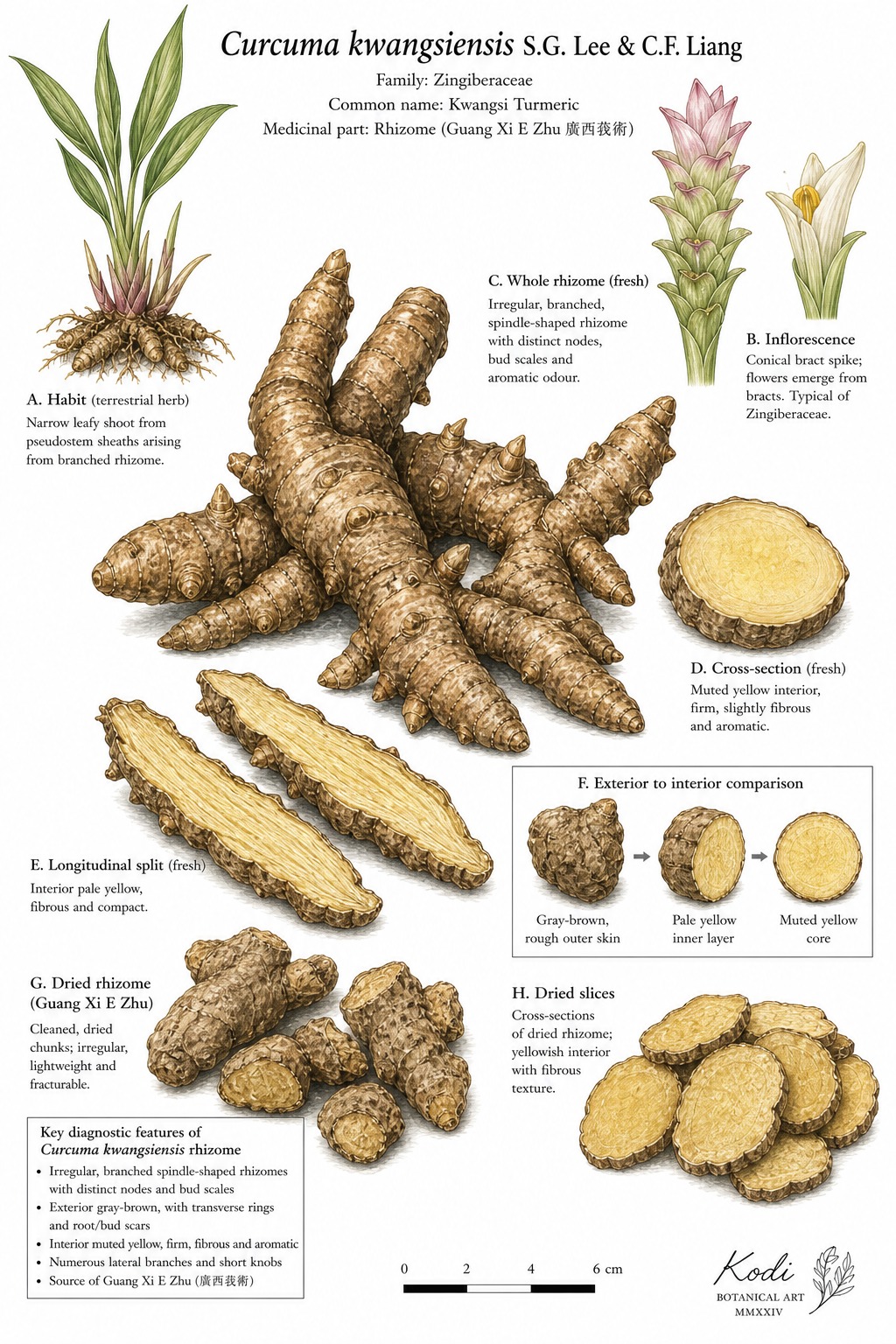
This acrid and bitter, warm herb enters the Liver and Spleen. Traditionally, it breaks up blood stasis and forcefully moves qi ... Guang Xi E Zhu is used for fixed abdominal pain, masses, amenorrhea, and stubborn stagnation patterns where strong movement is needed, most often applied for dysmenorrhea, abdominal pain, and traumatic injury. Modern research has identified Terpenoids among its active constituents.
Part used: Rhizome
Also Known As
Latin: Rhizoma Curcumae | Pinyin: Guang Xi E Zhu
TCM Properties
- Taste
- acrid, bitter
- Temperature
- warm
- Channels
- Liver, Spleen
Traditional Use
Primary Actions
- Breaks up blood stasis and forcefully moves qi ... Guang Xi E Zhu is used for fixed abdominal pain, masses, amenorrhea, and stubborn stagnation patterns where strong movement is needed.
- Reduces accumulations and relieves distension ... traditional use includes food stagnation or focal fullness when obstruction and pain travel together.
- Relieves pain in traumatic or stagnation-driven patterns ... its action is stronger and more dispersing than the gentler culinary-turmeric image many people assume.
Secondary Actions
- This page should stay distinct from `rhizome-of-common-turmeric` / Jiang Huang ... same botanical family, but Guang Xi E Zhu is the more forceful mass-dispersing and blood-breaking lane.
- The accepted source here is Curcuma kwangsiensis, and the medicinal identity is the irregular trade rhizome rather than culinary turmeric styling.
Classic Formulas
- E Zhu with San Leng ... classic pairing for stubborn masses, severe blood stasis, and fixed abdominal pain.
- Blood-stasis pain combinations with Dan Shen, Yan Hu Suo, or Dang Gui ... traditional strategy when obstruction and pain are intertwined.
- Stagnation and food-accumulation formulas with Shan Zha or Mai Ya ... used when fullness, obstruction, and pain coexist in the middle burner.
Classical References
- Traditional herbology places E Zhu among the stronger blood-invigorating medicinals that break accumulations and relieve pain.
- Unlike Jiang Huang, E Zhu is the harsher mass-resolving turmeric-family lane and is used more cautiously in depleted patients.
Modern Research
Active Compounds
- Terpenoids including curcumol-class and related sesquiterpene fractions ... central to modern E Zhu chemistry work
- Diarylheptanoids and volatile oils ... supportive constituents in pain and inflammation research
- Polysaccharides ... immune-modulating fractions explored in newer Curcuma kwangsiensis studies
Studied Effects
- A 2020 study found anti-inflammatory and antinociceptive effects from Curcuma kwangsiensis and its bioactive terpenoids, giving a direct modern correlate for the herb's pain-relief lane (PMID 32387235).
- A 2024 paper isolated terpenoids from Curcuma kwangsiensis rhizomes and reported anti-inflammatory activity, reinforcing the species-specific evidence base for this page (PMID 39053742).
- A 2023 review compared the sources, morphology, phytochemistry, and pharmacology of the turmeric-family medicinals, helping clarify why Curcumae Rhizoma should not be collapsed into Jiang Huang or Yu Jin without distinction (PMID 37719857).
PubMed References
- Anti-inflammatory and antinociceptive effects of Curcuma kwangsiensis and its bioactive terpenoids in vivo and in vitro. (2020)
- Terpenoids from the rhizomes of Curcuma kwangsiensis S.G. Lee et C.F. Ling and their anti-inflammatory activities. (2024)
- Sources, morphology, phytochemistry, pharmacology of Curcumae Longae Rhizoma, Curcumae Radix, and Curcumae Rhizoma: a review of the literature. (2023)
Safety & Interactions
Contraindications
- Pregnancy without professional supervision
- Heavy active bleeding without a clear blood-stasis rationale
- Very weak constitution without substantial stagnation or accumulation
Cautions
- Guang Xi E Zhu is a strong blood-moving herb and should not be confused with small culinary turmeric amounts used in food.
- Most antitumor and anti-inflammatory literature remains preclinical and does not justify unsupervised long-term use.
Drug Interactions
- Anticoagulant or antiplatelet drugs ... possible additive bleeding risk
Conditions
- Dysmenorrhea Traditional ★★★☆☆ JSON
- Abdominal Pain Traditional ★★★☆☆ JSON
- Traumatic Injury Traditional ★★★☆☆ JSON
- Menstrual Irregularities Traditional ★★☆☆☆ JSON
Frequently Asked Questions
What is Rhizome of Kwangsi Turmeric used for?
Rhizome of Kwangsi Turmeric is traditionally used to Breaks up blood stasis and forcefully moves qi ... Guang Xi E Zhu is used for fixed abdominal pain, masses, amenorrhea, and stubborn stagnation patterns where strong movement is needed., Reduces accumulations and relieves distension ... traditional use includes food stagnation or focal fullness when obstruction and pain travel together., Relieves pain in traumatic or stagnation-driven patterns ... its action is stronger and more dispersing than the gentler culinary-turmeric image many people assume.. Research has investigated its effects on: A 2020 study found anti-inflammatory and antinociceptive effects from Curcuma kwangsiensis and its bioactive terpenoids, giving a direct modern correlate for the herb's pain-relief lane (PMID 32387235).; A 2024 paper isolated terpenoids from Curcuma kwangsiensis rhizomes and reported anti-inflammatory activity, reinforcing the species-specific evidence base for this page (PMID 39053742)..
What are other names for Rhizome of Kwangsi Turmeric?
Rhizome of Kwangsi Turmeric is also known as Guang Xi E Zhu, Curcuma kwangsiensis Rhizome, Curcuma Rhizome. In TCM: Rhizoma Curcumae.
Is Rhizome of Kwangsi Turmeric safe during pregnancy?
Rhizome of Kwangsi Turmeric is not recommended during pregnancy.
What are the contraindications for Rhizome of Kwangsi Turmeric?
Rhizome of Kwangsi Turmeric should not be used in: Pregnancy without professional supervision; Heavy active bleeding without a clear blood-stasis rationale; Very weak constitution without substantial stagnation or accumulation. Consult a qualified healthcare provider before use.
Does Rhizome of Kwangsi Turmeric interact with any medications?
Rhizome of Kwangsi Turmeric may interact with: Anticoagulant or antiplatelet drugs ... possible additive bleeding risk. Always inform your healthcare provider of any herbal supplements you are taking.