Rhizome of Fragrant Solomonseal
- Chinese
- 黄精
- Pinyin
- Huang Jing
- Latin
- Rhizoma Polygonati
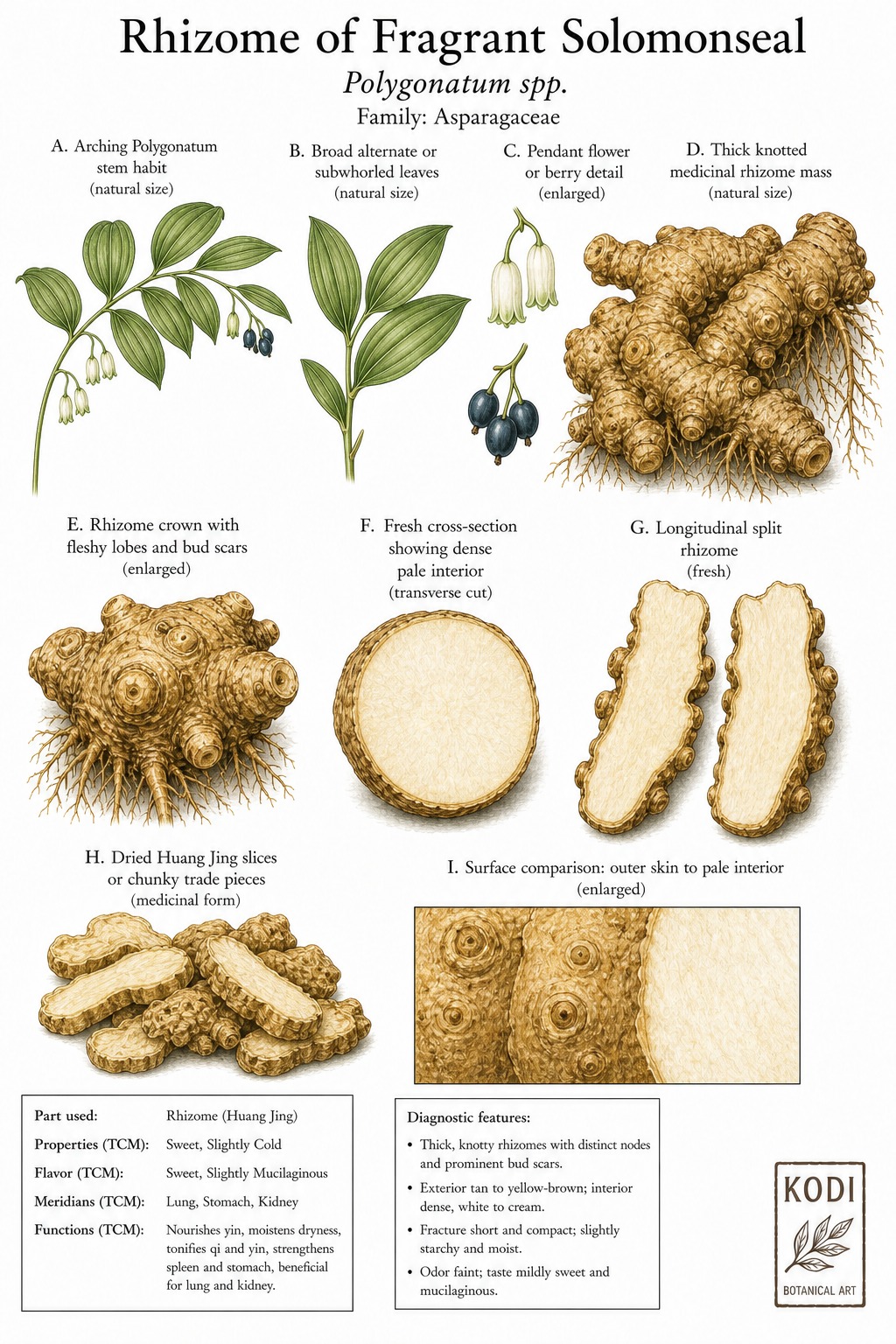
Known in TCM as Huang Jing (黄精), this sweet, neutral herb enters the Spleen, Lung, and Kidney. Traditionally, it tonifies qi and nourishes yin ... Huang Jing is used for fatigue, poor appetite, dryness, and weakness when depletion affects both energy and fluids, most often applied for fatigue, digestive weakness, and dry cough. Modern research has identified Polygonatum among its active constituents.
Part used: Rhizome
Also Known As
Latin: Rhizoma Polygonati | Pinyin: Huang Jing | Chinese: 黄精
TCM Properties
- Taste
- sweet
- Temperature
- neutral
- Channels
- Spleen, Lung, Kidney
Traditional Use
Primary Actions
- Tonifies qi and nourishes yin ... Huang Jing is used for fatigue, poor appetite, dryness, and weakness when depletion affects both energy and fluids.
- Strengthens the Spleen and supports recovery ... it helps chronic digestive weakness, weight loss, and frailty when a food-medicine style tonic is preferred.
- Moistens the Lung and benefits the Kidneys ... traditional use extends to dry cough, thirst, lower-burner weakness, and essence depletion.
Secondary Actions
- This page should stay on the larger knotty Huang Jing trade-rhizome tradition and remain clearly distinct from the smoother `fragrant-solomonseal-rhizome` or Yu Zhu lane and from the darker processed Polygonatum sibling.
- Compared with Yu Zhu, Huang Jing is fuller, more tonic, and more centered on qi-and-essence rebuilding rather than light moistening alone.
Classic Formulas
- Huang Jing-based tonic and convalescent formulas ... classic use when fatigue, dryness, and constitutional weakness overlap.
- Food-medicine restorative combinations with Shan Yao or Gou Qi Zi ... common strategy when long-term rebuilding is the goal.
- Lung-and-Spleen deficiency pairings ... used when weak digestion and dry cough travel together.
Classical References
- Traditional materia medica describes Huang Jing as sweet and neutral, entering the Spleen, Lung, and Kidney to tonify qi, nourish yin, and moisten dryness.
- Its knotty rhizome identity and tonic direction distinguish it from the lighter Yu Zhu lane despite the broader Polygonatum relationship.
Modern Research
Active Compounds
- Polygonatum polysaccharides ... the best-studied macromolecular fraction in Huang Jing research
- Steroidal saponins ... major secondary metabolites linked with tonic and metabolic study interest
- Flavonoids and phenolic compounds ... supportive antioxidant and anti-aging research constituents
Studied Effects
- A 2023 review summarized the ethnopharmacology, botany, phytochemistry, pharmacology, and applications of Polygonati Rhizoma as a medicine-food homologous material, providing a strong modern anchor for Huang Jing (PMID 36841378).
- A 2024 review focused on extraction, purification, secondary metabolites, and anti-aging effects of Polygonati Rhizoma, reinforcing its modern reputation as a restorative medicinal food (PMID 38437890).
- A 2022 review of edible and medicinal Polygonati Rhizoma polysaccharides highlighted translational interest from bench to market, especially for metabolic and immunologic support (PMID 34896461).
PubMed References
- Polygonati Rhizoma with the homology of medicine and food: A review of ethnopharmacology, botany, phytochemistry, pharmacology and applications. (2023)
- Polygonati Rhizoma: A review on the extraction, purification, structural characterization, biosynthesis of the main secondary metabolites and anti-aging effects. (2024)
- Recent advances in polysaccharides from edible and medicinal Polygonati rhizoma: From bench to market. (2022)
Safety & Interactions
Contraindications
- Damp-phlegm obstruction with marked fullness and greasy tongue
- Loose stool when richer tonic moistening worsens digestion
Cautions
- Huang Jing is richer and more tonic than Yu Zhu and can aggravate fullness or dampness in sensitive patients.
- Commercial Polygonatum products vary widely in processing and sweetness, so food-style products are not always equivalent to medicinal rhizome slices.
Conditions
- Fatigue Traditional ★★★★☆ JSON
- Digestive Weakness Traditional ★★★☆☆ JSON
- Dry Cough Traditional ★★★☆☆ JSON
- Yin Deficiency Traditional ★★★☆☆ JSON
Frequently Asked Questions
What is Rhizome of Fragrant Solomonseal used for?
Rhizome of Fragrant Solomonseal is traditionally used to Tonifies qi and nourishes yin ... Huang Jing is used for fatigue, poor appetite, dryness, and weakness when depletion affects both energy and fluids., Strengthens the Spleen and supports recovery ... it helps chronic digestive weakness, weight loss, and frailty when a food-medicine style tonic is preferred., Moistens the Lung and benefits the Kidneys ... traditional use extends to dry cough, thirst, lower-burner weakness, and essence depletion.. Research has investigated its effects on: A 2023 review summarized the ethnopharmacology, botany, phytochemistry, pharmacology, and applications of Polygonati Rhizoma as a medicine-food homologous material, providing a strong modern anchor for Huang Jing (PMID 36841378).; A 2024 review focused on extraction, purification, secondary metabolites, and anti-aging effects of Polygonati Rhizoma, reinforcing its modern reputation as a restorative medicinal food (PMID 38437890)..
What are other names for Rhizome of Fragrant Solomonseal?
Rhizome of Fragrant Solomonseal is also known as Polygonati Rhizoma, Huang Jing, Polygonatum Rhizome. In TCM: 黄精 (Huang Jing); Rhizoma Polygonati.
Is Rhizome of Fragrant Solomonseal safe during pregnancy?
The safety of Rhizome of Fragrant Solomonseal during pregnancy has not been established. Consult a qualified healthcare provider before use.
What are the contraindications for Rhizome of Fragrant Solomonseal?
Rhizome of Fragrant Solomonseal should not be used in: Damp-phlegm obstruction with marked fullness and greasy tongue; Loose stool when richer tonic moistening worsens digestion. Consult a qualified healthcare provider before use.