Rhizome of Common Turmeric
- Chinese
- 姜黄
- Pinyin
- Jiang Huang
- Latin
- Rhizoma Curcumae Longae
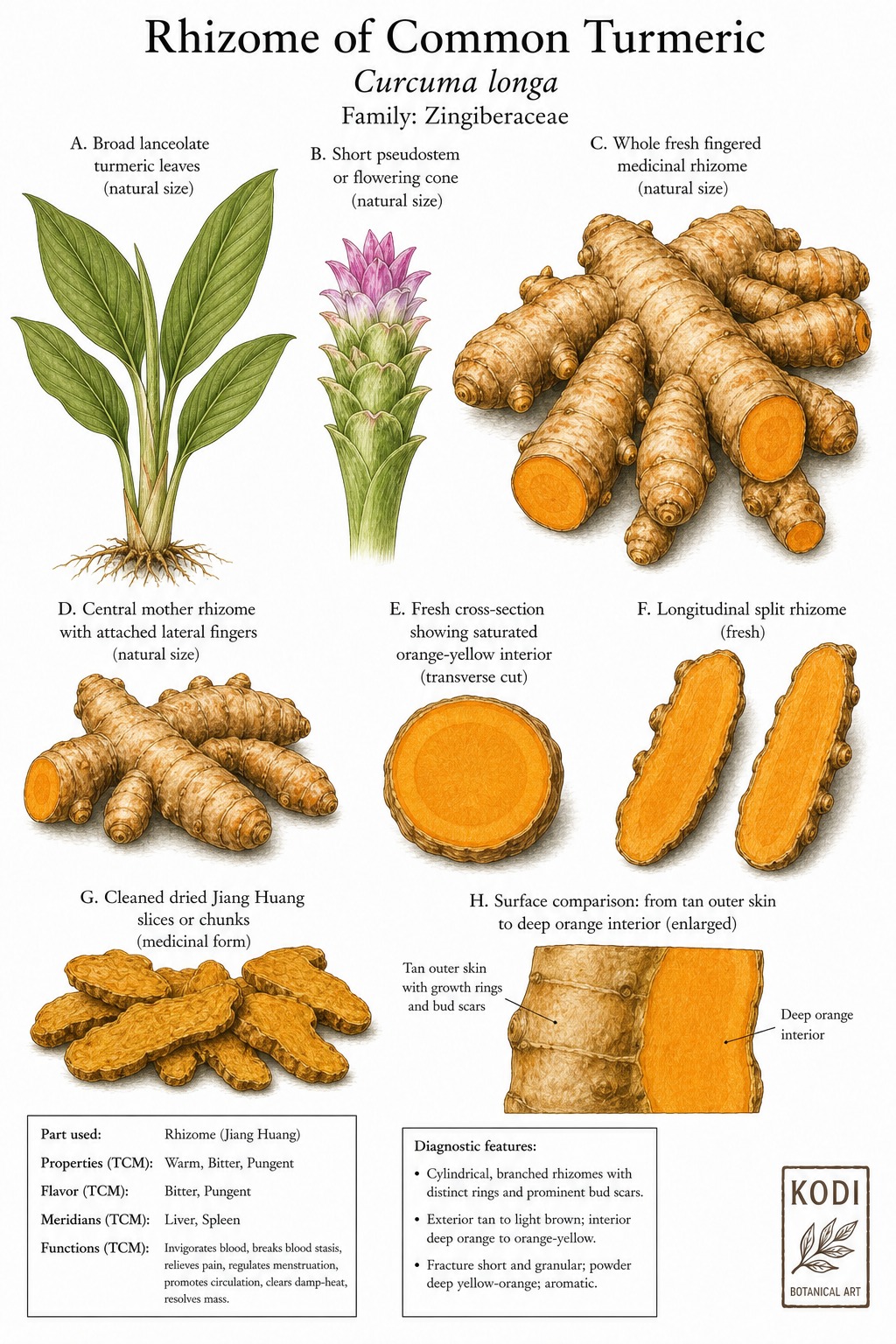
Known in TCM as Jiang Huang (姜黄), this acrid and bitter, warm herb enters the Spleen and Liver. Traditionally, it invigorates blood and moves qi ... Jiang Huang is used for blood-stasis pain, menstrual obstruction, abdominal pain, and traumatic bruising where movement and warmth are needed together, most often applied for dysmenorrhea, traumatic injury, and joint pain. Modern research has identified Curcumin among its active constituents.
Part used: Rhizome
Also Known As
Latin: Rhizoma Curcumae Longae | Pinyin: Jiang Huang | Chinese: 姜黄
TCM Properties
- Taste
- acrid, bitter
- Temperature
- warm
- Channels
- Spleen, Liver
Traditional Use
Primary Actions
- Invigorates blood and moves qi ... Jiang Huang is used for blood-stasis pain, menstrual obstruction, abdominal pain, and traumatic bruising where movement and warmth are needed together.
- Opens the channels and relieves pain ... it is especially associated with shoulder, arm, and upper-body pain as well as wind-damp obstruction with fixed soreness.
- Expels wind-damp in painful obstruction patterns ... unlike food turmeric alone, the medicinal Jiang Huang page should stay on channel-opening and pain-relieving logic.
Secondary Actions
- This page should be kept distinct from the still-stub `tuber-root-of-common-turmeric` or Yu Jin lane and from the still-upcoming `rhizome-of-kwangsi-turmeric` / E Zhu lane ... same botanical family, different medicinal directions.
- Jiang Huang combines blood movement and qi movement, which is why it is useful when pain is both fixed and distending.
Classic Formulas
- Juan Bi Tang modifications ... common use when wind-damp and blood stasis produce shoulder and limb pain.
- Blood-stasis pain combinations with Dang Gui, Chuan Xiong, or Yan Hu Suo ... traditional strategy for traumatic or menstrual pain.
- Upper-body obstruction formulas ... Jiang Huang is often chosen when pain favors the shoulders, arms, or chest-rib region.
Classical References
- Traditional herbology describes Jiang Huang as acrid, bitter, and warm, entering the Spleen and Liver to break up blood stasis, move qi, and relieve pain.
- Its clinical split from Yu Jin and E Zhu is fundamental ... turmeric-family medicinals are not interchangeable just because the plants are related.
Modern Research
Active Compounds
- Curcumin ... the best-known turmeric polyphenol
- Demethoxycurcumin and bisdemethoxycurcumin ... related curcuminoids contributing to antioxidant and anti-inflammatory profiles
- Turmerones and volatile oils ... important aromatic fractions of the rhizome
Studied Effects
- A 2025 review summarized the traditional applications, pharmacological activities, clinical applications, and product landscape of Curcuma longa, providing a broad modern reference point for Jiang Huang (PMID 40437595).
- A 2022 comprehensive review focused on the therapeutic potential of Curcuma longa in relation to curcumin, reinforcing why turmeric remains one of the most heavily studied medicinal rhizomes (PMID 35401176).
- An updated 2022 review examined turmeric and curcumin in metabolic syndrome, showing how modern clinical interest has expanded far beyond the herb's classic blood-stasis and pain lane (PMID 35292209).
PubMed References
- Curcuma Longa (turmeric): from traditional applications to modern plant medicine research hotspots. (2025)
- A Comprehensive Review on the Therapeutic Potential of Curcuma longa Linn. in Relation to its Major Active Constituent Curcumin. (2022)
- Effects of turmeric (Curcuma longa) and its constituent (curcumin) on the metabolic syndrome: An updated review. (2022)
Safety & Interactions
Contraindications
- Pregnancy without professional supervision
- Heavy active bleeding without a clear blood-stasis rationale
- Gallstone or bile-duct disease when concentrated extracts are being used
Cautions
- Jiang Huang moves blood and qi and is not the same thing as culinary turmeric added in small food amounts.
- Concentrated curcumin products are not equivalent to standard crude-herb dosing and may have different interaction or tolerance profiles.
Drug Interactions
- Anticoagulant or antiplatelet drugs ... possible additive bleeding risk
- Glucose-lowering therapy ... concentrated extracts may add metabolic effects
Conditions
- Dysmenorrhea Traditional ★★★☆☆ JSON
- Traumatic Injury Traditional ★★★☆☆ JSON
- Joint Pain Traditional ★★★☆☆ JSON
- Abdominal Pain Traditional ★★☆☆☆ JSON
Frequently Asked Questions
What is Rhizome of Common Turmeric used for?
Rhizome of Common Turmeric is traditionally used to Invigorates blood and moves qi ... Jiang Huang is used for blood-stasis pain, menstrual obstruction, abdominal pain, and traumatic bruising where movement and warmth are needed together., Opens the channels and relieves pain ... it is especially associated with shoulder, arm, and upper-body pain as well as wind-damp obstruction with fixed soreness., Expels wind-damp in painful obstruction patterns ... unlike food turmeric alone, the medicinal Jiang Huang page should stay on channel-opening and pain-relieving logic.. Research has investigated its effects on: A 2025 review summarized the traditional applications, pharmacological activities, clinical applications, and product landscape of Curcuma longa, providing a broad modern reference point for Jiang Huang (PMID 40437595).; A 2022 comprehensive review focused on the therapeutic potential of Curcuma longa in relation to curcumin, reinforcing why turmeric remains one of the most heavily studied medicinal rhizomes (PMID 35401176)..
What are other names for Rhizome of Common Turmeric?
Rhizome of Common Turmeric is also known as Turmeric Rhizome, Jiang Huang, Curcuma longa Rhizome. In TCM: 姜黄 (Jiang Huang); Rhizoma Curcumae Longae.
Is Rhizome of Common Turmeric safe during pregnancy?
Rhizome of Common Turmeric is not recommended during pregnancy.
What are the contraindications for Rhizome of Common Turmeric?
Rhizome of Common Turmeric should not be used in: Pregnancy without professional supervision; Heavy active bleeding without a clear blood-stasis rationale; Gallstone or bile-duct disease when concentrated extracts are being used. Consult a qualified healthcare provider before use.
Does Rhizome of Common Turmeric interact with any medications?
Rhizome of Common Turmeric may interact with: Anticoagulant or antiplatelet drugs ... possible additive bleeding risk; Glucose-lowering therapy ... concentrated extracts may add metabolic effects. Always inform your healthcare provider of any herbal supplements you are taking.