Rhizome of Chinese Ligusticum
- Chinese
- 藁本
- Pinyin
- Gao Ben
- Latin
- Ligustici Rhizoma et Radix
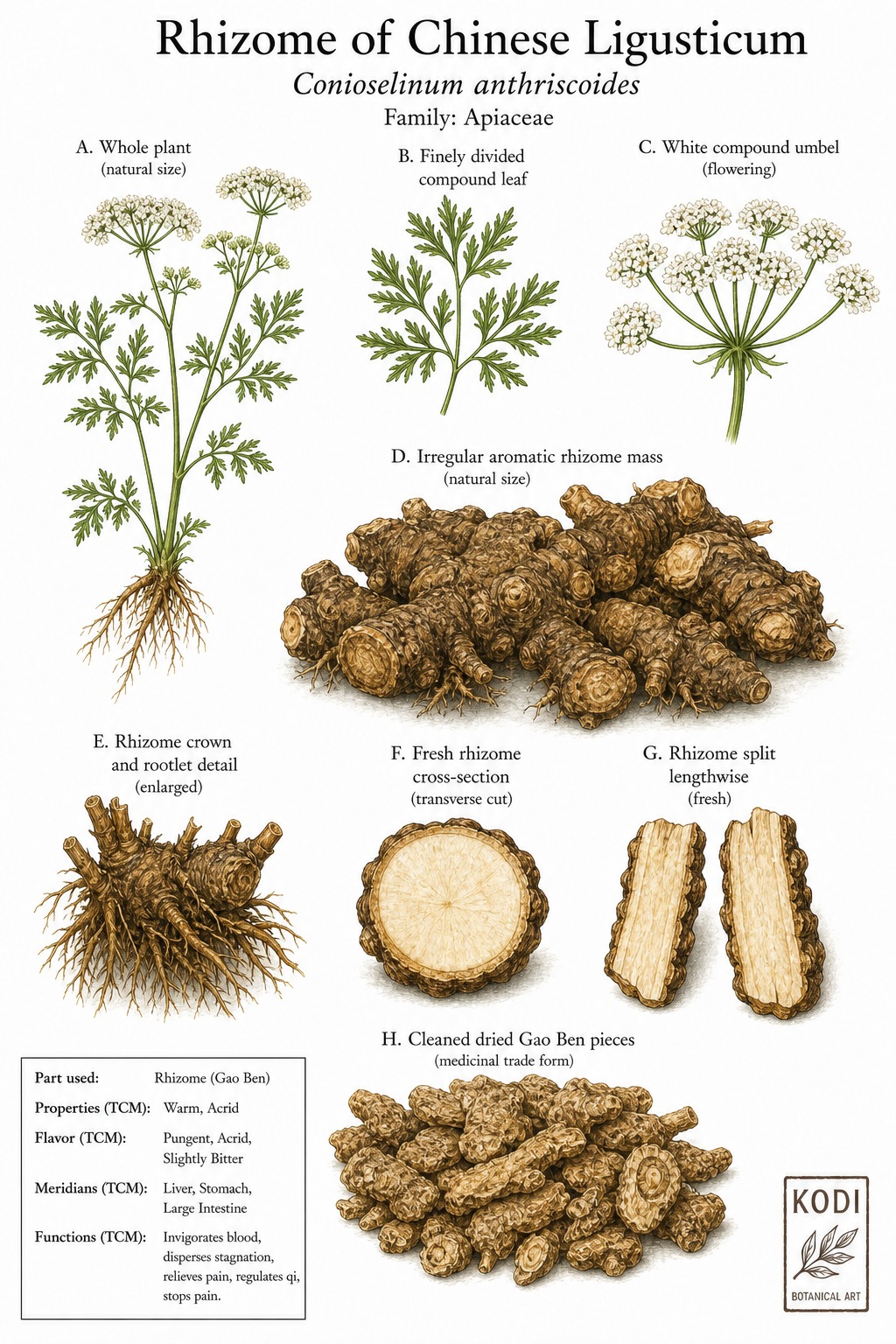
Known in TCM as Gao Ben (藁本), this acrid, warm herb enters the Bladder. Traditionally, it expels wind-cold and releases the exterior ... Gao Ben is used when headache, body ache, nasal blockage, and aversion to cold show a clear wind-cold pattern, most often applied for headache and common cold. Modern research has identified Volatile among its active constituents.
Part used: Rhizome
Also Known As
Latin: Ligustici Rhizoma et Radix | Pinyin: Gao Ben | Chinese: 藁本
TCM Properties
- Taste
- acrid
- Temperature
- warm
- Channels
- Bladder
Traditional Use
Primary Actions
- Expels wind-cold and releases the exterior ... Gao Ben is used when headache, body ache, nasal blockage, and aversion to cold show a clear wind-cold pattern.
- Relieves headache and pain ... it is especially associated with vertex and occipital headache, making it a directional herb for the top of the head.
- Dries dampness and opens the nose ... traditional use extends to sinus congestion, thick discharge, and damp-cold turbidity in the head.
Secondary Actions
- Gao Ben belongs with the aromatic wind-cold headache herbs, not with the blood-moving Chuanxiong lane even though the Apiaceae family resemblance can blur them in commerce.
- This page follows the broader Ligustici Rhizoma et Radix tradition and should stay on dry aromatic root-and-rhizome trade pieces rather than drift into stroke or blood-stasis rhetoric.
Classic Formulas
- Qiang Huo Sheng Shi Tang ... Gao Ben helps dispel wind-damp cold from the exterior and head.
- Chuan Xiong Cha Tiao San modifications ... commonly added when vertex headache is prominent within a wind attack.
- Nasal-opening combinations with Xin Yi or Bai Zhi ... classic strategy for cold-damp obstruction of the head and sinuses.
Classical References
- Traditional materia medica describes Gao Ben as acrid and warm, entering the Bladder channel to expel wind-cold and relieve vertex headache.
- Its directional specialty is a key reason it is preserved as a separate herb instead of being collapsed into generic aromatic Apiaceae roots.
Modern Research
Active Compounds
- Volatile oils rich in phthalides and aromatic constituents ... the main chemical basis for Gao Ben's dispersing identity
- Ligustilide-like and related phthalide compounds ... important quality and pharmacology markers in Ligustici Rhizoma et Radix research
- Coumarins and related aromatic secondary metabolites ... supportive constituents in authentication and volatile-oil studies
Studied Effects
- A 2024 comprehensive review of Ligustici Rhizoma et Radix covered botany, ethnopharmacology, phytochemistry, pharmacology, and quality control, providing a direct modern reference point for Gao Ben (PMID 38163554).
- A 2015 study showed an endothelium-independent vasorelaxant effect of Ligusticum jeholense root and rhizoma, illustrating that Gao Ben-family material has measurable vascular pharmacology beyond its classic headache role (PMID 26065836).
- A 2019 molecular-authentication study focused specifically on the medicinal species used as `Gao-ben`, reinforcing the importance of authenticated source material in this trade-sensitive herb (PMID 31024595).
PubMed References
- A comprehensive review of the botany, ethnopharmacology, phytochemistry, pharmacology, quality control and other applications of Ligustici Rhizoma et Radix. (2024)
- Endothelium-Independent Vasorelaxant Effect of Ligusticum jeholense Root and Rhizoma on Rat Thoracic Aorta. (2015)
- Molecular Authentication of the Medicinal Species of Ligusticum (Ligustici Rhizoma et Radix, "Gao-ben") by Integrating Non-coding Internal Transcribed Spacer 2 (ITS2) and Its Secondary Structure. (2019)
Safety & Interactions
Contraindications
- Yin deficiency headache or dryness without wind-cold
- Liver yang rising or blood deficiency headaches not caused by external cold
Cautions
- Gao Ben is warm, aromatic, and drying and is a poor fit for hot dry headache patterns.
- Because several Ligusticum-like roots circulate in trade, authenticated source material matters for consistent use.
Conditions
- Headache Traditional ★★★★☆ JSON
- Common Cold Traditional ★★★☆☆ JSON
Frequently Asked Questions
What is Rhizome of Chinese Ligusticum used for?
Rhizome of Chinese Ligusticum is traditionally used to Expels wind-cold and releases the exterior ... Gao Ben is used when headache, body ache, nasal blockage, and aversion to cold show a clear wind-cold pattern., Relieves headache and pain ... it is especially associated with vertex and occipital headache, making it a directional herb for the top of the head., Dries dampness and opens the nose ... traditional use extends to sinus congestion, thick discharge, and damp-cold turbidity in the head.. Research has investigated its effects on: A 2024 comprehensive review of Ligustici Rhizoma et Radix covered botany, ethnopharmacology, phytochemistry, pharmacology, and quality control, providing a direct modern reference point for Gao Ben (PMID 38163554).; A 2015 study showed an endothelium-independent vasorelaxant effect of Ligusticum jeholense root and rhizoma, illustrating that Gao Ben-family material has measurable vascular pharmacology beyond its classic headache role (PMID 26065836)..
What are other names for Rhizome of Chinese Ligusticum?
Rhizome of Chinese Ligusticum is also known as Ligusticum Root and Rhizome, Gao Ben, Ligustici Rhizoma. In TCM: 藁本 (Gao Ben); Ligustici Rhizoma et Radix.
Is Rhizome of Chinese Ligusticum safe during pregnancy?
The safety of Rhizome of Chinese Ligusticum during pregnancy has not been established. Consult a qualified healthcare provider before use.
What are the contraindications for Rhizome of Chinese Ligusticum?
Rhizome of Chinese Ligusticum should not be used in: Yin deficiency headache or dryness without wind-cold; Liver yang rising or blood deficiency headaches not caused by external cold. Consult a qualified healthcare provider before use.