Rhizome of Bistort
- Chinese
- 拳参
- Pinyin
- Quan Shen
- Latin
- Rhizoma Bistortae
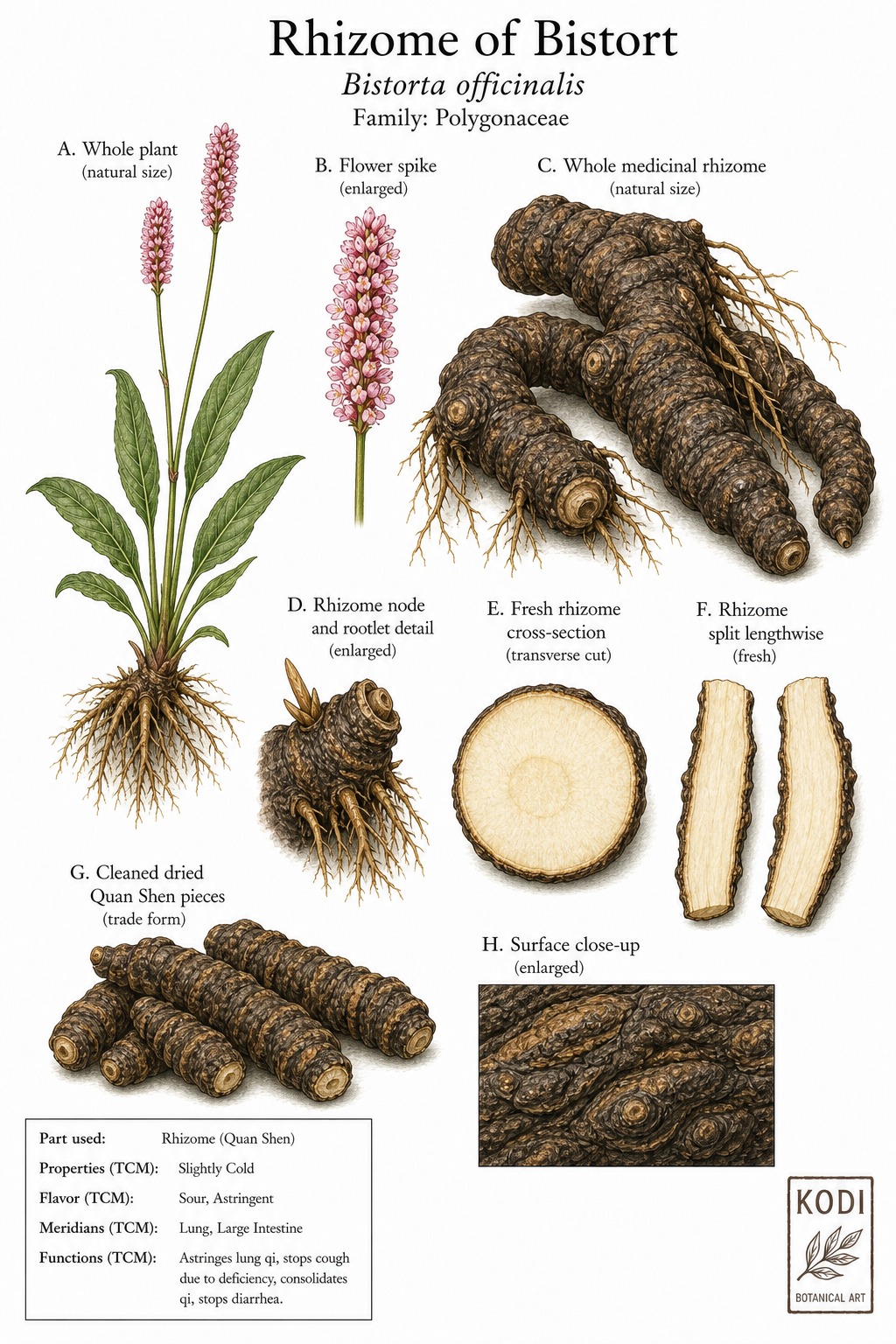
Known in TCM as Quan Shen (拳参), this bitter and astringent, slightly cold herb enters the Liver and Lung. Traditionally, it clears heat and resolves toxicity ... Quan Shen is used for swollen painful throat, toxic sores, and hot inflammatory conditions where hardness and swelling dominate, most often applied for sore throat, scrofula, and thyroid nodule. Modern research has identified Tannins among its active constituents.
Part used: Rhizome
Also Known As
Latin: Rhizoma Bistortae | Pinyin: Quan Shen | Chinese: 拳参
TCM Properties
- Taste
- bitter, astringent
- Temperature
- slightly cold
- Channels
- Liver, Lung
Traditional Use
Primary Actions
- Clears heat and resolves toxicity ... Quan Shen is used for swollen painful throat, toxic sores, and hot inflammatory conditions where hardness and swelling dominate.
- Cools blood and reduces swelling ... older use includes carbuncles, abscesses, and lesions where blood heat and toxin combine.
- Softens and disperses masses ... the herb also appears in scrofula and nodule-oriented traditions when phlegm, heat, and hardness lodge in the neck.
Secondary Actions
- Quan Shen should not be mistaken for a generic Western astringent bistort-only folk herb ... in the TCM lane it leans toward heat toxin, throat, and mass-dispersing applications.
- The twisted rhizome identity matters because this page belongs beside the toxic-swelling and throat-clearing family rather than digestive tonic herbs.
Classic Formulas
- Toxic-swelling and throat combinations with Ban Lan Gen or Bei Dou Gen ... common strategy when painful throat inflammation is the main presentation.
- Scrofula and hard-mass pairings with Xuan Shen or Zhe Bei Mu ... formula logic when heat, phlegm, and nodules coexist.
- Topical and internal sore-management traditions ... older use includes carbuncles and hot ulcerative lesions.
Classical References
- Traditional materia medica describes Quan Shen as a bitter slightly cold rhizome that clears heat, resolves toxicity, cools blood, and reduces swelling.
- Its throat and nodule orientation distinguishes it from simple food-medicine Polygonaceae roots.
Modern Research
Active Compounds
- Tannins and phenolic compounds ... classic astringent and anti-inflammatory fractions of bistort rhizome
- Gallic-acid-related polyphenols and flavonoids ... constituents linked to antioxidant and anti-inflammatory study interest
- Triterpenoid and other secondary-metabolite fractions ... supportive bioactive components reported from Polygonum bistorta
Studied Effects
- A 1994 study demonstrated anti-inflammatory activity of Polygonum bistorta in a rat model, providing an older but direct pharmacologic correlate for Quan Shen's swelling-reducing reputation (PMID 8051612).
- A 1999 isolation study characterized anti-inflammatory compounds from Polygonum bistorta, supporting the rhizome's role as more than a purely astringent folk herb (PMID 10364846).
- A 2024 study on Polygonum bistorta reported protection against LPS-induced acute lung injury through NF-kB pathway inhibition, which fits its broader heat-toxin and inflammatory lane (PMID 40007534).
PubMed References
- Anti-inflammatory activity of Polygonum bistorta, Guaiacum officinale and Hamamelis virginiana in rats. (1994)
- The anti-inflammatory compounds of Polygonum bistorta: isolation and characterisation. (1999)
- Exploration of the anti-inflammatory potential of Polygonum bistorta L.: protection against LPS-induced acute lung injury in rats via NF-ĸβ pathway inhibition. (2024)
Safety & Interactions
Contraindications
- Cold deficiency without heat or toxicity
- Pregnancy without professional supervision when mass-dispersing or blood-moving combinations are being used
Cautions
- Quan Shen is cooler and more detoxifying than ordinary food-like knotweed roots, so pattern fit matters.
- Persistent neck masses, ulcerative lesions, or recurrent throat swelling need proper diagnosis rather than repeated self-treatment.
Conditions
- Sore Throat Traditional ★★★★☆ JSON
- Scrofula Traditional ★★★☆☆ JSON
- Thyroid Nodule Traditional ★★☆☆☆ JSON
- Abscess Traditional ★★☆☆☆ JSON
Frequently Asked Questions
What is Rhizome of Bistort used for?
Rhizome of Bistort is traditionally used to Clears heat and resolves toxicity ... Quan Shen is used for swollen painful throat, toxic sores, and hot inflammatory conditions where hardness and swelling dominate., Cools blood and reduces swelling ... older use includes carbuncles, abscesses, and lesions where blood heat and toxin combine., Softens and disperses masses ... the herb also appears in scrofula and nodule-oriented traditions when phlegm, heat, and hardness lodge in the neck.. Research has investigated its effects on: A 1994 study demonstrated anti-inflammatory activity of Polygonum bistorta in a rat model, providing an older but direct pharmacologic correlate for Quan Shen's swelling-reducing reputation (PMID 8051612).; A 1999 isolation study characterized anti-inflammatory compounds from Polygonum bistorta, supporting the rhizome's role as more than a purely astringent folk herb (PMID 10364846)..
What are other names for Rhizome of Bistort?
Rhizome of Bistort is also known as Bistort Rhizome, Polygonum bistorta Rhizome, Quan Shen. In TCM: 拳参 (Quan Shen); Rhizoma Bistortae.
Is Rhizome of Bistort safe during pregnancy?
The safety of Rhizome of Bistort during pregnancy has not been established. Consult a qualified healthcare provider before use.
What are the contraindications for Rhizome of Bistort?
Rhizome of Bistort should not be used in: Cold deficiency without heat or toxicity; Pregnancy without professional supervision when mass-dispersing or blood-moving combinations are being used. Consult a qualified healthcare provider before use.