Rhizome of Biglcaf Yam
- Chinese
- 怀山药
- Pinyin
- Huai Shan Yao
- Latin
- Rhizoma Dioscoreae
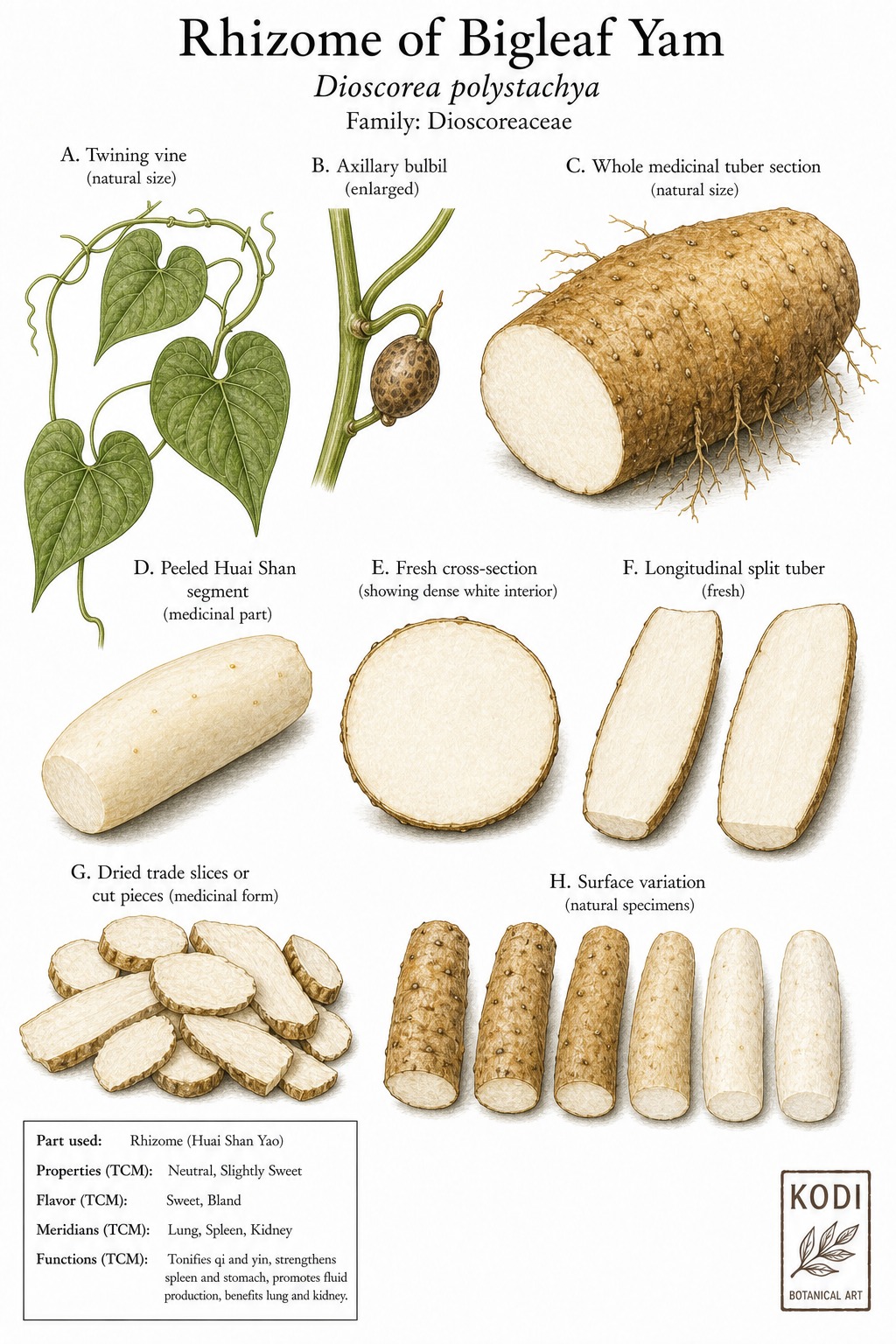
Known in TCM as Huai Shan Yao (怀山药), this sweet, neutral herb enters the Spleen, Lung, and Kidney. Traditionally, it tonifies the Spleen and supports digestion ... Huai Shan Yao is the region-emphasized trade lane of Shan Yao used for poor appetite, loose stools, chronic diarrhea, and recovery from digestive weakness, most often applied for diarrhea, poor appetite, and digestive weakness. Modern research has identified Chinese among its active constituents.
Part used: Rhizome
Also Known As
Latin: Rhizoma Dioscoreae | Pinyin: Huai Shan Yao | Chinese: 怀山药
TCM Properties
- Taste
- sweet
- Temperature
- neutral
- Channels
- Spleen, Lung, Kidney
Traditional Use
Primary Actions
- Tonifies the Spleen and supports digestion ... Huai Shan Yao is the region-emphasized trade lane of Shan Yao used for poor appetite, loose stools, chronic diarrhea, and recovery from digestive weakness.
- Nourishes Lung qi and Lung yin ... it helps chronic cough, mild shortness of breath, and dryness from deficiency when a gentle non-cloying tonic is preferred.
- Benefits the Kidneys and secures essence ... traditional use includes frequent urination, leucorrhea, spermatorrhea, and lower-burner weakness associated with Spleen-Kidney deficiency.
Secondary Actions
- This page should be read as the Huai-origin naming lane of the already-live `common-yam-rhizome` or Shan Yao tradition rather than as a truly different medicinal species.
- Compared with more generic Shan Yao wording, Huai Shan Yao emphasizes the dense authentic trade tuber pieces historically prized for tonifying without excessive cloying.
Classic Formulas
- Shen Ling Bai Zhu San ... foundational Spleen-tonifying formula where Shan Yao supports digestion and stops chronic diarrhea.
- Liu Wei Di Huang Wan ... Shan Yao anchors the middle while helping secure essence in Kidney-Liver yin deficiency formulas.
- Jin Suo Gu Jing Wan and related leakage formulas ... illustrates Huai Shan Yao's ability to supplement while securing.
Classical References
- Traditional herb texts consistently treat Huai Shan Yao as a prized trade lane within the broader Shan Yao family, with sweet neutral tonifying effects on the Spleen, Lung, and Kidney.
- Its reputation rests on being both food and medicine ... nourishing enough for chronic deficiency, yet gentle enough for longer use.
Modern Research
Active Compounds
- Chinese yam polysaccharides ... central to gut, metabolic, and immune research
- Phenolic compounds and resistant starch fractions ... relevant to antioxidant and gastrointestinal studies
- Mucilage and nutritive carbohydrate fractions ... important to the food-medicine profile
Studied Effects
- A 2025 systematic review found accumulating evidence that Dioscoreae Rhizoma benefits gastrointestinal function through anti-inflammatory, antioxidant, microbiota-modulating, and mucosal-protective mechanisms (PMID 41010469).
- Recent rapid chemical-identification work on Huai Yam documented multiple active ingredients and reflects strong continuing interest in authenticated trade material and quality control (PMID 38586954).
- Because Huai Shan Yao is a naming and origin lane within the broader Dioscoreae Rhizoma tradition, modern evidence is best read as applying to Shan Yao broadly rather than to a separate pharmacologic herb.
PubMed References
Safety & Interactions
Contraindications
- Patterns dominated by food stagnation or thick damp obstruction without deficiency
- Acute external excess where tonifying therapy would trap the pathogen
Cautions
- Huai Shan Yao is generally gentle, but large tonic doses can still worsen fullness if active food stagnation is not addressed first.
- This origin-centered lane should not be confused with unrelated edible yam marketing that ignores the medicinal pattern context.
Conditions
- Diarrhea Traditional ★★★★☆ JSON
- Poor Appetite Traditional ★★★★☆ JSON
- Digestive Weakness Traditional ★★★★☆ JSON
- Frequent Urination Traditional ★★☆☆☆ JSON
- Leucorrhea Traditional ★★☆☆☆ JSON
Frequently Asked Questions
What is Rhizome of Biglcaf Yam used for?
Rhizome of Biglcaf Yam is traditionally used to Tonifies the Spleen and supports digestion ... Huai Shan Yao is the region-emphasized trade lane of Shan Yao used for poor appetite, loose stools, chronic diarrhea, and recovery from digestive weakness., Nourishes Lung qi and Lung yin ... it helps chronic cough, mild shortness of breath, and dryness from deficiency when a gentle non-cloying tonic is preferred., Benefits the Kidneys and secures essence ... traditional use includes frequent urination, leucorrhea, spermatorrhea, and lower-burner weakness associated with Spleen-Kidney deficiency.. Research has investigated its effects on: A 2025 systematic review found accumulating evidence that Dioscoreae Rhizoma benefits gastrointestinal function through anti-inflammatory, antioxidant, microbiota-modulating, and mucosal-protective mechanisms (PMID 41010469).; Recent rapid chemical-identification work on Huai Yam documented multiple active ingredients and reflects strong continuing interest in authenticated trade material and quality control (PMID 38586954)..
What are other names for Rhizome of Biglcaf Yam?
Rhizome of Biglcaf Yam is also known as Huai Shan, Huai Chinese Yam, Dioscoreae Rhizoma. In TCM: 怀山药 (Huai Shan Yao); Rhizoma Dioscoreae.
Is Rhizome of Biglcaf Yam safe during pregnancy?
The safety of Rhizome of Biglcaf Yam during pregnancy has not been established. Consult a qualified healthcare provider before use.
What are the contraindications for Rhizome of Biglcaf Yam?
Rhizome of Biglcaf Yam should not be used in: Patterns dominated by food stagnation or thick damp obstruction without deficiency; Acute external excess where tonifying therapy would trap the pathogen. Consult a qualified healthcare provider before use.