Rhizome of Airpotato Yam
- Chinese
- 黄药子
- Pinyin
- Huang Yao Zi
- Latin
- Rhizoma Dioscoreae Bulbiferae
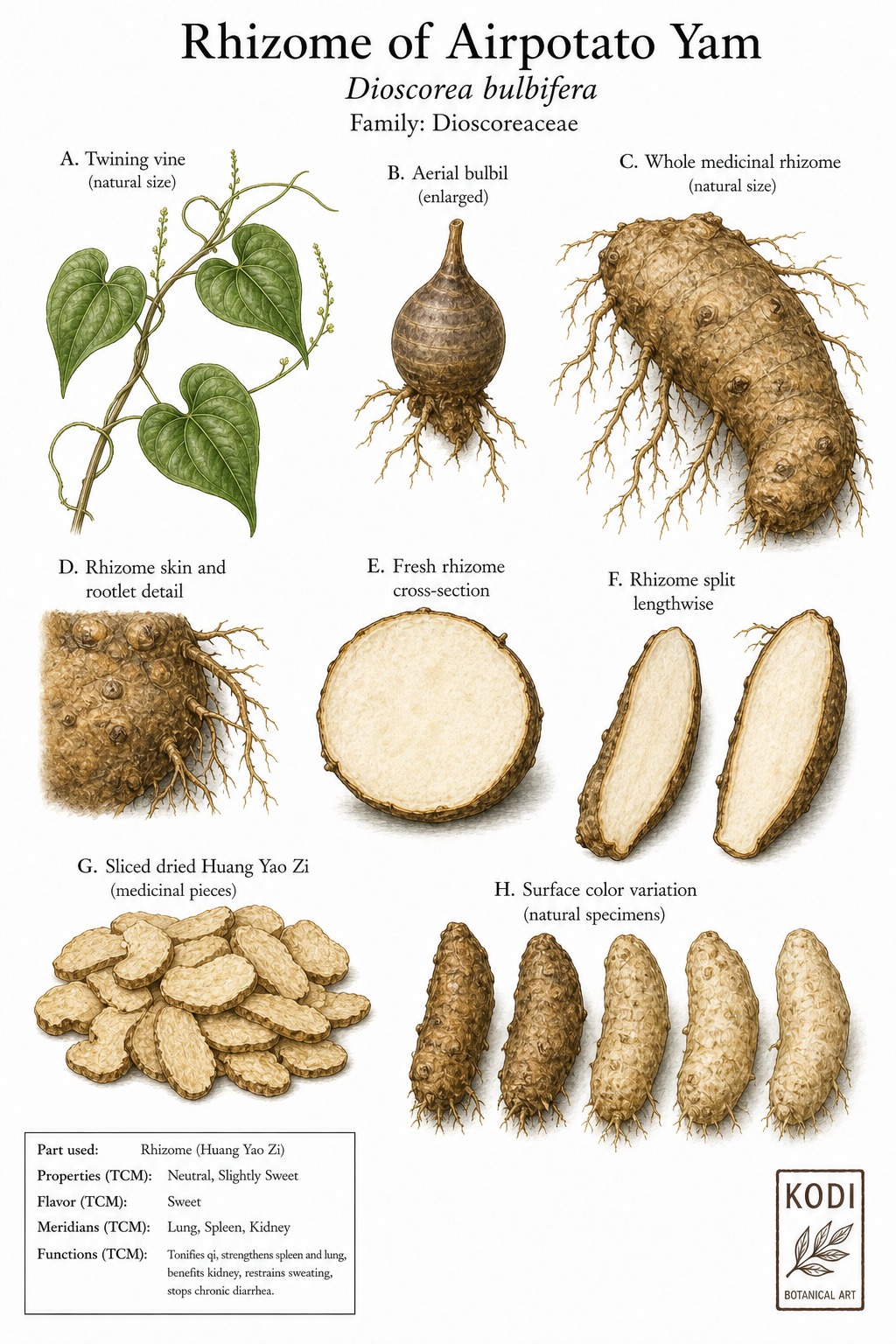
Known in TCM as Huang Yao Zi (黄药子), this bitter, cold herb enters the Liver and Lung. Traditionally, it resolves phlegm and dissipates nodules ... Huang Yao Zi is classically used for goiter, scrofula, and hard masses with a phlegm-fire or toxic-swelling character, most often applied for thyroid nodule, scrofula, and cough. Modern research has identified Diosbulbin-type among its active constituents.
Part used: Rhizome
Also Known As
Latin: Rhizoma Dioscoreae Bulbiferae | Pinyin: Huang Yao Zi | Chinese: 黄药子
TCM Properties
- Taste
- bitter
- Temperature
- cold
- Channels
- Liver, Lung
Traditional Use
Primary Actions
- Resolves phlegm and dissipates nodules ... Huang Yao Zi is classically used for goiter, scrofula, and hard masses with a phlegm-fire or toxic-swelling character.
- Clears heat and resolves toxicity ... traditional use extends to sore throat, ulcerative swelling, and toxic lesions where hardness and inflammation coexist.
- Relieves cough and wheezing when phlegm-heat binds the Lung ... the herb is used more for knotty obstructive patterns than for simple everyday cough.
Secondary Actions
- Huang Yao Zi sits in the transform-phlegm-and-nodule family, but its toxicity keeps it from being treated like an ordinary cooling food herb despite the yam lineage.
- This page should remain on the medicinal air-potato tuber tradition rather than drift into edible-yam or generic Dioscorea nutrition claims.
Classic Formulas
- Goiter and scrofula combinations with Hai Zao, Kun Bu, or Xia Ku Cao ... classic strategy when hard phlegm masses dominate.
- Toxic-swelling and throat formulas ... Huang Yao Zi appears when phlegm, heat, and hardness converge in the neck or throat.
- Cancer-oriented folk and later integrative traditions ... these help explain the herb's modern notoriety but do not erase the need for toxicology caution.
Classical References
- Traditional herbology describes Huang Yao Zi as bitter, cold, and toxic, entering the Liver and Lung to resolve phlegm, soften hard masses, and clear heat toxin.
- Its classic identity revolves around nodules and goiter rather than around tonification, even though the source plant belongs to the broader yam family.
Modern Research
Active Compounds
- Diosbulbin-type diterpenoids ... major constituents linked to both bioactivity and hepatotoxicity
- Steroidal saponins and phenanthrene derivatives ... supportive phytochemical fractions in antitumor and anti-inflammatory studies
- Furanoterpenoid-related toxic fractions ... central to safety concerns
Studied Effects
- A 2026 critical review summarized the phytotherapeutic potential and toxicological risks of Dioscorea bulbifera, reinforcing the herb's importance as both a pharmacologic lead and a hepatotoxicity concern (PMID 41461207).
- A 2020 review specifically examined Dioscorea bulbifera-induced hepatotoxicity and linked it to metabolic activation of furanoterpenoids, which is directly relevant to modern handling of Huang Yao Zi (PMID 32757959).
- Recent review literature repeatedly describes the plant as a double-edged medicine whose traditional mass-resolving reputation must be balanced against genuine liver-injury risk.
PubMed References
Safety & Interactions
Contraindications
- Pregnancy
- Pre-existing liver disease
- Any unsupervised long-term or high-dose internal use
Cautions
- Huang Yao Zi has a real hepatotoxicity record and should not be treated as a safe do-it-yourself thyroid or nodule remedy.
- The source plant's broad yam identity does not imply food-level safety for this medicinal tuber preparation.
- Persistent neck masses or thyroid enlargement need proper diagnosis rather than prolonged self-treatment.
Drug Interactions
- Potential additive liver-injury risk with hepatotoxic drugs or supplements
Conditions
Frequently Asked Questions
What is Rhizome of Airpotato Yam used for?
Rhizome of Airpotato Yam is traditionally used to Resolves phlegm and dissipates nodules ... Huang Yao Zi is classically used for goiter, scrofula, and hard masses with a phlegm-fire or toxic-swelling character., Clears heat and resolves toxicity ... traditional use extends to sore throat, ulcerative swelling, and toxic lesions where hardness and inflammation coexist., Relieves cough and wheezing when phlegm-heat binds the Lung ... the herb is used more for knotty obstructive patterns than for simple everyday cough.. Research has investigated its effects on: A 2026 critical review summarized the phytotherapeutic potential and toxicological risks of Dioscorea bulbifera, reinforcing the herb's importance as both a pharmacologic lead and a hepatotoxicity concern (PMID 41461207).; A 2020 review specifically examined Dioscorea bulbifera-induced hepatotoxicity and linked it to metabolic activation of furanoterpenoids, which is directly relevant to modern handling of Huang Yao Zi (PMID 32757959)..
What are other names for Rhizome of Airpotato Yam?
Rhizome of Airpotato Yam is also known as Air Potato Rhizome, Dioscorea bulbifera Tuber, Huang Yao Zi. In TCM: 黄药子 (Huang Yao Zi); Rhizoma Dioscoreae Bulbiferae.
Is Rhizome of Airpotato Yam safe during pregnancy?
Rhizome of Airpotato Yam is not recommended during pregnancy.
What are the contraindications for Rhizome of Airpotato Yam?
Rhizome of Airpotato Yam should not be used in: Pregnancy; Pre-existing liver disease; Any unsupervised long-term or high-dose internal use. Consult a qualified healthcare provider before use.
Does Rhizome of Airpotato Yam interact with any medications?
Rhizome of Airpotato Yam may interact with: Potential additive liver-injury risk with hepatotoxic drugs or supplements. Always inform your healthcare provider of any herbal supplements you are taking.