Rhizome and Root of Black Falsehellebore
- Chinese
- 藜芦
- Pinyin
- Li Lu
- Latin
- Rhizoma et Radix Veratri
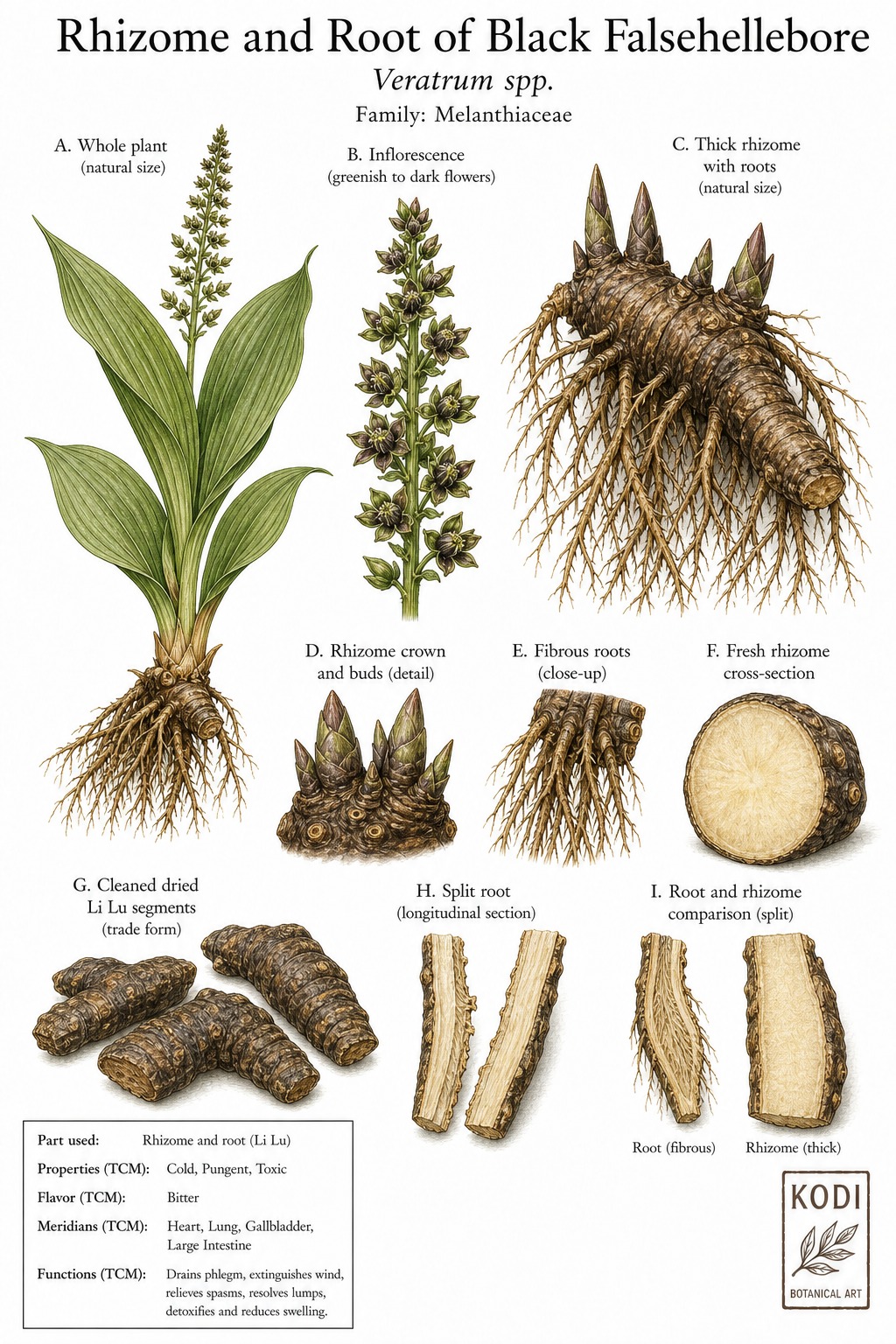
Known in TCM as Li Lu (藜芦), this bitter and acrid, cold herb enters the Lung, Liver, and Stomach. Traditionally, it induces vomiting of stubborn phlegm and retained food ... Li Lu is a harsh emetic preserved mainly as a historical toxic herb rather than a routine modern internal medicine, most often applied for phlegm accumulation, scabies, and eczema. Modern research has identified Steroidal among its active constituents.
Part used: Rhizome
Also Known As
Latin: Rhizoma et Radix Veratri | Pinyin: Li Lu | Chinese: 藜芦
TCM Properties
- Taste
- bitter, acrid
- Temperature
- cold
- Channels
- Lung, Liver, Stomach
Traditional Use
Primary Actions
- Induces vomiting of stubborn phlegm and retained food ... Li Lu is a harsh emetic preserved mainly as a historical toxic herb rather than a routine modern internal medicine.
- Kills parasites and relieves itching externally ... powdered Li Lu was applied to scabies, damp skin disease, lice, and other parasitic or intensely itchy lesions.
- Dries dampness and attacks toxic skin conditions ... classical use includes chronic wet lesions where a toxic antiparasitic mineral-or-herb approach was desired.
Secondary Actions
- Li Lu is one of the clearest examples of a herb whose classical power and modern safety concerns cannot be separated.
- The old incompatibility tradition with ginseng, shashen, xuan shen, and several other herbs is part of the identity of this record and should be stated explicitly rather than smoothed over.
Classic Formulas
- Historical emetic use for acute phlegm obstruction ... Li Lu belongs to an older therapeutic logic that is rarely carried forward in routine modern practice.
- Topical parasite and itch preparations ... external powders with oil or lard were used for scabies and stubborn wet-toxic skin disease.
- Classical incompatibility lists ... Li Lu is a reference herb in the Eighteen Incompatibilities tradition.
Classical References
- Traditional materia medica describes Li Lu as bitter, acrid, cold, and highly toxic, used to induce vomiting and kill parasites.
- Older herbology repeatedly warns against combining Li Lu with important tonic and yin-nourishing roots, making the incompatibility teaching part of its core identity.
Modern Research
Active Compounds
- Steroidal alkaloids such as veratramine, jervine, and cyclopamine-related compounds ... the main drivers of both pharmacology and toxicity
- Broader Veratrum alkaloid fractions ... responsible for emetic, hypotensive, teratogenic, and neurotoxic risk
Studied Effects
- A 2024 comprehensive review summarized Veratrum nigrum ethnopharmacology, phytochemistry, toxicity, and incompatibility, providing a strong modern context for why Li Lu remains historically important but clinically dangerous (PMID 38663784).
- A toxicology review of Veratrum poisoning detailed the serious human and animal toxicity associated with the genus, reinforcing that Li Lu is not an herb for unsupervised experimentation (PMID 16958554).
- Modern interest in Veratrum alkaloids often focuses on molecular or anticancer leads, but that research does not convert crude Li Lu into a broadly acceptable clinical medicine.
PubMed References
Safety & Interactions
Contraindications
- Pregnancy
- Any unsupervised internal use
- Concurrent use with classical incompatible herb pairs such as ginseng or xuan shen
- Frailty, children, or cardiovascular instability
Cautions
- Li Lu is a highly toxic emetic herb and is not appropriate for casual household use.
- Topical use can still irritate skin and mucosa, and internal overdose can produce severe gastrointestinal, neurologic, cardiovascular, and respiratory symptoms.
- The old incompatibility tradition with ginseng-family and related herbs should be taken seriously as part of Li Lu handling.
Conditions
Frequently Asked Questions
What is Rhizome and Root of Black Falsehellebore used for?
Rhizome and Root of Black Falsehellebore is traditionally used to Induces vomiting of stubborn phlegm and retained food ... Li Lu is a harsh emetic preserved mainly as a historical toxic herb rather than a routine modern internal medicine., Kills parasites and relieves itching externally ... powdered Li Lu was applied to scabies, damp skin disease, lice, and other parasitic or intensely itchy lesions., Dries dampness and attacks toxic skin conditions ... classical use includes chronic wet lesions where a toxic antiparasitic mineral-or-herb approach was desired.. Research has investigated its effects on: A 2024 comprehensive review summarized Veratrum nigrum ethnopharmacology, phytochemistry, toxicity, and incompatibility, providing a strong modern context for why Li Lu remains historically important but clinically dangerous (PMID 38663784).; A toxicology review of Veratrum poisoning detailed the serious human and animal toxicity associated with the genus, reinforcing that Li Lu is not an herb for unsupervised experimentation (PMID 16958554)..
What are other names for Rhizome and Root of Black Falsehellebore?
Rhizome and Root of Black Falsehellebore is also known as Veratrum Root and Rhizome, False Hellebore Root, Li Lu. In TCM: 藜芦 (Li Lu); Rhizoma et Radix Veratri.
Is Rhizome and Root of Black Falsehellebore safe during pregnancy?
Rhizome and Root of Black Falsehellebore is not recommended during pregnancy.
What are the contraindications for Rhizome and Root of Black Falsehellebore?
Rhizome and Root of Black Falsehellebore should not be used in: Pregnancy; Any unsupervised internal use; Concurrent use with classical incompatible herb pairs such as ginseng or xuan shen; Frailty, children, or cardiovascular instability. Consult a qualified healthcare provider before use.