Resin of Garcinia
- Chinese
- 藤黄
- Pinyin
- Teng Huang
- Latin
- Resina Garciniae
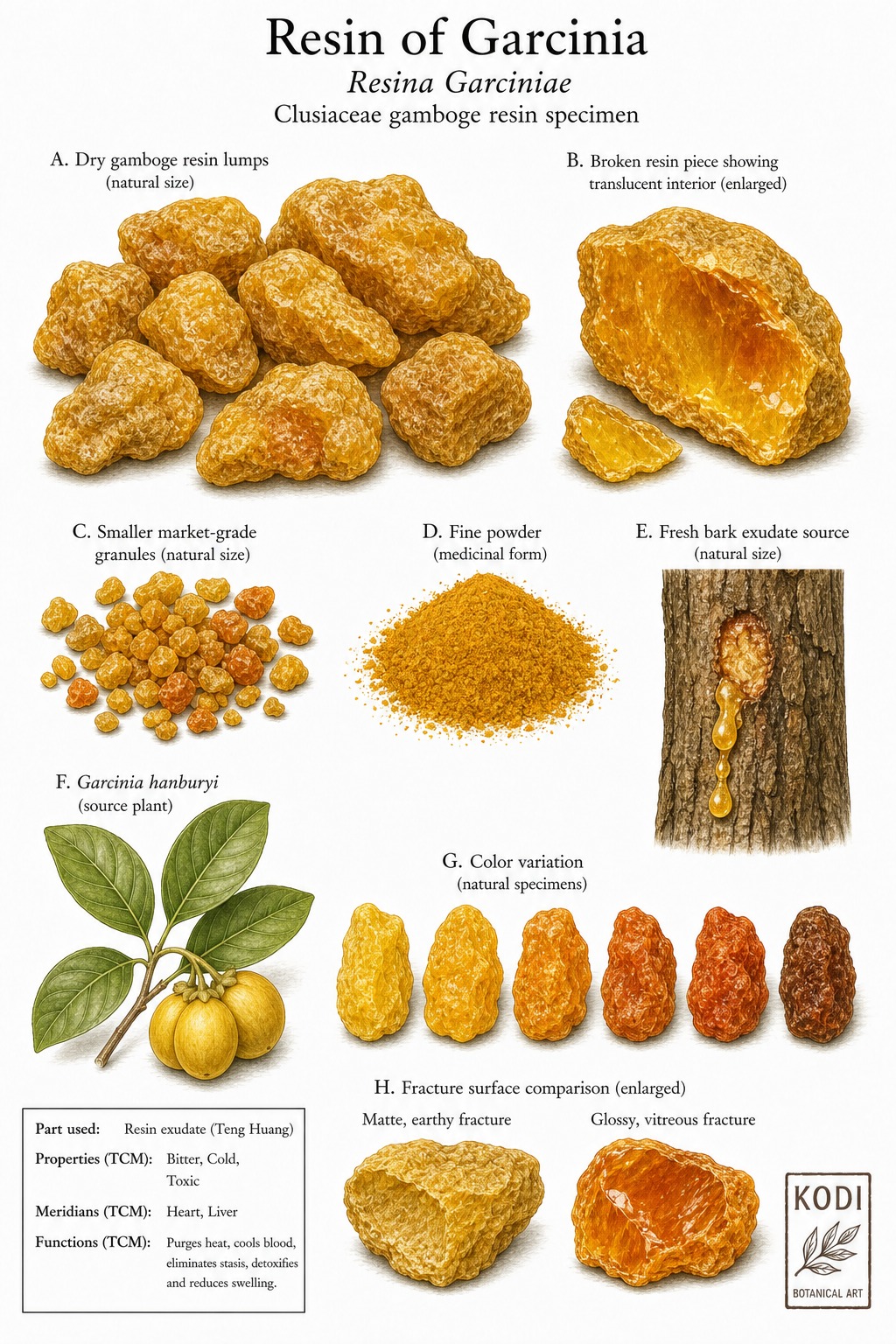
Known in TCM as Teng Huang (藤黄), this sour and astringent, cold herb enters the Liver and Spleen. Traditionally, it resolves toxin and reduces swelling ... Teng Huang is a harsh resin used historically for ulcers, abscesses, and stubborn toxic masses rather than as a gentle internal herb, most often applied for abscess, intestinal parasites, and thyroid nodule. Modern research has identified Gambogic among its active constituents.
Part used: Resin
Also Known As
Latin: Resina Garciniae | Pinyin: Teng Huang | Chinese: 藤黄
TCM Properties
- Taste
- sour, astringent
- Temperature
- cold
- Channels
- Liver, Spleen
Traditional Use
Primary Actions
- Resolves toxin and reduces swelling ... Teng Huang is a harsh resin used historically for ulcers, abscesses, and stubborn toxic masses rather than as a gentle internal herb.
- Kills parasites and attacks accumulation ... older records include tapeworm and other persistent parasitic or obstructive conditions in which a toxic resin was used to drive out what was lodged.
- Breaks stubborn masses in a narrow historical sense ... later cancer-oriented and mass-dispersing traditions helped keep Teng Huang in circulation, but always with caution because its effect is inseparable from toxicity.
Secondary Actions
- This page should stay on dry gamboge resin lumps rather than on Garcinia fruit, weight-loss products, or generalized mangosteen-family supplements.
- Traditional use is forceful and narrow ... modern self-treatment with Teng Huang is not supported simply because gambogic-acid cancer literature exists.
Classic Formulas
- Topical sore and ulcer preparations ... historical use focused on toxic swelling, ulceration, and hard lesion management rather than broad internal tonic use.
- Older parasite-attacking powders and pills ... Teng Huang appears in aggressive traditional strategies for tapeworm and entrenched toxic accumulation.
- Later oncology-oriented folk and patent traditions ... these preserve the mass-dispersing reputation but do not erase the herb's real toxic burden.
Classical References
- Traditional materia medica remembers Teng Huang as a cold toxic resin used for sores, masses, and parasites rather than as a routine digestive or tonic medicine.
- Its resin identity matters ... this is not simply another Garcinia food plant, but a concentrated medicinal exudate with a much narrower safety margin.
Modern Research
Active Compounds
- Gambogic acid ... the best-known caged xanthone isolated from gamboge resin
- Gambogenic acid and related prenylated xanthones ... supportive resin constituents in antitumor research
- Broader resinous polyprenylated xanthone fractions ... important to both bioactivity and toxicity discussions
Studied Effects
- A 2025 review summarized the antitumor effects and mechanisms of traditional Chinese medicine gamboge, showing why Teng Huang remains prominent in modern oncology-oriented pharmacology discussions despite its narrow safety margin (PMID 40900835).
- A 2018 review focused on gambogic acid as a cancer-targeting caged xanthone and reinforced that most enthusiasm centers on isolated compounds rather than on casual whole-resin self-use (PMID 29246645).
- A systematic review of herb-induced liver injury included gamboge-associated risk within the broader toxic-herb landscape, which supports keeping this monograph's safety framing strict (PMID 34307603).
PubMed References
Safety & Interactions
Contraindications
- Pregnancy
- Any unsupervised internal use
- Liver disease, frailty, or use in children
Cautions
- Teng Huang is a toxic resin and should not be treated as a routine antiparasitic, detox, or anticancer self-care product.
- Modern gambogic-acid research does not make crude gamboge resin a safe over-the-counter medicine.
- Because concentrated Garcinia products exist in supplement markets, identity matters ... food or nutraceutical Garcinia products are not interchangeable with medicinal Teng Huang.
Conditions
- Abscess Traditional ★★☆☆☆ JSON
- Intestinal Parasites Traditional ★★☆☆☆ JSON
- Thyroid Nodule Traditional ★☆☆☆☆ JSON
Frequently Asked Questions
What is Resin of Garcinia used for?
Resin of Garcinia is traditionally used to Resolves toxin and reduces swelling ... Teng Huang is a harsh resin used historically for ulcers, abscesses, and stubborn toxic masses rather than as a gentle internal herb., Kills parasites and attacks accumulation ... older records include tapeworm and other persistent parasitic or obstructive conditions in which a toxic resin was used to drive out what was lodged., Breaks stubborn masses in a narrow historical sense ... later cancer-oriented and mass-dispersing traditions helped keep Teng Huang in circulation, but always with caution because its effect is inseparable from toxicity.. Research has investigated its effects on: A 2025 review summarized the antitumor effects and mechanisms of traditional Chinese medicine gamboge, showing why Teng Huang remains prominent in modern oncology-oriented pharmacology discussions despite its narrow safety margin (PMID 40900835).; A 2018 review focused on gambogic acid as a cancer-targeting caged xanthone and reinforced that most enthusiasm centers on isolated compounds rather than on casual whole-resin self-use (PMID 29246645)..
What are other names for Resin of Garcinia?
Resin of Garcinia is also known as Gamboge, Garcinia Resin, Gamboge Resin. In TCM: 藤黄 (Teng Huang); Resina Garciniae.
Is Resin of Garcinia safe during pregnancy?
Resin of Garcinia is not recommended during pregnancy.
What are the contraindications for Resin of Garcinia?
Resin of Garcinia should not be used in: Pregnancy; Any unsupervised internal use; Liver disease, frailty, or use in children. Consult a qualified healthcare provider before use.