Red Yeast Rice
- Chinese
- 红曲
- Pinyin
- Hong Qu
- Latin
- Semen Oryzae Cum Monasco Fermentatum
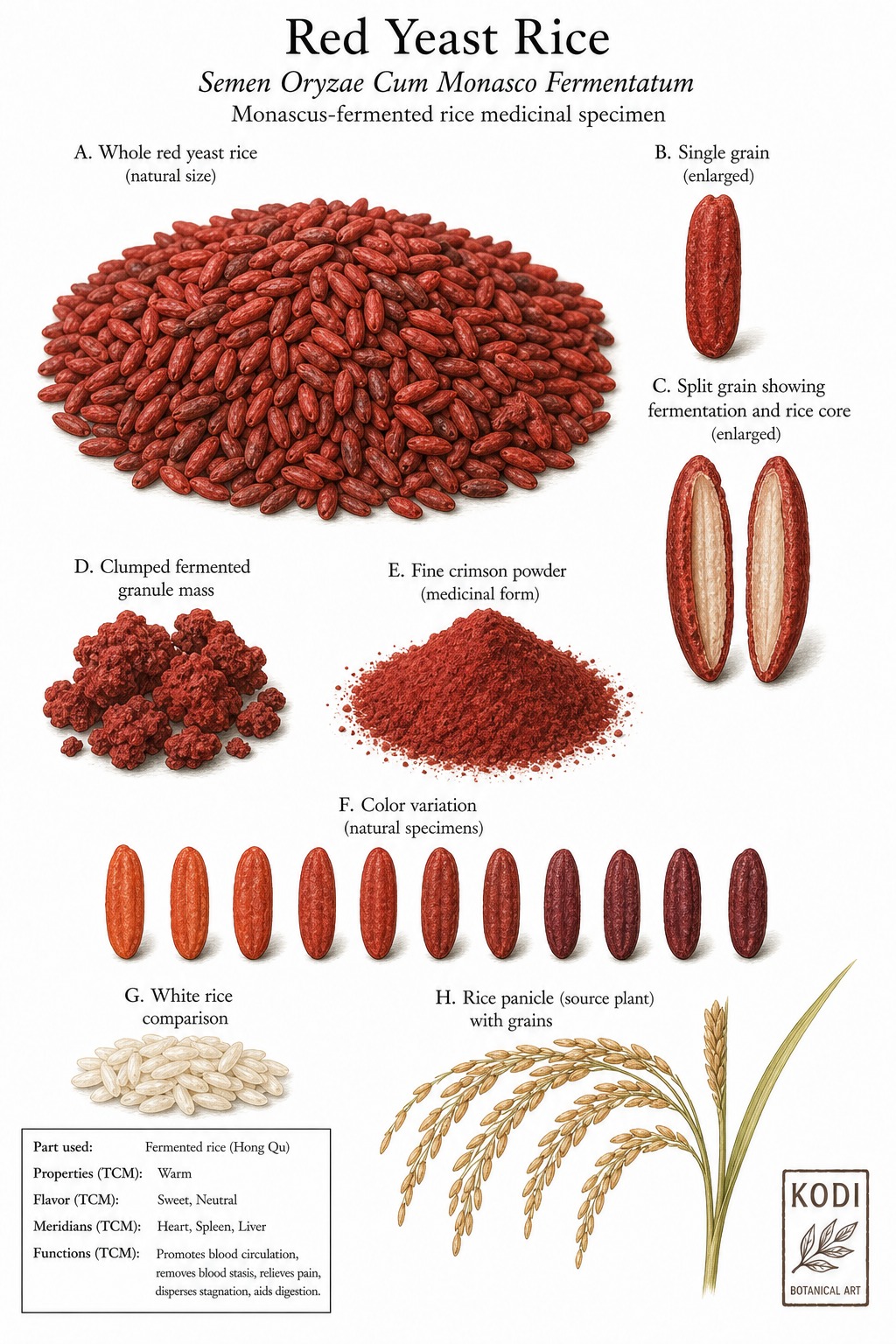
Known in TCM as Hong Qu (红曲), this sweet, warm herb enters the Liver, Spleen, and Large Intestine. Traditionally, it invigorates blood and dispels stasis ... Hong Qu is used for postpartum retention, traumatic bruising, and fixed pain when food medicine and blood movement overlap, most often applied for indigestion, abdominal distension, and blood stasis. Modern research has identified Monacolin among its active constituents.
Part used: Seed
Also Known As
Latin: Semen Oryzae Cum Monasco Fermentatum | Pinyin: Hong Qu | Chinese: 红曲
TCM Properties
- Taste
- sweet
- Temperature
- warm
- Channels
- Liver, Spleen, Large Intestine
Traditional Use
Primary Actions
- Invigorates blood and dispels stasis ... Hong Qu is used for postpartum retention, traumatic bruising, and fixed pain when food medicine and blood movement overlap.
- Reduces food stagnation and improves digestion ... it is especially associated with overeating greasy or heavy foods, abdominal fullness, and poor appetite.
- Harmonizes the middle burner without harsh purgation ... the fermented rice is gentler than strong downward-draining digestants and often sits near the food-medicine boundary.
Secondary Actions
- Traditional Hong Qu is a fermented medicinal rice, not just a colorant or supplement capsule ... source organism, fermentation quality, and monacolin content can vary enormously in modern commerce.
- This page should stay separate from `charred-malt` and other digestant grains ... Hong Qu combines food-reduction with a clearer blood-stasis lane.
Classic Formulas
- Digestive and meat-retention combinations with Shan Zha and Mai Ya ... classic pairing style when greasy food accumulation and fullness dominate.
- Postpartum or lochia-resolving combinations with Dang Gui and Tao Ren ... traditional use when stasis and food weakness coexist after childbirth.
- Hong Qu wine or powder traditions ... older single-herb preparations used for mild food stagnation or blood stasis rather than as a general tonic.
Classical References
- Traditional materia medica describes Hong Qu as sweet and warm, entering the Liver, Spleen, and Large Intestine to invigorate blood and reduce food stagnation.
- Its identity depends on Monascus fermentation of rice, which explains why it is discussed both as a medicinal and as a food-derived fermented material.
Modern Research
Active Compounds
- Monacolin K and related monacolins ... the best-known lipid-related fermentation metabolites
- Monascus pigments such as monascin and ankaflavin ... characteristic red-fermentation compounds
- Unsaturated fatty acids and fermentation-derived sterols ... supportive metabolic research constituents
Studied Effects
- A 2023 narrative review concluded that red yeast rice can improve lipid profiles in mild-to-moderate hypercholesterolemia, explaining why Hong Qu has become a major modern cardiometabolic supplement topic (PMID 37242171).
- A 2019 safety mini-review emphasized that red yeast rice products can act like low-dose statin exposure, with corresponding concerns around myopathy, liver effects, and product standardization (PMID 31118742).
- Testing of retail products found striking variability in monacolin strength among red yeast rice supplements, showing why contemporary commercial products cannot be assumed equivalent or predictable (PMID 28641460).
PubMed References
Safety & Interactions
Contraindications
- Pregnancy or breastfeeding
- Active liver disease, prior statin intolerance, or unexplained muscle symptoms
- Concurrent prescription statin use without professional supervision
Cautions
- Modern red yeast rice products can behave like low-dose statin exposure, and potency varies widely across brands and batches.
- Some commercial preparations may also contain citrinin or other fermentation byproducts, so supplement quality matters more here than with ordinary culinary red rice.
- Traditional Hong Qu as a medicinal fermented grain should not be assumed equivalent to standardized or non-standardized capsule products.
Drug Interactions
Red yeast rice products with monacolin K can behave like lovastatin. Combining them with a prescription statin can increase muscle, kidney, and liver risk, and products may also interact with medicines handled by CYP3A4 or P-glycoprotein.
- Prescription statins … Monacolin K is chemically identical to lovastatin, so combined exposure can increase muscle, kidney, and liver adverse effects. (Major) Source: NCCIH Red Yeast Rice
- CYP3A4 and P-glycoprotein substrate medicines … Preclinical studies show red yeast rice extracts can inhibit CYP3A4 and P-glycoprotein and may alter drug exposure. Clinical relevance is not known. (Uncertain) Source: Memorial Sloan Kettering About Herbs
- Other medicines with statin-like muscle or liver toxicity … NCCIH notes that red yeast rice can share the same interaction types as statin drugs, which may increase adverse-effect risk. (Major) Source: NCCIH Red Yeast Rice
Conditions
- Indigestion Traditional ★★★★☆ JSON
- Abdominal Distension Traditional ★★★☆☆ JSON
- Blood Stasis Traditional ★★☆☆☆ JSON
- Cardiovascular Disease Research ★★☆☆☆ JSON
Frequently Asked Questions
What is Red Yeast Rice used for?
Red Yeast Rice is traditionally used to Invigorates blood and dispels stasis ... Hong Qu is used for postpartum retention, traumatic bruising, and fixed pain when food medicine and blood movement overlap., Reduces food stagnation and improves digestion ... it is especially associated with overeating greasy or heavy foods, abdominal fullness, and poor appetite., Harmonizes the middle burner without harsh purgation ... the fermented rice is gentler than strong downward-draining digestants and often sits near the food-medicine boundary.. Research has investigated its effects on: A 2023 narrative review concluded that red yeast rice can improve lipid profiles in mild-to-moderate hypercholesterolemia, explaining why Hong Qu has become a major modern cardiometabolic supplement topic (PMID 37242171).; A 2019 safety mini-review emphasized that red yeast rice products can act like low-dose statin exposure, with corresponding concerns around myopathy, liver effects, and product standardization (PMID 31118742)..
What are other names for Red Yeast Rice?
Red Yeast Rice is also known as Monascus-Fermented Rice, Red Fermented Rice, Angkak. In TCM: 红曲 (Hong Qu); Semen Oryzae Cum Monasco Fermentatum.
Is Red Yeast Rice safe during pregnancy?
Red Yeast Rice is not recommended during pregnancy.
What are the contraindications for Red Yeast Rice?
Red Yeast Rice should not be used in: Pregnancy or breastfeeding; Active liver disease, prior statin intolerance, or unexplained muscle symptoms; Concurrent prescription statin use without professional supervision. Consult a qualified healthcare provider before use.
Does Red Yeast Rice interact with any medications?
Red Yeast Rice may interact with: Prescription statins - Monacolin K is chemically identical to lovastatin, so combined exposure can increase muscle, kidney, and liver adverse effects. - (Major severity); CYP3A4 and P-glycoprotein substrate medicines - Preclinical studies show red yeast rice extracts can inhibit CYP3A4 and P-glycoprotein and may alter drug exposure. Clinical relevance is not known. - (Uncertain severity); Other medicines with statin-like muscle or liver toxicity - NCCIH notes that red yeast rice can share the same interaction types as statin drugs, which may increase adverse-effect risk. - (Major severity). Always inform your healthcare provider of any herbal supplements you are taking.