Red Tangerine Peel
- Chinese
- 橘红
- Pinyin
- Ju Hong Pi
- Latin
- Exocarpium Citri Rubrum
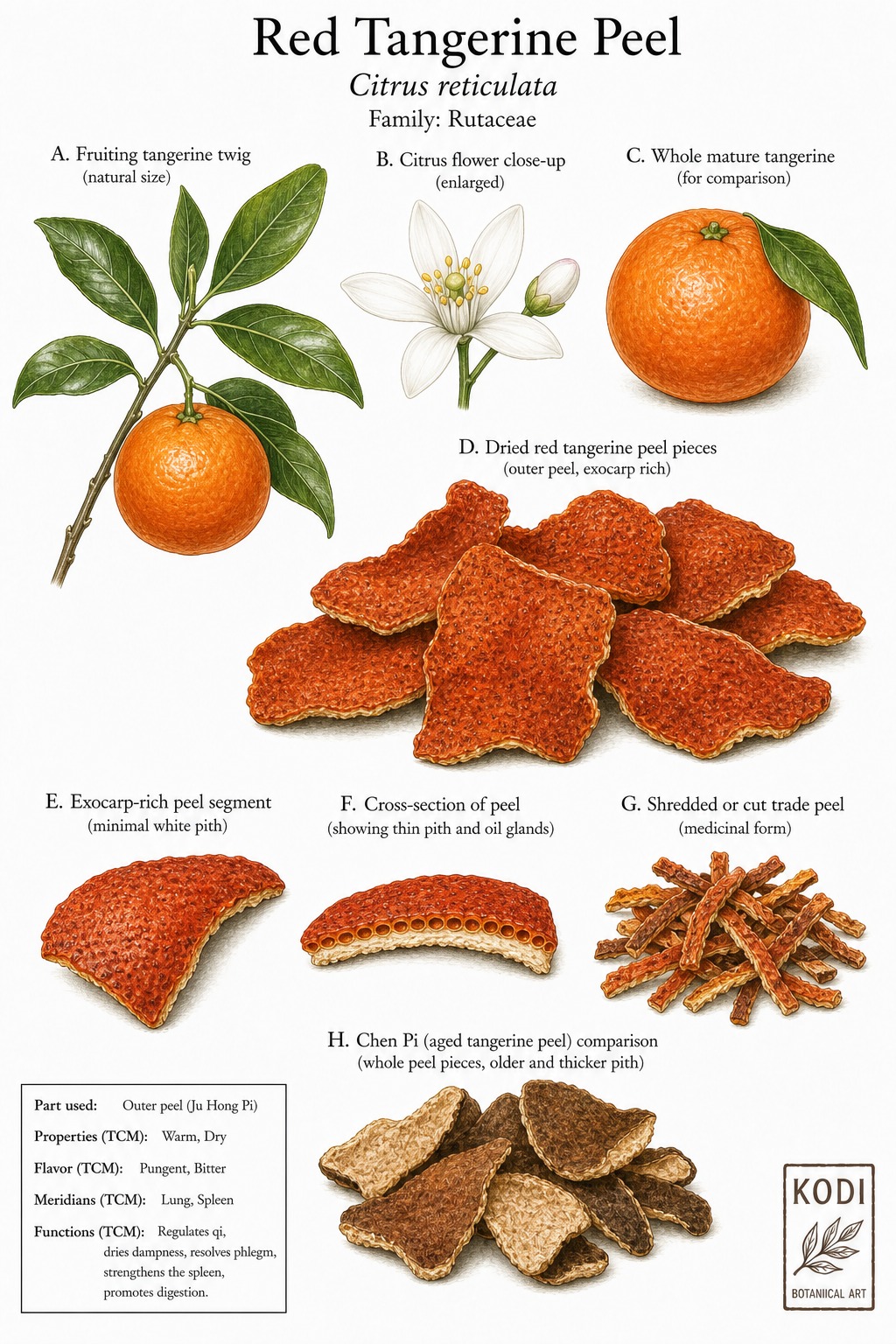
Known in TCM as Ju Hong Pi (橘红), this acrid and bitter, warm herb enters the Lung and Spleen. Traditionally, it transforms phlegm and dries dampness ... Ju Hong Pi is the red outer tangerine peel lane used for cough, chest congestion, sticky sputum, and damp-phlegm obstruction, most often applied for productive cough, wheezing, and nausea. Modern research has identified Nobiletin among its active constituents.
Part used: Outer peel
Also Known As
Latin: Exocarpium Citri Rubrum | Pinyin: Ju Hong Pi | Chinese: 橘红
TCM Properties
- Taste
- acrid, bitter
- Temperature
- warm
- Channels
- Lung, Spleen
Traditional Use
Primary Actions
- Transforms phlegm and dries dampness ... Ju Hong Pi is the red outer tangerine peel lane used for cough, chest congestion, sticky sputum, and damp-phlegm obstruction.
- Regulates qi and relieves fullness ... like Chen Pi it opens the middle burner, reduces distension, and improves appetite when phlegm and food stagnation travel together.
- Relieves cough and wheezing ... classical use favors it when phlegm blocks the Lung and the cough is heavy, productive, or hard to clear.
Secondary Actions
- This page should stay distinct from full-thickness Chen Pi and from the already-live pummelo `Hua Ju Hong` page ... the focus here is the thinner red tangerine exocarp with minimal white pith.
- Compared with Chen Pi, Ju Hong Pi is usually framed as more Lung-phlegm forward and a little less broad as a middle-burner harmonizer.
Classic Formulas
- Ju Hong Wan ... straightforward formula family centered on red tangerine peel for phlegm cough.
- Er Chen Tang modifications ... Ju Hong Pi deepens the phlegm-transforming citrus direction when sputum is thicker and the chest feels obstructed.
- Cough and damp-phlegm combinations with Ban Xia and Fu Ling ... classical pairing style when phlegm and digestive dampness coexist.
Classical References
- Traditional herb texts describe Ju Hong as acrid, bitter, and warm, entering the Lung and Spleen to dry dampness, transform phlegm, and regulate qi.
- Its identification depends on emphasizing the red exocarp rather than a thick pith-rich peel, which is why it is kept separate from Chen Pi and Hua Ju Hong.
Modern Research
Active Compounds
- Nobiletin and tangeretin ... polymethoxyflavones prominent in citrus-peel quality work
- Hesperidin and related flavonoids ... important citrus antioxidant markers
- Volatile oils from the aromatic rind ... contributors to digestive and respiratory interest
Studied Effects
- A 2017 study characterized chemical composition, chromatographic fingerprints, and antioxidant activity of Citri Exocarpium Rubrum, giving a direct modern quality-control and phytochemistry anchor for Ju Hong Pi (PMID 28138336).
- A 2022 comparative analysis distinguished Citri Exocarpium Rubrum from related citrus medicinals such as Citri Reticulatae Endocarpium Alba and Citri Fructus Retinervus, supporting why separate monograph lanes matter (PMID 36171768).
- A 2020 rapid identification study showed how fingerprinting and UHPLC-Q-TOF MS can distinguish Citri Exocarpium Rubrum from Chen Pi, reinforcing the monograph's taxonomy split (PMID 32307475).
PubMed References
- Chemical compositions, chromatographic fingerprints and antioxidant activities of Citri Exocarpium Rubrum (Juhong). (2017)
- Comparative analysis of chemical constituents in Citri Exocarpium Rubrum, Citri Reticulatae Endocarpium Alba, and Citri Fructus Retinervus. (2022)
- A rapid protocol to distinguish between Citri Exocarpium Rubrum and Citri Reticulatae Pericarpium based on the characteristic fingerprint and UHPLC-Q-TOF MS methods. (2020)
Safety & Interactions
Contraindications
- Dry cough from Yin deficiency without damp-phlegm
- Marked fluid depletion or dryness aggravated by aromatic warming peels
Cautions
- Ju Hong Pi is more drying and more specifically phlegm-facing than ordinary culinary citrus zest.
- Because commerce can blur Ju Hong, Chen Pi, and Hua Ju Hong, identity matters if the traditional distinction is clinically important.
Conditions
- Productive Cough Traditional ★★★★☆ JSON
- Wheezing Traditional ★★★☆☆ JSON
- Nausea Traditional ★★☆☆☆ JSON
- Poor Appetite Traditional ★★☆☆☆ JSON
Frequently Asked Questions
What is Red Tangerine Peel used for?
Red Tangerine Peel is traditionally used to Transforms phlegm and dries dampness ... Ju Hong Pi is the red outer tangerine peel lane used for cough, chest congestion, sticky sputum, and damp-phlegm obstruction., Regulates qi and relieves fullness ... like Chen Pi it opens the middle burner, reduces distension, and improves appetite when phlegm and food stagnation travel together., Relieves cough and wheezing ... classical use favors it when phlegm blocks the Lung and the cough is heavy, productive, or hard to clear.. Research has investigated its effects on: A 2017 study characterized chemical composition, chromatographic fingerprints, and antioxidant activity of Citri Exocarpium Rubrum, giving a direct modern quality-control and phytochemistry anchor for Ju Hong Pi (PMID 28138336).; A 2022 comparative analysis distinguished Citri Exocarpium Rubrum from related citrus medicinals such as Citri Reticulatae Endocarpium Alba and Citri Fructus Retinervus, supporting why separate monograph lanes matter (PMID 36171768)..
What are other names for Red Tangerine Peel?
Red Tangerine Peel is also known as Ju Hong, Red Citrus Exocarp, Citri Exocarpium Rubrum. In TCM: 橘红 (Ju Hong Pi); Exocarpium Citri Rubrum.
Is Red Tangerine Peel safe during pregnancy?
The safety of Red Tangerine Peel during pregnancy has not been established. Consult a qualified healthcare provider before use.
What are the contraindications for Red Tangerine Peel?
Red Tangerine Peel should not be used in: Dry cough from Yin deficiency without damp-phlegm; Marked fluid depletion or dryness aggravated by aromatic warming peels. Consult a qualified healthcare provider before use.