Red Lead
- Chinese
- 铅丹
- Pinyin
- Qian Dan
- Latin
- Minium
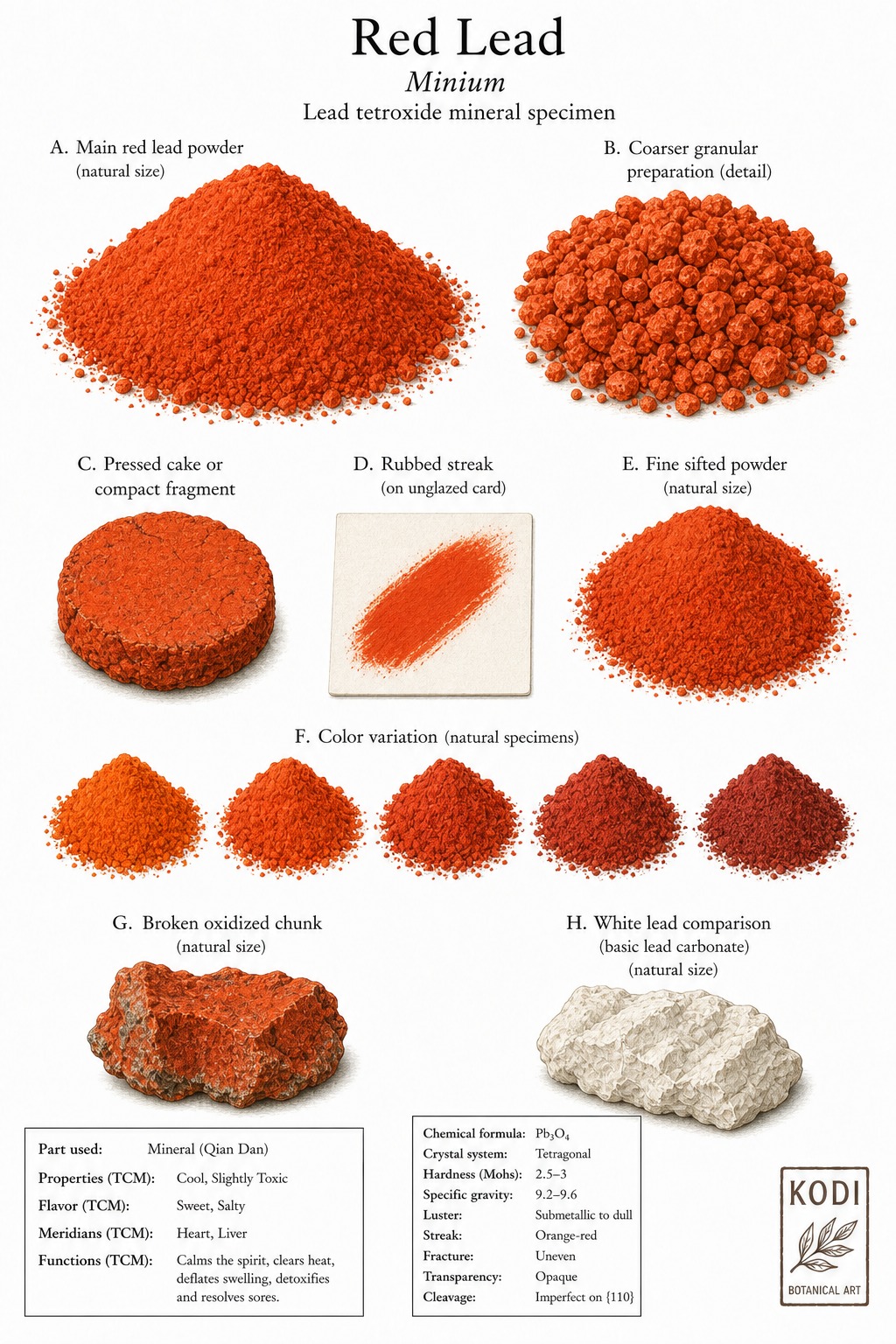
Known in TCM as Qian Dan (铅丹), this acrid, slightly cold herb enters the Heart and Liver. Traditionally, it draws out toxin and dries damp lesions ... historical Qian Dan use centered on external sores, eczema, scabies, and chronic wet lesions that needed a harsh drying mineral, most often applied for scabies, eczema, and burns. Modern research has identified Lead among its active constituents.
Part used: Minium
Also Known As
Latin: Minium | Pinyin: Qian Dan | Chinese: 铅丹
TCM Properties
- Taste
- acrid
- Temperature
- slightly cold
- Channels
- Heart, Liver
Traditional Use
Primary Actions
- Draws out toxin and dries damp lesions ... historical Qian Dan use centered on external sores, eczema, scabies, and chronic wet lesions that needed a harsh drying mineral.
- Promotes tissue closure in ulcerated or slow-healing skin conditions ... older topical practice used the powder in plasters and ointments for abscesses, burns, and damaged tissue.
- Historically reduced phlegm and settled fright in minute internal use ... this indication is preserved as a historical note only, not as a modern therapeutic endorsement.
Secondary Actions
- Qian Dan belongs to the same toxic lead-mineral cluster as Qian Fen, but it is the oxidized red form and is framed primarily as an external historical medicament.
- This page should stay distinct from `lead-powder` and `red-mercuric-oxide` ... similar color and old surgical use do not make them interchangeable or equally toxic.
Classic Formulas
- External ulcer and parasite powders ... classical use paired Qian Dan with borneol, alum, or other drying minerals for sores, scabies, and damp-toxic lesions.
- Historical plasters for burns or non-healing wounds ... Qian Dan appears in older tissue-closing preparations now viewed through a strict toxicology lens.
- Rare internal pill traditions for phlegm or fright are recorded in older literature but are not carried forward here as practical modern recommendations.
Classical References
- Traditional materia medica describe Qian Dan as an acrid toxic mineral that removes toxin, dries dampness, kills parasites, and promotes flesh growth.
- The same historical sources that preserve these actions also make modern reinterpretation necessary, because lead toxicology now outweighs any casual expansion of use.
Modern Research
Active Compounds
- Lead tetroxide ... the defining lead oxide in red lead preparations
- Bioavailable lead ion burden ... the clinically relevant exposure pathway behind neurologic, renal, hematologic, and reproductive toxicity
Studied Effects
- Modern literature treats lead exposure as harmful rather than therapeutic, with multisystem toxicity dominating the evidence base and providing no support for casual medicinal ingestion of red lead (PMID 27486361).
- A case report and literature review documented lead poisoning from traditional Chinese medicine, reinforcing how historical mineral medicines can still produce serious toxic exposure when identity and dosing are poorly controlled (PMID 29081456).
- A broader review of heavy-metal toxicity from traditional medicines described lead-associated encephalopathy, underscoring why Qian Dan must be framed primarily as a toxicology record (PMID 18690981).
PubMed References
Safety & Interactions
Contraindications
- Any internal self-use
- Pregnancy, breastfeeding, or pediatric exposure
- Large-area, broken-skin, or prolonged external use
Cautions
- Lead is a cumulative toxic heavy metal, and this record should never be read as support for ingesting lead-containing remedies, pigments, cosmetics, or folk preparations.
- Historical topical use still carries absorption risk, especially on damaged skin or with repeated exposure.
- Industrial red lead, antique paint pigments, and decorative mineral powders are not medicinally prepared Qian Dan.
Conditions
Frequently Asked Questions
What is Red Lead used for?
Red Lead is traditionally used to Draws out toxin and dries damp lesions ... historical Qian Dan use centered on external sores, eczema, scabies, and chronic wet lesions that needed a harsh drying mineral., Promotes tissue closure in ulcerated or slow-healing skin conditions ... older topical practice used the powder in plasters and ointments for abscesses, burns, and damaged tissue., Historically reduced phlegm and settled fright in minute internal use ... this indication is preserved as a historical note only, not as a modern therapeutic endorsement.. Research has investigated its effects on: Modern literature treats lead exposure as harmful rather than therapeutic, with multisystem toxicity dominating the evidence base and providing no support for casual medicinal ingestion of red lead (PMID 27486361).; A case report and literature review documented lead poisoning from traditional Chinese medicine, reinforcing how historical mineral medicines can still produce serious toxic exposure when identity and dosing are poorly controlled (PMID 29081456)..
What are other names for Red Lead?
Red Lead is also known as Minium, Lead Tetroxide, Red Lead Oxide. In TCM: 铅丹 (Qian Dan); Minium.
Is Red Lead safe during pregnancy?
Red Lead is not recommended during pregnancy.
What are the contraindications for Red Lead?
Red Lead should not be used in: Any internal self-use; Pregnancy, breastfeeding, or pediatric exposure; Large-area, broken-skin, or prolonged external use. Consult a qualified healthcare provider before use.