Red Ginseng
- Chinese
- 红参
- Pinyin
- Hong Shen
- Latin
- Radix Ginseng Rubra
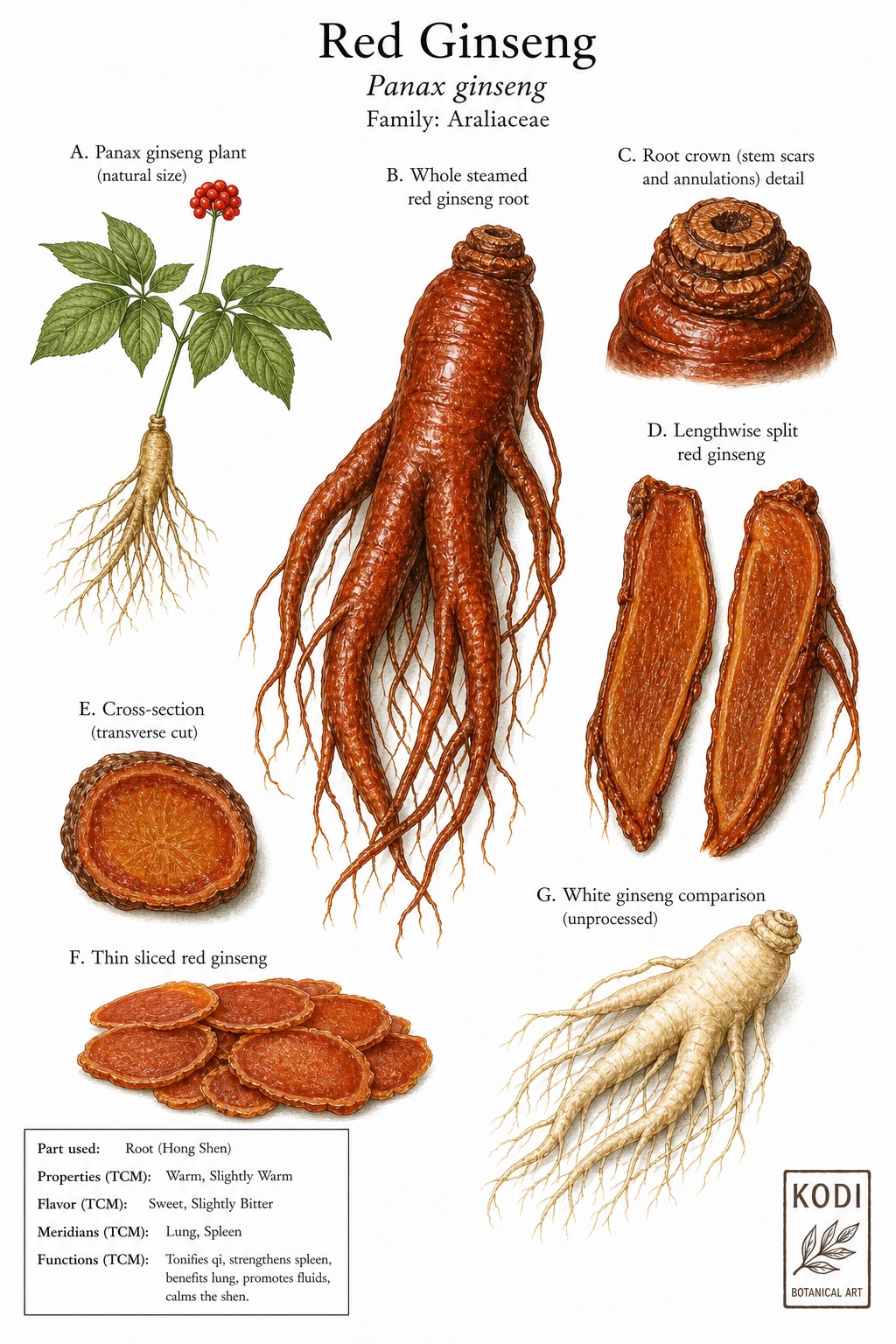
Known in TCM as Hong Shen (红参), this sweet and slightly bitter, warm herb enters the Heart, Lung, and Spleen. Traditionally, it strongly tonifies source qi and rescues collapse ... Hong Shen is chosen when profound exhaustion, weak pulse, cold limbs, or major post-illness depletion calls for a more restoring form of ginseng, most often applied for fatigue, digestive weakness, and cough. Modern research has identified Major among its active constituents.
Part used: Root
Also Known As
Latin: Radix Ginseng Rubra | Pinyin: Hong Shen | Chinese: 红参
TCM Properties
- Taste
- sweet, slightly bitter
- Temperature
- warm
- Channels
- Heart, Lung, Spleen
Traditional Use
Primary Actions
- Strongly tonifies source qi and rescues collapse ... Hong Shen is chosen when profound exhaustion, weak pulse, cold limbs, or major post-illness depletion calls for a more restoring form of ginseng.
- Tonifies the Spleen and Lung and supports fluid generation ... it is used for poor appetite, shortness of breath, chronic cough from deficiency, and thirst after serious qi-fluid loss.
- Benefits the Heart and stabilizes the spirit ... later use includes palpitations, insomnia from depletion, and recovery states where qi and fluids no longer anchor the Heart well.
Secondary Actions
- Red ginseng is Panax ginseng that has been steamed and dried, which makes it denser, more warming, and more restoring than the generic fresh or white-ginseng lanes.
- This Hong Shen page should stay distinct from both the generic Ren Shen record and the origin-centered Gao Li Shen page ... here the key variable is processing, not merely provenance.
Classic Formulas
- Shen Fu Tang ... collapse-rescue pattern where strongly restoring ginseng combines with warming yang support.
- Sheng Mai San ... classic use when qi and fluids are both depleted and the pulse needs protection.
- Bu Zhong Yi Qi Tang or related tonifying formulas ... later adaptation when severe qi deficiency also shows sinking, fatigue, and poor appetite.
Classical References
- Traditional processing lore regards Hong Shen as a stronger restoring form of Ren Shen, especially when collapse, cold depletion, or deep qi-fluid loss is central.
- The steaming step is not cosmetic ... it changes handling, appearance, and chemical profile enough that Hong Shen earns its own monograph logic.
Modern Research
Active Compounds
- Major ginsenosides such as Rg1, Rb1, Rc, Rd, and Re ... core Panax constituents retained from the source root
- Minor processed ginsenosides such as Rg3, Rk1, and Rg5 ... enriched or generated by steaming
- Ginseng polysaccharides ... important immune and metabolic research fractions
Studied Effects
- A detailed 2015 review described the history, preparation method, and chemical composition of Korean red ginseng, clarifying why steaming creates a distinct medicinal profile (PMID 26869832).
- A 2022 systematic review and meta-analysis found that Panax ginseng products improved several glucose, lipid, and blood-pressure measures in pooled analyses, supporting ongoing cardiometabolic interest in red-ginseng preparations as well (PMID 35509826).
- A randomized phase III trial in colorectal-cancer patients receiving chemotherapy found Korean red ginseng clinically relevant enough to test for fatigue support, illustrating the processed product's modern human-trial footprint even when results remain context dependent (PMID 32172198).
PubMed References
- Characterization of Korean Red Ginseng (Panax ginseng Meyer): History, preparation method, and chemical composition. (2015)
- Effects of Panax ginseng on hyperglycemia, hypertension, and hyperlipidemia: A systematic review and meta-analysis. (2022)
- Korean red ginseng for cancer-related fatigue in colorectal cancer patients with chemotherapy: A randomised phase III trial. (2020)
Safety & Interactions
Contraindications
- Acute excess heat or agitation without deficiency
- Concurrent warfarin therapy without close monitoring
- Marked stimulant-type insomnia, palpitations, or uncontrolled hypertension with clear excess signs
Cautions
- Red ginseng is not interchangeable with fresh ginseng, white ginseng, or origin-only ginseng grades because steaming changes both clinical feel and ginsenoside profile.
- High-dose use may cause insomnia, palpitations, headache, blood-pressure fluctuation, or gastrointestinal upset in sensitive patients.
Drug Interactions
- Warfarin ... possible change in anticoagulant effect
- Insulin or hypoglycemic drugs ... possible additive glucose-lowering effect
- MAOIs or stimulant-like drugs ... possible overstimulation, headache, or insomnia
Conditions
- Fatigue Traditional ★★★★☆ JSON
- Digestive Weakness Traditional ★★★☆☆ JSON
- Cough Traditional ★★☆☆☆ JSON
- Palpitations Traditional ★★☆☆☆ JSON
- Type 2 Diabetes Research ★★☆☆☆ JSON
Frequently Asked Questions
What is Red Ginseng used for?
Red Ginseng is traditionally used to Strongly tonifies source qi and rescues collapse ... Hong Shen is chosen when profound exhaustion, weak pulse, cold limbs, or major post-illness depletion calls for a more restoring form of ginseng., Tonifies the Spleen and Lung and supports fluid generation ... it is used for poor appetite, shortness of breath, chronic cough from deficiency, and thirst after serious qi-fluid loss., Benefits the Heart and stabilizes the spirit ... later use includes palpitations, insomnia from depletion, and recovery states where qi and fluids no longer anchor the Heart well.. Research has investigated its effects on: A detailed 2015 review described the history, preparation method, and chemical composition of Korean red ginseng, clarifying why steaming creates a distinct medicinal profile (PMID 26869832).; A 2022 systematic review and meta-analysis found that Panax ginseng products improved several glucose, lipid, and blood-pressure measures in pooled analyses, supporting ongoing cardiometabolic interest in red-ginseng preparations as well (PMID 35509826)..
What are other names for Red Ginseng?
Red Ginseng is also known as Steamed Ginseng, Red Panax Ginseng, Ginseng. In TCM: 红参 (Hong Shen); Radix Ginseng Rubra.
Is Red Ginseng safe during pregnancy?
The safety of Red Ginseng during pregnancy has not been established. Consult a qualified healthcare provider before use.
What are the contraindications for Red Ginseng?
Red Ginseng should not be used in: Acute excess heat or agitation without deficiency; Concurrent warfarin therapy without close monitoring; Marked stimulant-type insomnia, palpitations, or uncontrolled hypertension with clear excess signs. Consult a qualified healthcare provider before use.
Does Red Ginseng interact with any medications?
Red Ginseng may interact with: Warfarin ... possible change in anticoagulant effect; Insulin or hypoglycemic drugs ... possible additive glucose-lowering effect; MAOIs or stimulant-like drugs ... possible overstimulation, headache, or insomnia. Always inform your healthcare provider of any herbal supplements you are taking.